

Key takeaways
- A pint of 5% lager is up to 222 kcal and a 175 ml glass of 12% wine up to 158 kcal — before anything you eat alongside them.
- Alcohol also increases how much food you eat. A meta-analysis found people ate around 82 kcal more food when drinking, on top of the alcohol itself.
- Your body deals with alcohol first, which pushes fat burning to the back of the queue while it does so.
- UK guidance is no more than 14 units a week for both men and women, spread over three or more days with drink-free days.
Most people who are careful about food are not careful about drink. The food diary gets filled in, the four pints on Friday don’t. And unlike most things you consume, alcohol doesn’t announce itself — there’s no label on a pint glass telling you what’s in it, because in the UK there doesn’t have to be.
Here’s the arithmetic, and the part of it that isn’t arithmetic at all.
What’s actually in a drink
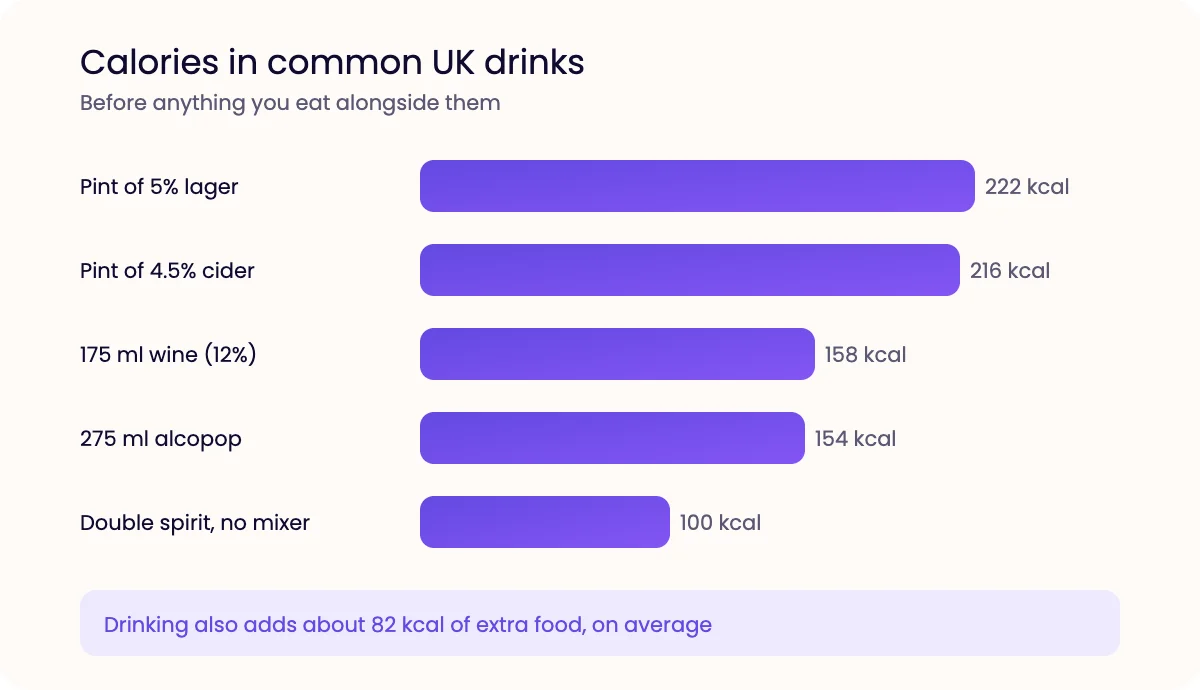
Alcohol provides 7 kcal per gram, which puts it closer to fat (9) than to carbohydrate or protein (4 each). NHS figures for common drinks [2]:
| Drink | Calories |
|---|---|
| Pint of 5% beer or lager | up to 222 kcal |
| 175 ml glass of 12% wine | up to 158 kcal |
| Double (50 ml) 40% spirit, no mixer | 100 kcal |
| 275 ml bottle of 4.5% alcopop | 154 kcal |
| 75 ml fortified wine (17.5%) | 102 kcal |
| Pint of 4.5% cider | around 216 kcal [3] |
Put that into a normal week rather than a single drink:
- Four pints on a Friday: about 890 kcal
- A bottle of wine split across the weekend: about 600 kcal
- Two gin and tonics on a Wednesday: about 250 kcal with regular tonic
That’s roughly 1,700 kcal a week, or the equivalent of a whole extra day’s eating, from drinks that felt unremarkable.
The bigger problem: what you eat around it
The calories in the glass are the part people can at least estimate. The part almost nobody accounts for is that drinking makes you eat more.
A systematic review and meta-analysis of twelve studies found that when people drank alcohol they ate, on average, around 82 kcal more food than when they didn’t — and once the alcohol itself was added, total energy intake rose by roughly 256 kcal [4]. The authors’ conclusion was blunt: adults do not compensate for alcohol’s calories by eating less, and even a modest amount of alcohol can increase food consumption.
And that’s in a laboratory, with controlled portions. In real life the extra food is a kebab at midnight and a fry-up the next morning, which is a rather different number.
What your body does with alcohol
Alcohol can’t be stored, and it’s mildly toxic, so your body prioritises clearing it. Everything else waits — including burning fat. Experimental work using indirect calorimetry showed that alcohol suppresses fat oxidation while it’s being metabolised [5].
The practical implication isn’t that alcohol converts directly to belly fat. It’s that the chips you eat alongside it arrive while your fat-burning is paused, which makes them more likely to be stored.
How much is too much
UK Chief Medical Officers advise no more than 14 units a week for both men and women, spread over three or more days, with several drink-free days and no bingeing [1]. Fourteen units is about six pints of average-strength beer or six medium glasses of wine.
That guideline exists for health reasons — liver disease, several cancers, blood pressure, mental health — rather than weight. But the two overlap neatly, because for most people drinking within 14 units also keeps alcohol from quietly eating their calorie deficit.
Useful to know: a standard 175 ml glass of 13% wine is about 2.3 units, so a “couple of glasses” most evenings can pass 14 units without ever feeling like heavy drinking [6].
If you don’t want to stop drinking
Most people don’t, and an article that only says “drink less” isn’t much use. Things that genuinely reduce the damage:
- Decide before you go out. The number you choose at 6pm is nearly always lower than the number you’d choose at 10pm.
- Alternate with water. It slows the pace and reduces the total without any announcement to anyone.
- Pick the cheaper drinks, calorically. A single spirit with slimline tonic is 60–70 kcal against 222 for a pint. Over an evening, that’s a meal’s difference.
- Eat properly beforehand. A protein-containing meal before drinking makes the late-night food decision much less compelling.
- Watch the sizes. A large glass of wine is a third of a bottle. Two of them is most of it.
- Keep drink-free days. They do more for the weekly total than moderating every session.
The bit worth being honest about
If cutting down is harder than it sounds, that’s common and it’s not a character defect. Your GP can help, and Drinkaware and the NHS both have self-assessment tools. It’s also worth knowing that alcohol interacts with a number of medicines, so if you’re taking anything regularly, that’s a question for your pharmacist.
When to speak to a clinician
Speak to your GP if you regularly drink more than 14 units a week and find it difficult to cut down, if you drink to cope with stress or low mood, or if you have symptoms such as persistent upper abdominal pain, yellowing of the skin or eyes, or vomiting blood — the last of those needs urgent attention.
Frequently asked questions
How many calories are in a pint?
The NHS puts a pint of 5% beer or lager at up to 222 kcal. A 4% pint is nearer 180 kcal and a strong craft beer at 6-7% can exceed 250. A pint of 4.5% cider is around 216 kcal.
Does alcohol stop you burning fat?
While alcohol is in your system your body prioritises clearing it, because it cannot be stored. Fat oxidation is suppressed during that window. It is temporary rather than permanent damage, but it means the calories you eat alongside a drink are more likely to be stored.
What is the least fattening alcoholic drink?
A single spirit with a sugar-free mixer is usually lowest, at around 50-60 kcal for a 25 ml measure. A double is about 100 kcal before mixers. Dry wine and light beers sit in the middle; cocktails, sweet mixers, cider and cream liqueurs are highest.
Is there a thing as a beer belly?
Alcohol is associated with fat gain around the middle, though the mechanism is mostly the extra calories rather than beer specifically. The pattern matters because abdominal fat carries more metabolic risk than fat elsewhere.
Do alcoholic drinks have to show calories in the UK?
No. Drinks above 1.2% ABV are not required to display calorie information on the label, which is why most people have no idea what they are drinking. Larger out-of-home food businesses do have to show calories on menus, including for alcoholic drinks.
References
- Department of Health. UK Chief Medical Officers' low risk drinking guidelines. 2016. www.gov.uk/government/publications/alcohol-consumption-advice-on-low-r
- NHS. Calories in alcohol. www.nhs.uk/live-well/alcohol-advice/calories-in-alcohol/
- Drinkaware. Units and calories in cider. www.drinkaware.co.uk/facts/information-about-alcohol/alcoholic-drinks-
- Kwok A, Dordevic AL, Paton G, Page MJ, Truby H. Effect of alcohol consumption on food energy intake: a systematic review and meta-analysis. British Journal of Nutrition. 2019;121(5):481-495. doi.org/10.1017/S0007114518003677
- Suter PM, Schutz Y, Jequier E. The effect of ethanol on fat storage in healthy subjects. New England Journal of Medicine. 1992;326(15):983-987. doi.org/10.1056/NEJM199204093261503
- NHS. Alcohol units. www.nhs.uk/live-well/alcohol-advice/calculating-alcohol-units/
- NHS. Risks of drinking too much alcohol. www.nhs.uk/live-well/alcohol-advice/the-risks-of-drinking-too-much/
Medical reviewer
Naeem Teni
Clinical Lead at Manova. Registered pharmacist and independent prescriber, GPhC 2215591. Reviews Manova’s clinical content for accuracy and safety.
Written by
Manova Editorial Team
Researched and written to our editorial policy, using NICE, NHS, MHRA and peer-reviewed sources.
This article is for general information and isn’t a substitute for advice from your own clinician. If you feel unwell, contact your GP or NHS 111. In an emergency, call 999.