
Key takeaways
- Shed hairs have a small pale bulb at one end and came from the follicle; broken hairs are snapped along the shaft with no bulb and of varying lengths.
- Breakage responds quickly to changing what you do to your hair, because it is a problem of the fibre rather than the follicle.
- Chemical relaxing combined with tension is the highest-risk combination for genuine follicular damage, and it is the one worth changing first.
- Washing frequency does not cause hair loss, though an inflamed or flaky scalp increases shedding and breakage and is worth treating on its own terms.
There is one distinction that makes this whole subject manageable, and most people have never had it explained to them.
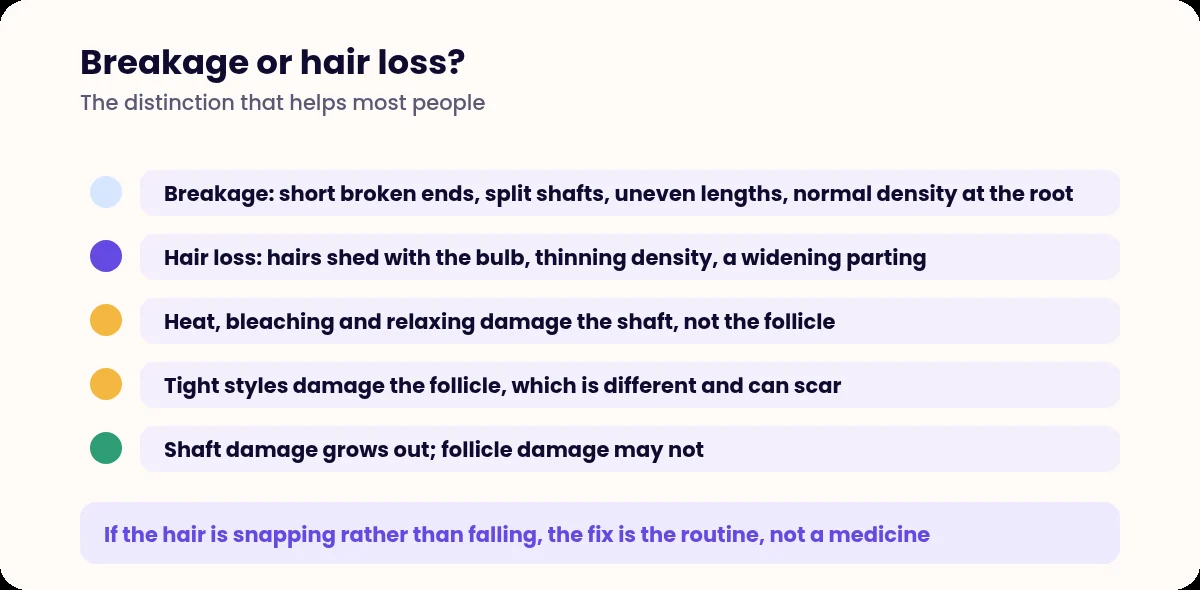
Hair loss happens at the follicle. The hair comes out from the root, and the reason lies in the skin — hormones, inflammation, a systemic trigger, tension.
Breakage happens along the shaft. The follicle is fine and still producing hair; the fibre it produces is snapping somewhere between the scalp and the end.
They look similar in the sink and they need completely different responses. Getting this wrong is why people spend a year on supplements for a problem caused by a straightener, and why others spend a year on bond-repair treatments for a problem that was never in the fibre.
Telling them apart
The most reliable check takes thirty seconds. Collect the hairs from your brush or the shower and look at the ends in good light.
Shed hairs have a small, pale, slightly bulbous swelling at one end — the root sheath. They tend to be close to your full hair length, because they grew to full length before being released.
Broken hairs have no bulb. They are snapped at both ends, and a handful will contain a wide range of lengths, from a few centimetres upwards.
Other pointers towards breakage rather than loss:
- short, wiry hairs standing up along the parting and crown — these are not new growth, they are the surviving stubs of broken hairs
- hair that looks thinner towards the ends while density at the scalp seems unchanged
- split ends, roughness and a dull, frayed appearance
- the problem concentrated where you apply heat or tension, rather than spread evenly or in a pattern
Pointers towards genuine loss: a visibly widening parting, a receding or thinning pattern with normal-looking hair elsewhere, more scalp visible in overhead light, or a diffuse increase in shedding that started a few months after an illness, a birth, a crash diet or a major stressor — the classic telogen effluvium picture.
You can have both at once, and plenty of people do.
Where the damage happens
Heat
Straighteners, curling tongs and hot brushes apply direct contact heat, and hairdryers apply it at a distance. Damage depends on temperature, contact time and how wet the hair is — water in the shaft turning to steam is what produces the sudden, audible damage from a straightener used on damp hair.
Practical adjustments that matter more than product choice: use the lowest temperature that does the job, dry hair fully before applying direct heat, keep the tool moving rather than clamped, and reduce the number of passes rather than the frequency of styling. A heat protectant helps and does not make high heat safe.
Bleaching and permanent colour
Bleaching opens the cuticle and removes pigment, and in doing so it permanently reduces the tensile strength of the fibre. The effect accumulates with each application, and repeated bleaching of the same length — as happens when roots are done but the lengths are pulled through — compounds it.
The practical implications: space out applications, keep bleach off previously bleached lengths where possible, and be realistic that heavily bleached hair will not tolerate the heat styling that virgin hair did.
Relaxers, and the combination that matters most
Chemical relaxers break and reform the bonds that give textured hair its curl pattern, and in the process reduce the tensile strength of the shaft [3].
On its own, that is a fibre problem. Combined with tension it becomes a follicle problem. Relaxing plus traction is the highest-risk combination in the literature on styling-related hair damage, and the prevention line from the review that established it is blunt: no braids or weaves on relaxed hair [3]. If you change one thing after reading this page, that is the one.
Tight styles and tension
Tension that pulls at the root damages the follicle rather than the fibre, which is why it belongs in a different category from everything else here. Early it is reversible; sustained over years it becomes permanent. The full picture is in traction alopecia, and the warning sign is simple: if a style hurts when it is fitted, it is too tight.
Mechanical handling
Undramatic and underrated. Brushing hair while wet, when it is at its most extensible and most fragile; using a fine brush through tangles rather than detangling from the ends upwards; tight elastics placed in the same spot daily; sleeping on cotton rather than a smoother surface; towel-drying by rubbing rather than blotting. None of these will make you bald. All of them contribute to a fibre that snaps more readily.
Washing: what it does and does not do
Washing frequency does not cause hair loss. The follicle is unaffected by shampoo, which sits on the scalp for a minute or two and is rinsed off.
The reason people believe otherwise is a counting artefact. Hairs that have shed stay caught in the surrounding hair until something dislodges them. Wash daily and you collect a day’s worth; wash weekly and you collect a week’s worth in one alarming handful. The total is the same.
What washing frequency can affect is the fibre. Frequent washing with a strongly detergent shampoo strips lipids from the shaft and can worsen dryness and breakage in hair types that are dry to begin with — and equally, washing too infrequently allows scalp inflammation and flaking to build, which increases shedding and scratching-related breakage. Our guide to dandruff and seborrhoeic dermatitis covers that side, and hair loss shampoos covers what the shelf actually contains.
What actually helps breakage
Hair is not living tissue. It cannot heal, and no product repairs it in the sense of restoring the original fibre. What products can do is improve how damaged hair behaves — reduce friction, smooth the cuticle, temporarily bridge weakened areas — which makes it less likely to snap from here on and makes it look considerably better. That is a legitimate benefit, and it is not the same as repair.
The interventions that reliably work:
- Cut off the damaged length. Unglamorous and the only permanent fix.
- Reduce the input — fewer heat passes, longer between chemical services, looser styles.
- Detangle from the ends upwards, on dry or conditioned hair rather than wet and bare.
- Condition the lengths consistently, and leave conditioner on long enough to do anything.
- Give it time. Hair grows at roughly a centimetre a month, so growing out damage is measured in seasons.
If the density at your scalp is genuinely reducing rather than the ends thinning out, none of the above is the answer and male pattern baldness or a diffuse shed is the more relevant read.
Frequently asked questions
How do I know if my hair is breaking or falling out?
Look at the ends of the hairs you are collecting. A hair that has shed from the follicle has a small pale bulb at one end and is usually close to your full hair length. A broken hair has no bulb, is snapped at both ends, and the collection will be a mixture of lengths. Breakage also shows as short wiry hairs standing up along the parting and a fraying, thinning look towards the ends rather than at the root.
Does washing your hair every day cause hair loss?
No. Washing does not damage the follicle, and hairs that come out during washing were already shed and waiting to be dislodged — which is why people who wash less often see more hair at once and assume washing caused it. Frequent washing can strip lipids from the shaft and worsen dryness and breakage in some hair types, which is a fibre problem with a fibre solution.
Can heat damage be repaired?
Not in the sense of restoring the fibre. Hair is not living tissue and cannot heal, so damaged sections stay damaged until they are cut off. Conditioning products can improve how damaged hair behaves, feels and reflects light, which is genuinely worth doing, but the only permanent fix is growing it out and removing the damaged length.
Is it my shampoo?
Rarely the main cause. Shampoo is on the scalp for a minute or two and does not reach the follicle in any meaningful way. Harsh detergents can contribute to dryness and breakage in some hair types, and an unsuitable product can irritate a sensitive scalp, but a shampoo switch is not the answer to genuine thinning at the root.
References
- NHS. Hair loss. www.nhs.uk/conditions/hair-loss/
- DermNet. Hair shaft abnormalities. dermnetnz.org/topics/hair-shaft-abnormalities
- Billero V, Miteva M. Traction alopecia: the root of the problem. Clinical, Cosmetic and Investigational Dermatology, 2018. www.ncbi.nlm.nih.gov/pmc/articles/PMC5896623/
- DermNet. Telogen effluvium. dermnetnz.org/topics/telogen-effluvium
- British Association of Dermatologists. Patient information leaflets on hair care. www.skinhealthinfo.org.uk/
Medical reviewer
Naeem Teni
Clinical Lead at Manova. Registered pharmacist and independent prescriber, GPhC 2215591. Reviews Manova’s clinical content for accuracy and safety.
Written by
Manova Editorial Team
Researched and written to our editorial policy, using NICE, NHS, MHRA and peer-reviewed sources.
This article is for general information and isn’t a substitute for advice from your own clinician. If you feel unwell, contact your GP or NHS 111. In an emergency, call 999.