
Key takeaways
- Traction alopecia begins as non-scarring and reversible, but prolonged tension destroys the follicle and the loss becomes permanent — there is no agreed cut-off in months, so acting early matters more than counting weeks.
- The highest-risk combination is chemical relaxing plus traction; the prevention line from the literature is blunt — no braids or weaves on relaxed hair.
- The fringe sign, a band of fine short hairs surviving in front of the area of loss, points towards traction, but frontal fibrosing alopecia can mimic it, so it is not diagnostic on its own.
- Hair casts, yellowish-white cylinders sliding along the shafts, indicate that the traction is still ongoing rather than historical.
Traction alopecia is one of the few kinds of hair loss with a cause you can name, point at and remove. Sustained mechanical pull on the follicle — from a style, a fastening, a weight, or a covering — eventually makes the follicle give up.
That makes it unusually hopeful hair loss, and unusually frustrating, because the window in which removing the cause fixes the problem does not stay open indefinitely. Early traction alopecia is non-scarring and reversible. Longstanding traction alopecia is scarring and permanent. The literature is clear about both ends of that sentence and clear that there is no agreed cut-off in months between them, so anyone who tells you that you have six months to sort it out is inventing the number.
What tension does to a follicle
Under a biopsy early on, the changes are recoverable ones: trichomalacia — distorted, damaged hair shafts — and a shift of follicles out of the growing phase into catagen and telogen. Critically, the sebaceous glands are preserved at this stage [1].
Late disease looks entirely different. Terminal follicles and the sebaceous glands are both replaced by fibrous tracts [1]. There is nothing left to restart. This is the same endpoint as any other scarring alopecia, arrived at through mechanics rather than inflammation.
The styles and practices that carry risk
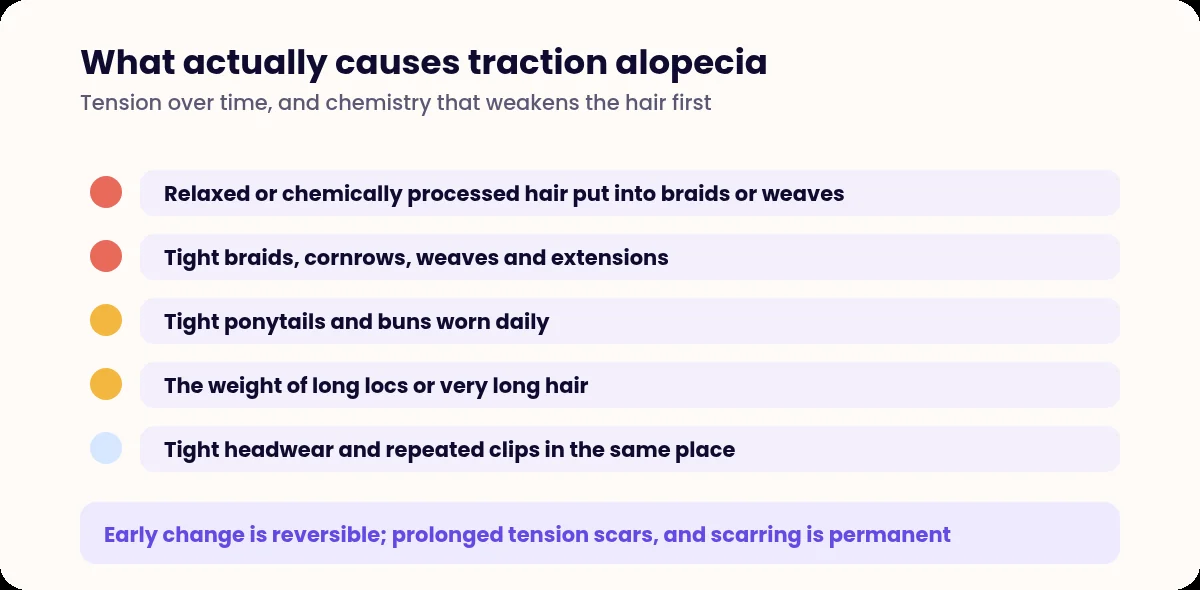
The list is longer than most people expect, and several items on it are not styles at all [1, 4, 5]:
- tight ponytails and buns, particularly worn daily and particularly high on the head
- braids, cornrows and dreadlocks fitted under tension
- weaves and extensions, where the added weight pulls on the anchoring hair
- tight headscarves and headbands
- clips, grips and hair ties placed in the same spot every day
- the sheer weight of very long hair
- hair twisted and secured under a turban, described in some Sikh men
Two general principles are more useful than the list. Tension at the root is the mechanism, so any style that produces soreness, tension headache or small bumps along the hairline when it is fitted is applying more force than the follicle tolerates. And duration multiplies with force: a tight style worn for an evening is not the same exposure as one worn continuously for eight weeks.
The combination that matters most
The single highest-risk pattern in the literature is chemical relaxing plus traction [1]. Relaxers reduce the tensile strength of the hair shaft; traction then applies load to a weakened fibre and to the follicle holding it. The prevention line from the review that named the problem is worth quoting directly: no braids or weaves on relaxed hair [1].
Why Afro-textured hair features so heavily
This needs saying precisely, because it is routinely said badly.
Afro-textured hair has an elliptical cross-section and retro-curvature — the shaft twists and doubles back on itself — and those features create points of mechanical weakness along its length [1]. That is a structural fact about a hair type, not a statement about a person or a group. It interacts with styling practice: the styles that are culturally common, long-worn and often chemically processed happen to be the ones that apply sustained tension to a shaft with those properties.
So the honest framing is hair structure plus styling practice, and both halves are modifiable in ways that hair type is not. The same styles applied to any hair type under the same tension for the same duration cause the same problem.
The prevalence figures deserve the same care. Most of the data are South African rather than UK [1, 2]. Around one-third of women of African descent wearing prolonged traumatic styles are affected in those series. The contrast the review reports is striking: 1.0% among Black adults attending a London dermatology clinic, against 37% in Cape Town primary care [1]. That gap is far more likely to reflect setting, referral pattern and prevailing styling practice than anything about the populations themselves, and it is a good reason not to import a South African prevalence figure into a conversation about a London clinic.
The fringe sign, and why it is not proof
The fringe sign is the retention of a thin band of fine, short hairs along the frontal or temporal hairline, sitting in front of the area of loss [1]. In traction alopecia those hairs survive because they take less of the pull.
It is often taught as the way to distinguish traction alopecia from frontal fibrosing alopecia, where the hairline band is lost entirely as the margin recedes. It is a genuinely useful sign. It is not diagnostic on its own, because frontal fibrosing alopecia can produce a convincing imitation of it [3].
That caveat has practical weight. If you have hairline loss and a surviving fringe, traction is the likely explanation — but if there is also itch or pain, small facial papules on the forehead and temples, eyebrow thinning, or skin that looks smooth and shiny rather than pitted with pores, the fringe does not rule out a scarring process and you need a clinician to look. Eyebrow changes in particular are covered in our guide to beard and eyebrow hair loss.
What a clinician looks for with a dermatoscope
Three findings do most of the work [1, 5]:
- Reduced density with absent follicular openings — a late finding, and a bad one, because it indicates follicles that have already been replaced.
- Hair casts — yellowish-white cylinders wrapped around the shafts that slide up and down. These indicate ongoing traction, which is clinically useful: they tell you the cause has not stopped.
- Broken hairs of varying lengths across the affected area.
What actually helps
The only intervention with a clear rationale is stopping the traction [1, 4]. Everything else is adjunctive, and every drug treatment used for this condition is off-label for it, with evidence at case-series level rather than trial level [1].
Practically, that means:
- Take down tight styles and give the scalp genuine rest periods rather than swapping one tight style for another.
- Vary parting lines and fastening positions so the same follicles are not loaded daily.
- Avoid applying traction to relaxed hair at all.
- Treat soreness on fitting as a signal to loosen, not something to endure.
Topical minoxidil at 2% or 5% — a pharmacy medicine in the UK — is sometimes used alongside, on the reasoning that it can support follicles still capable of regrowing, though it is not licensed for this indication and the evidence in traction alopecia specifically is thin [1]. Topical or intralesional corticosteroids are used where there is inflammation, and oral antibiotics where folliculitis has developed. Transplantation is considered only once traction has ceased, and is private-only in the UK; our guide to hair transplants in the UK covers what that involves.
One UK-specific note: central centrifugal cicatricial alopecia dominates the American literature on hair loss in Black women and is seen considerably less often by UK clinicians. It commonly coexists with traction alopecia, which is one reason a scalp that does not improve after traction stops deserves a proper dermatological assessment rather than more product.
If the thinning is diffuse and central rather than along the margins, traction may not be the story at all — see female pattern hair loss.
Frequently asked questions
Will my hairline grow back if I stop wearing tight styles?
If the loss is recent — weeks to a few months — and the follicular openings are still visible, regrowth is likely once the tension stops. If the area has been thin for years and the skin looks smooth with no visible pores, the follicles have been replaced by fibrous tissue and will not regrow. Nobody can give you a reliable cut-off date, which is the argument for changing the styling now rather than later.
Are braids and weaves bad for hair?
Tension is the problem, not the style. A loosely dressed braid that does not pull at the root, taken down and rested regularly, carries far less risk than a tight one worn continuously. What compounds risk is applying traction to hair that has been chemically relaxed, because relaxing reduces the tensile strength of the shaft.
Does traction alopecia itch or hurt?
Tension headaches, scalp soreness and small tender bumps along the hairline after a style is fitted are all common and all signal that the style is too tight. Pain on the day of fitting is not something to push through. Persistent burning or itch with smooth shiny skin is a different matter and needs a dermatology opinion.
Can I have a hair transplant for traction alopecia?
Only once the traction has completely stopped and the area has been stable for a period, because transplanted follicles placed into a scalp still under tension will fail the same way. It is a private-only procedure in the UK and requires an assessment that confirms there is no active scarring process.
References
- Billero V, Miteva M. Traction alopecia: the root of the problem. Clinical, Cosmetic and Investigational Dermatology, 2018. www.ncbi.nlm.nih.gov/pmc/articles/PMC5896623/
- Khumalo NP et al. Determinants of marginal traction alopecia in African girls and women. Journal of the American Academy of Dermatology, 2008. pubmed.ncbi.nlm.nih.gov/18191325/
- Pirmez R et al. It's not all traction: the pseudo 'fringe sign' in frontal fibrosing alopecia. British Journal of Dermatology, 2015;173:1336. pubmed.ncbi.nlm.nih.gov/26058320/
- British Association of Dermatologists. Traction alopecia patient information leaflet, updated 10 January 2025. www.skinhealthinfo.org.uk/
- DermNet. Traction alopecia. dermnetnz.org/topics/traction-alopecia
- NHS. Hair loss. www.nhs.uk/conditions/hair-loss/
Medical reviewer
Naeem Teni
Clinical Lead at Manova. Registered pharmacist and independent prescriber, GPhC 2215591. Reviews Manova’s clinical content for accuracy and safety.
Written by
Manova Editorial Team
Researched and written to our editorial policy, using NICE, NHS, MHRA and peer-reviewed sources.
This article is for general information and isn’t a substitute for advice from your own clinician. If you feel unwell, contact your GP or NHS 111. In an emergency, call 999.