

Key takeaways
- Eyebrow thinning or loss often precedes scalp changes in frontal fibrosing alopecia, which scars permanently — that makes it the single most important red flag in this area.
- Patchy, well-demarcated beard loss with intact follicular openings is usually alopecia areata barbae, which can regrow at any stage, often initially white.
- The 2025 update to the BAD living guideline on alopecia areata specifically addresses eyebrow and beard involvement and cautions about depigmentation risk from corticosteroids in darker skin.
- The suggestion that sunscreen or facial products cause frontal fibrosing alopecia comes from case-control studies vulnerable to recall bias and is contested, not established.
Hair loss below the hairline is discussed far less than hair loss above it, and it is diagnostically more informative. A thinning crown tells a clinician very little that they could not guess from your age. A missing eyebrow, or a smooth patch in a beard, narrows the field considerably.
Start with the point that matters most. Eyebrow thinning or loss often precedes the scalp changes in frontal fibrosing alopecia [2]. Because that condition scars permanently and treatment can only halt it, the eyebrows are sometimes the only warning that arrives while there is still something to protect.
The red flag list
If your eyebrows are thinning, work through this. It is short and it does most of the sorting.
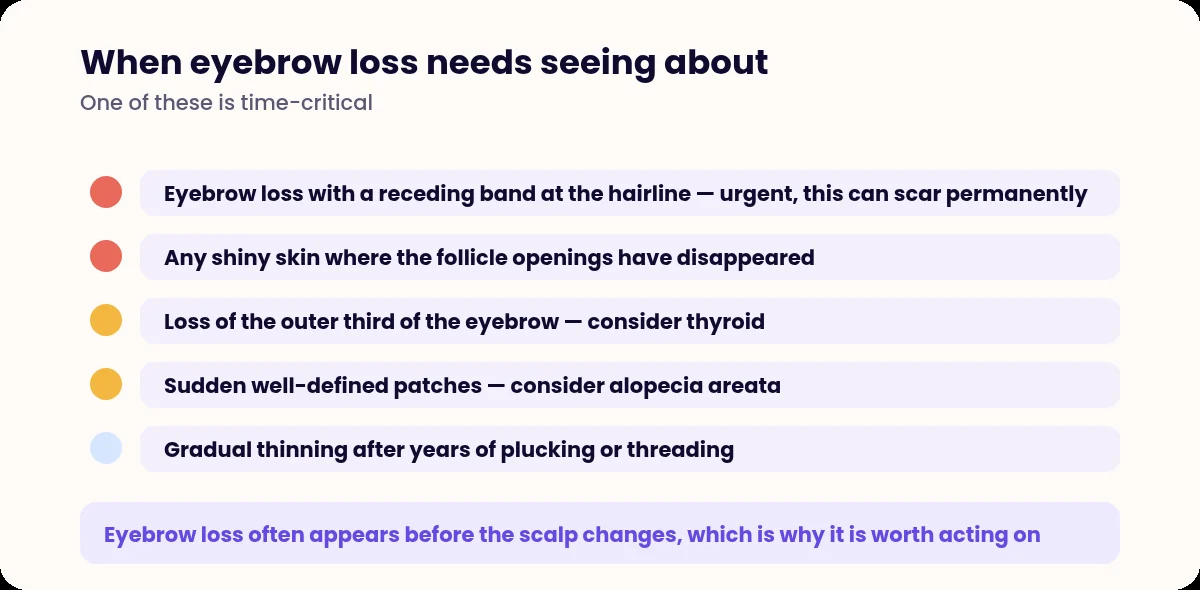
- Loss of the outer (lateral) third — consider thyroid disease. Classically described, worth checking, and covered in hair loss and thyroid disease.
- Eyebrow loss together with scalp hairline recession, facial papules, itch or pain, or body hair loss — this points to frontal fibrosing alopecia and needs an urgent dermatology referral, because the loss is scarring and time-critical.
- Sudden, well-demarcated patches, possibly with short tapering “exclamation mark” hairs at the edge — alopecia areata.
- Eyebrow loss with systemic features — consider nutritional deficiency (iron, zinc), secondary syphilis, chemotherapy, discoid lupus, and, rarely in the UK but relevant in returning travellers and recent migrants, leprosy.
- Any scarring, shiny, follicle-less skin, anywhere — urgent referral regardless of site.
The action for items 2 and 5 is a same-week GP appointment with a specific request for urgent dermatology referral, naming your concern about a scarring alopecia. Naming it changes how the request is triaged.
Alopecia areata of the beard
Alopecia areata barbae is patchy, non-scarring, immune-mediated loss confined to the beard [3]. It may be isolated or part of wider alopecia areata affecting the scalp and elsewhere.
The reassuring features are that the skin looks normal, the follicular openings are still visible, and regrowth is possible at any stage [3]. The disconcerting feature is that initial regrowth is often white or depigmented, which alarms people who assume it means permanent damage. Pigment usually returns over subsequent cycles.
What the UK guideline says
The British Association of Dermatologists maintains a living guideline for managing people with alopecia areata. The second iteration was published on 14 November 2025, with the literature surveilled to 11 July 2025 and 11 of 56 recommendations amended or new [1]. “Living” means it is revised as evidence arrives rather than every five years, so it is worth checking the current version rather than a summary.
Severity is defined by the SALT score: limited is 1 to 20% of the scalp, moderate 21 to 49%, severe 50 to 100%, with critical outcomes defined as SALT 0, SALT ≤10 and SALT ≤20 [1].
For adults with limited to moderate disease, the guideline’s first-line recommendations are a potent or very potent topical corticosteroid once daily for three to six months, and intralesional triamcinolone acetonide at 2.5 to 10 mg/mL [1]. On the specific question at hand, it advises clinicians to “consider intralesional corticosteroids in people with eyebrow or beard alopecia on a case-by-case basis” [1] — which is a deliberately cautious formulation, reflecting that these are cosmetically sensitive sites with thin skin.
Two further points from the guideline are worth knowing before a consultation. For rapidly progressive disease, oral prednisolone at 0.5 mg/kg/day tapered over 6 to 12 weeks may be considered [1]. And there is an explicit caution about depigmentation risk with corticosteroids in darker skin [1] — a real, visible and sometimes lasting effect that is worth raising directly if it applies to you. JAK inhibitors sit in the severe-disease pathway rather than being an option for a single beard patch [1].
Our fuller guide to alopecia areata covers the condition across all sites.
Frontal fibrosing alopecia
This is the reason eyebrow loss deserves attention.
Frontal fibrosing alopecia was originally described in post-menopausal white women over 50. That description is now outdated: it is seen in younger women, in men, in children and across all ethnic groups, and its incidence is reported to be increasing worldwide [2]. Women of African descent tend to present earlier, often in their early forties and before the menopause [2].
The features to recognise [2]:
- a pale, shiny band of scarred skin along the hairline, with absent follicular openings
- the “lonely hair” sign — isolated surviving hairs stranded within the band of loss
- skin-coloured or yellowish facial papules on the forehead and temples
- near-total limb hair loss, which is common and rarely volunteered unless asked
- itch and pain, which often precede any visible thinning
Hairline recession averages 1.8 to 2.6 cm, and the condition is usually slowly progressive and often self-limiting after several years [2]. That sounds tolerable until you register the crucial word: scarring means permanent. DermNet’s formulation is that hair does not regrow unless treatment is instituted early, and that treatment aims to halt progression, not to restore [2].
The treatments used are all off-label, with weak evidence and no randomised controlled trials: 5-alpha reductase inhibitors (where benefit may partly reflect coexisting pattern hair loss), intralesional and oral corticosteroids, tetracyclines, hydroxychloroquine, ciclosporin and mycophenolate, with low-dose oral minoxidil, low-dose naltrexone and JAK inhibitors as emerging options [2]. DermNet states plainly that “there is no uniformly effective treatment for FFA to date” [2].
On the sunscreen hypothesis
You will read that sunscreen or facial cosmetic use causes frontal fibrosing alopecia. This is contested and should not be presented as established. It rests on case-control studies that ask people to recall product use over years, a design highly vulnerable to recall bias — people who have developed a disfiguring condition think harder about what they have put on their face than people who have not [2]. There is no good basis for abandoning sun protection on this evidence, and doing so carries its own risks.
Our guide to scarring alopecia covers this group of conditions in full.
Over-plucking, threading and waxing
Repeated plucking, threading and waxing cause traction alopecia of the eyebrow. It follows the same course as traction anywhere else: initially reversible, permanent after years of repetition, with no reliable cut-off between the two. The mechanics are the same as those described in traction alopecia.
The distinction worth making is from trichotillomania, where hair is pulled out compulsively. The clue is the appearance of what remains: irregular areas with broken hairs of varying lengths, rather than the smooth, uniformly bare skin of a plucked or immune-mediated loss. It is a distinction that leads to completely different help, and it is worth raising honestly with a clinician rather than working around.
Frequently asked questions
Why has a bald patch appeared in my beard?
A round or oval, smooth, well-demarcated patch that appeared over a few weeks is most often alopecia areata barbae, an immune-mediated loss confined to the beard. The skin looks normal and the follicular openings are still visible. It can be isolated or part of wider alopecia areata, and regrowth is possible at any stage, though the first hairs back are often white.
When is eyebrow loss serious?
When it comes with scalp hairline recession, small skin-coloured or yellowish papules on the forehead and temples, itch or pain in the scalp, or loss of body and limb hair. That combination suggests frontal fibrosing alopecia, which is scarring and time-critical, and it needs an urgent dermatology referral rather than a watch-and-wait.
Will my eyebrows grow back after years of plucking?
Sometimes. Repeated plucking, threading and waxing cause traction alopecia of the eyebrow, which is reversible in its early stages and becomes permanent after years of repetition. There is no reliable cut-off, so stopping now is the only useful move. If the hairs that remain are broken at irregular lengths, that points towards a different cause worth discussing with a clinician.
Does losing the outer third of my eyebrows mean thyroid disease?
It is a classically described sign of hypothyroidism and worth mentioning at an appointment, but it is neither sensitive nor specific. Thyroid function is easy to check and reasonable to check, and a normal result does not mean the eyebrow loss has no cause — it just moves the question elsewhere.
References
- British Association of Dermatologists living guideline for the management of people with alopecia areata, 2025 update. British Journal of Dermatology, 2025;194(2):e56, published 14 November 2025. academic.oup.com/bjd
- DermNet. Frontal fibrosing alopecia. dermnetnz.org/topics/frontal-fibrosing-alopecia
- DermNet. Alopecia areata. dermnetnz.org/topics/alopecia-areata
- NHS. Hair loss. www.nhs.uk/conditions/hair-loss/
- DermNet. Eyebrow and eyelash loss. dermnetnz.org/topics/eyelash-and-eyebrow-disorders
- British Association of Dermatologists. Patient information leaflets. www.skinhealthinfo.org.uk/
Medical reviewer
Naeem Teni
Clinical Lead at Manova. Registered pharmacist and independent prescriber, GPhC 2215591. Reviews Manova’s clinical content for accuracy and safety.
Written by
Manova Editorial Team
Researched and written to our editorial policy, using NICE, NHS, MHRA and peer-reviewed sources.
This article is for general information and isn’t a substitute for advice from your own clinician. If you feel unwell, contact your GP or NHS 111. In an emergency, call 999.