

Key takeaways
- Scarring alopecias destroy the follicular stem cell niche permanently — treatment can halt progression and preserve what remains, but cannot regrow hair from scarred skin.
- Suspected scarring alopecia is a same-week dermatology referral, not a watch-and-wait. Ask your GP for an urgent referral rather than monitoring it yourself.
- The red flags are loss of the visible follicular openings, smooth shiny skin, perifollicular redness and scale, tufting, itch or burning or pain, and a receding band along the hairline rather than patterned thinning.
- In frontal fibrosing alopecia, eyebrow thinning often comes before the scalp changes, and single surviving hairs stranded in the band of loss are a near-characteristic sign.
Most hair loss is not urgent. Pattern hair loss unfolds over decades, and a few months either way changes very little. Scarring alopecia is the exception, and it is the one thing on this site that should change what you do today rather than what you buy.
Scarring alopecias — also called cicatricial alopecias — destroy the follicular stem cell niche in the bulge region of the follicle. Once that is gone, the follicle is gone. Treatment can suppress the inflammation, halt progression and preserve what remains. It cannot regrow hair from scarred skin. Every month of delay converts follicles that could have been saved into ones that cannot.
If the features below describe your scalp, ask your GP for a same-week appointment and an urgent dermatology referral. This is not a watch-and-wait situation, and it is not something to manage through an online hair loss service. This clinic does not treat scarring alopecia.
The red flags
The distinction that matters is between hair loss where the follicular openings are still present and hair loss where they are not. Look at the affected skin in bright light, zoomed in on a phone camera if that helps.
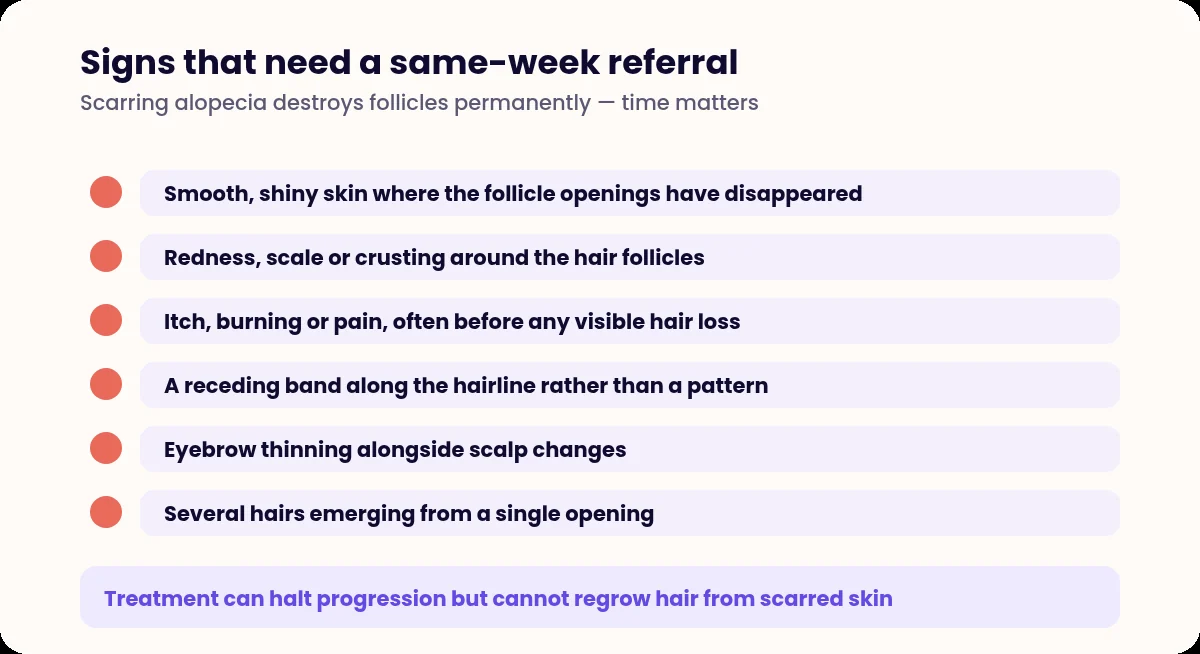
Features pointing to a scarring process:
- Loss of the follicular openings — the skin looks smooth and shiny, with no visible pores where hairs should emerge.
- Perifollicular redness and scale — a rim of inflammation or fine scaling collared around the base of remaining hairs.
- Tufting — several hairs emerging together from a single opening, like the bristles of a doll’s hair.
- Symptoms before signs — itch, burning or pain in the scalp, sometimes for months before any visible loss. Pattern hair loss does not hurt.
- A receding band along the hairline rather than the patterned recession and crown thinning of androgenetic alopecia.
- Loss of eyebrows, particularly the outer thirds.
By contrast, in pattern hair loss and in alopecia areata the follicular openings remain visible and the skin looks normal. That single observation separates most of the field.
Frontal fibrosing alopecia
Frontal fibrosing alopecia (FFA) produces a uniform linear band of hair loss along the front and sides of the scalp hair margin [1]. The hairline moves backwards as a band, leaving a strip of pale, slightly shiny skin between the new margin and the forehead skin, which often looks subtly different in texture and colour.
It was originally described in postmenopausal white women over 50. That description is now out of date: FFA increasingly affects younger women, men and children, and people of all ethnic backgrounds, and incidence is rising worldwide [1].
Two features are worth knowing about specifically.
Eyebrow thinning or loss frequently precedes the scalp changes. For many people it is the earliest sign, and it is often not connected to the scalp at all until a clinician asks. If your eyebrows have thinned over the past year or two and your hairline has started moving, mention both in the same sentence at your appointment.
“Lonely hairs” — single surviving hairs stranded within the band of loss, well in front of the new hairline — are a near-characteristic sign [1]. They are easy to spot once you know to look.
Active disease shows perifollicular redness and scale. Dermoscopy shows absent follicular openings, white dots and tubular scale wrapped around the hair shafts [1].
Associations include hypothyroidism, fragrance allergy and autoimmune conditions. Sunscreen and facial cosmetic use has been reported in association with FFA repeatedly, but this remains unproven and contested [1]. It is a hypothesis generated by observational studies, not an established cause, and it is not a reason to abandon sun protection.
Hairline recession in FFA averages around 1.8 to 2.6 cm and the condition is typically self-limiting after several years [1]. The recession up to that point is permanent, which is precisely why early suppression of the inflammation matters.
Lichen planopilaris
Lichen planopilaris (LPP) is a lymphocytic scarring alopecia producing patchy, irregular areas of loss, usually on the vertex and crown, with perifollicular redness and scale at the active margins [2]. Itch, burning and tenderness are common. It may occur alongside cutaneous or mucosal lichen planus, so a history of an itchy rash or mouth ulceration is relevant.
FFA shares the histopathology of LPP and is often described as a variant of it, though DermNet notes that the differences between them raise real doubts about whether that is correct [2]. Graham-Little-Piccardi-Lassueur syndrome is a third related entity.
How the diagnosis is made
Clinical features plus dermoscopy plus a scalp biopsy [1, 2]. The biopsy is usually a 4mm punch, ideally two — one processed horizontally and one vertically — taken from an active margin.
The common error is biopsying the middle of a bald area. A burnt-out patch shows scarring and nothing else, which tells the pathologist what has already happened and nothing about what is driving it. If you are having a biopsy, it is a reasonable question to ask where it is being taken from.
What treatment can and cannot do
The aims are explicit: arrest the inflammation, halt progression, relieve symptoms, preserve the follicles that remain [1, 2]. Regrowth from scarred skin is not an aim because it is not achievable.
Options used in UK dermatology include ultrapotent topical and intralesional corticosteroids, topical calcineurin inhibitors, hydroxychloroquine as a first-line systemic agent, doxycycline, methotrexate, mycophenolate, ciclosporin and oral retinoids. 5-alpha reductase inhibitors are widely used in FFA with observational support, and JAK inhibitors are an emerging option [1, 2].
Two caveats matter. The evidence base is almost entirely retrospective and observational — there are essentially no adequately powered randomised trials in FFA or LPP, so treatment choice rests on experience rather than trial data. And there is no NICE guidance on scarring alopecia, though the British Association of Dermatologists publishes patient information leaflets for both conditions [4].
Hair transplantation is generally contraindicated in active disease and frequently fails even when the condition is quiescent [1]. If you are considering surgery, read our guide to hair transplants in the UK and get a dermatology opinion first.
What to do now
If the red flags above describe your scalp: book a same-week GP appointment, take clear photographs including a close-up of the hairline and your eyebrows, and ask specifically for an urgent dermatology referral because you are concerned about a scarring alopecia. Naming the concern changes how the request is triaged.
If your loss is patterned, painless, and the follicular openings are still visible, our guide to male pattern baldness is the more relevant read.
Frequently asked questions
How do I tell scarring from ordinary hair loss?
Look closely at the bald skin in good light, ideally with a phone camera zoomed in. In pattern hair loss and alopecia areata you can still see the tiny follicular openings. In scarring alopecia those openings are gone and the skin looks smooth and shiny. Redness or scale around the remaining hairs, and itching, burning or soreness, all point the same way.
Can scarring alopecia be reversed?
No. The stem cells in the follicle bulge are destroyed, and no treatment recovers a follicle once it is gone. What treatment does is suppress the inflammation so that the follicles you still have are preserved. That is why the timing of diagnosis determines the outcome more than the choice of treatment does.
Does sunscreen cause frontal fibrosing alopecia?
It is an association that has been reported repeatedly in studies, but it remains unproven and contested. Association is not causation, and a reported link in observational studies can arise from how the studies were done. There is no good basis for stopping sun protection on this evidence, and doing so has its own risks.
Can I have a hair transplant for scarring alopecia?
Transplantation is generally contraindicated in active disease and often fails even when the condition is quiescent, because the transplanted follicles are placed into skin where the same inflammatory process can act. Any surgeon who agrees to operate without a dermatology assessment and a period of documented stability is taking a risk with your remaining hair.
References
- DermNet. Frontal fibrosing alopecia. dermnetnz.org/topics/frontal-fibrosing-alopecia
- DermNet. Lichen planopilaris. dermnetnz.org/topics/lichen-planopilaris
- NHS. Hair loss. www.nhs.uk/conditions/hair-loss/
- British Association of Dermatologists. Patient information leaflets on frontal fibrosing alopecia and lichen planopilaris. www.skinhealthinfo.org.uk/
- DermNet. Male pattern hair loss. dermnetnz.org/topics/male-pattern-hair-loss
Medical reviewer
Naeem Teni
Clinical Lead at Manova. Registered pharmacist and independent prescriber, GPhC 2215591. Reviews Manova’s clinical content for accuracy and safety.
Written by
Manova Editorial Team
Researched and written to our editorial policy, using NICE, NHS, MHRA and peer-reviewed sources.
This article is for general information and isn’t a substitute for advice from your own clinician. If you feel unwell, contact your GP or NHS 111. In an emergency, call 999.