

Key takeaways
- Ferritin, full blood count and thyroid function explain a large share of reversible hair shedding and are the core tests.
- Pattern hair loss in men with a typical presentation often needs no blood tests at all; diffuse shedding, especially in women, usually does.
- Ferritin is the iron store marker most relevant to hair, and it can be low while haemoglobin is still normal.
- Large commercial 'hair loss panels' add many tests with little bearing on hair, and abnormal incidental results can cause unnecessary worry.
Not everyone with hair loss needs blood tests. A man with a receding hairline, thinning at the crown, a gradual course over years and a father and grandfather with the same thing is diagnosed by looking at him. Testing him extensively finds incidental results, not answers.
Where testing earns its place is diffuse shedding — hair coming out all over rather than in a pattern — and hair loss in women, where reversible contributors are more often present [1].
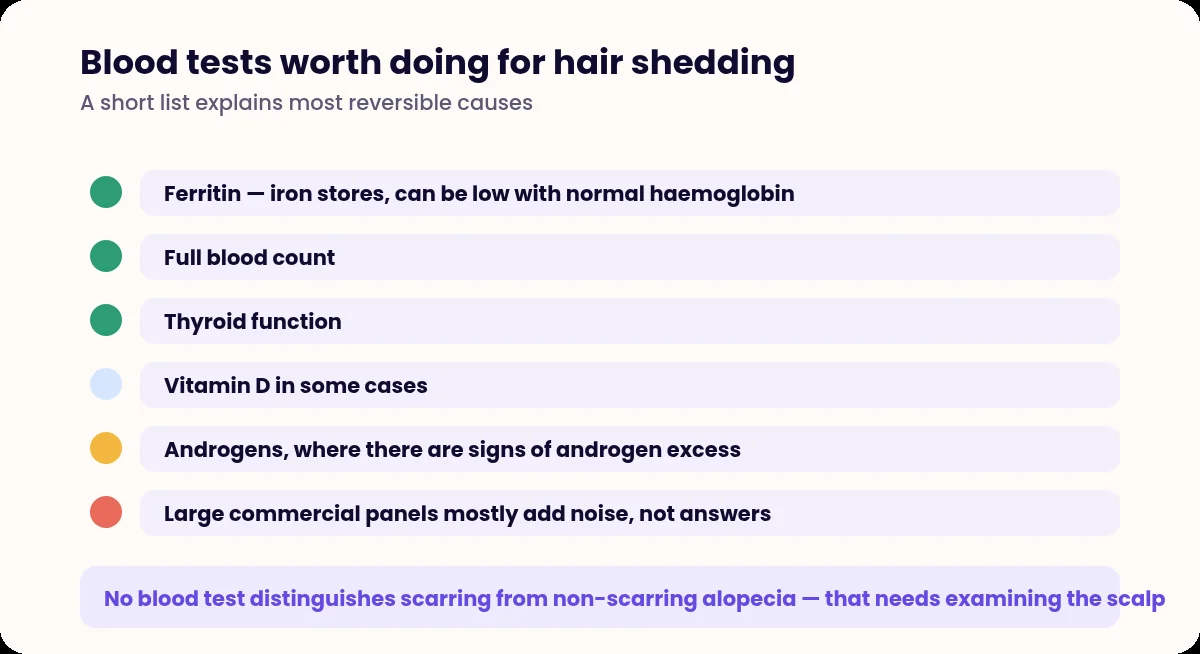
The core tests
Ferritin
Ferritin reflects iron stores, and it is the test most consistently associated with hair shedding. Crucially, ferritin can be low while haemoglobin is still normal — you can have depleted iron stores without being anaemic, and hair is sensitive to that [2].
There is no universally agreed ferritin threshold for hair. Many dermatologists aim above the bottom of the laboratory range when treating shedding, while acknowledging the evidence for a specific target is limited.
One caveat worth knowing: ferritin is an acute phase protein, so it rises with inflammation or infection. A normal ferritin measured during an inflammatory illness can conceal genuinely low iron stores, which is why it is sometimes read alongside CRP.
And a low ferritin is a finding, not a diagnosis. The question of why iron is low — heavy periods, dietary intake, coeliac disease, gastrointestinal blood loss — matters more than the number, particularly in men and postmenopausal women, in whom unexplained iron deficiency warrants investigation [2].
Full blood count
Detects anaemia and gives context to the ferritin. Also picks up other abnormalities that occasionally present with hair changes.
Thyroid function
Both hypothyroidism and hyperthyroidism cause diffuse hair loss, and both are treatable, so TSH — with free T4 if TSH is abnormal — is standard in a shedding work-up [1, 3]. Thyroid disease frequently comes with other clues: weight change, temperature intolerance, altered bowel habit, tiredness, palpitations, changes to periods.
Vitamin D
Often included. The association with hair loss is less firmly established than for iron, but deficiency is common in the UK, particularly through winter, and correcting it is straightforward.
Tests added depending on the picture
Androgens — testosterone, SHBG, sometimes DHEAS — in women with signs of androgen excess: irregular periods, acne, unwanted facial or body hair. These point towards conditions such as PCOS, which changes the treatment approach [1].
Prolactin, where periods are irregular.
Zinc, where diet is restricted, after bariatric surgery, or in malabsorption. Real zinc deficiency causes hair loss; supplementing without deficiency does not help and excess zinc interferes with copper absorption.
Coeliac screen, where there is unexplained iron deficiency, gut symptoms, or a family history.
ANA and other autoimmune screening, where alopecia areata, lupus or another autoimmune condition is suspected clinically.
HbA1c, where diabetes is a possibility.
Syphilis serology in the right clinical context — secondary syphilis causes a characteristic patchy “moth-eaten” hair loss, and it is worth remembering because it is entirely treatable.
What tends not to be useful
Very large commercial panels. Testing forty analytes in someone with hair shedding produces a handful of marginally abnormal results by chance, most of which have nothing to do with hair and some of which generate months of anxiety and further testing. More tests is not more information.
Serum iron and transferrin saturation alone. These fluctuate with recent meals and time of day; ferritin is the more stable store marker.
Hair mineral analysis. Sold widely, unreliable as a measure of nutritional status, and not used in mainstream practice.
Testosterone in men with typical pattern baldness. Pattern hair loss is about follicle sensitivity to DHT, not about circulating levels, which are usually normal. Testosterone is checked when there are symptoms of deficiency — see low testosterone symptoms — not as part of a hair work-up.
Genetic “hair loss risk” tests. Interesting, not actionable. They tell you about a risk you can already estimate from your family and, more to the point, from your own scalp.
The thing tests can’t do
Blood tests do not diagnose the type of hair loss. That comes from the history — how it started, how fast, in what pattern — and from examining the scalp. The single most important distinction, between scarring and non-scarring alopecia, is made by looking: redness, scaling, loss of follicular openings and a smooth shiny scalp point to a scarring process, which needs prompt specialist assessment because the follicle loss is permanent [5].
No panel of bloods will tell you that. This is why an assessment beats a test kit, and why a normal set of results is reassuring but not a full answer.
What to do with results
Take them to someone who can put them next to your history and your scalp. If everything is normal and the picture is androgenetic, our guides to male pattern baldness and female pattern hair loss cover what comes next. If something is low, correcting it is worth doing on its own merits, whether or not it fully explains the hair — but remember that hair responds slowly, and improvement after correcting iron typically takes three to six months to become visible.
Frequently asked questions
What ferritin level is needed for healthy hair?
There is no agreed threshold specific to hair, and laboratory reference ranges vary. Many dermatologists aim higher than the bottom of the normal range when treating hair shedding, but this is a clinical judgement rather than a fixed number, and the underlying reason for low iron still needs finding.
Do I need a test if I have typical male pattern baldness?
Often not. A receding hairline and crown thinning developing gradually with a family history is usually diagnosed clinically. Tests are added when the pattern is atypical, the shedding is diffuse or sudden, or there are other symptoms.
Are at-home hair loss test kits worth it?
They can flag something worth following up, but results need interpreting alongside your history and an examination of the scalp, which a kit cannot do. Take the results to a clinician rather than acting on them alone.
Can a vitamin deficiency cause hair loss?
Genuine deficiencies of iron, zinc and vitamin D have been linked to hair shedding, and correcting a real deficiency can help. Taking supplements without a deficiency does not improve hair, and excess vitamin A and excess selenium can actually cause hair loss.
References
- NICE Clinical Knowledge Summaries. Alopecia, androgenetic – female. cks.nice.org.uk/topics/alopecia-androgenetic-female/
- NHS. Iron deficiency anaemia. www.nhs.uk/conditions/iron-deficiency-anaemia/
- NHS. Underactive thyroid (hypothyroidism). www.nhs.uk/conditions/underactive-thyroid-hypothyroidism/
- DermNet. Telogen effluvium. dermnetnz.org/topics/telogen-effluvium
- British Association of Dermatologists. Patient information leaflets. www.skinhealthinfo.org.uk/
Medical reviewer
Naeem Teni
Clinical Lead at Manova. Registered pharmacist and independent prescriber, GPhC 2215591. Reviews Manova’s clinical content for accuracy and safety.
Written by
Manova Editorial Team
Researched and written to our editorial policy, using NICE, NHS, MHRA and peer-reviewed sources.
This article is for general information and isn’t a substitute for advice from your own clinician. If you feel unwell, contact your GP or NHS 111. In an emergency, call 999.