
Key takeaways
- Female pattern hair loss usually shows as diffuse thinning over the top of the scalp with a widening parting, rather than a receding hairline.
- Other causes — iron deficiency, thyroid disease, telogen effluvium after illness or childbirth, and some medicines — are more often contributing than in men, so testing matters.
- Topical minoxidil is the main licensed treatment; other options used in the UK include spironolactone and, in specialist care, other antiandrogens.
- Finasteride is not licensed for women and must not be handled by anyone who is or may become pregnant.
Hair thinning in women tends to be noticed at the parting. It widens. The ponytail gets thinner. Scalp becomes visible under bright light where it wasn’t before. The hairline at the front is usually preserved, which is one of the clearest differences from the male pattern [2, 4].
What it looks like
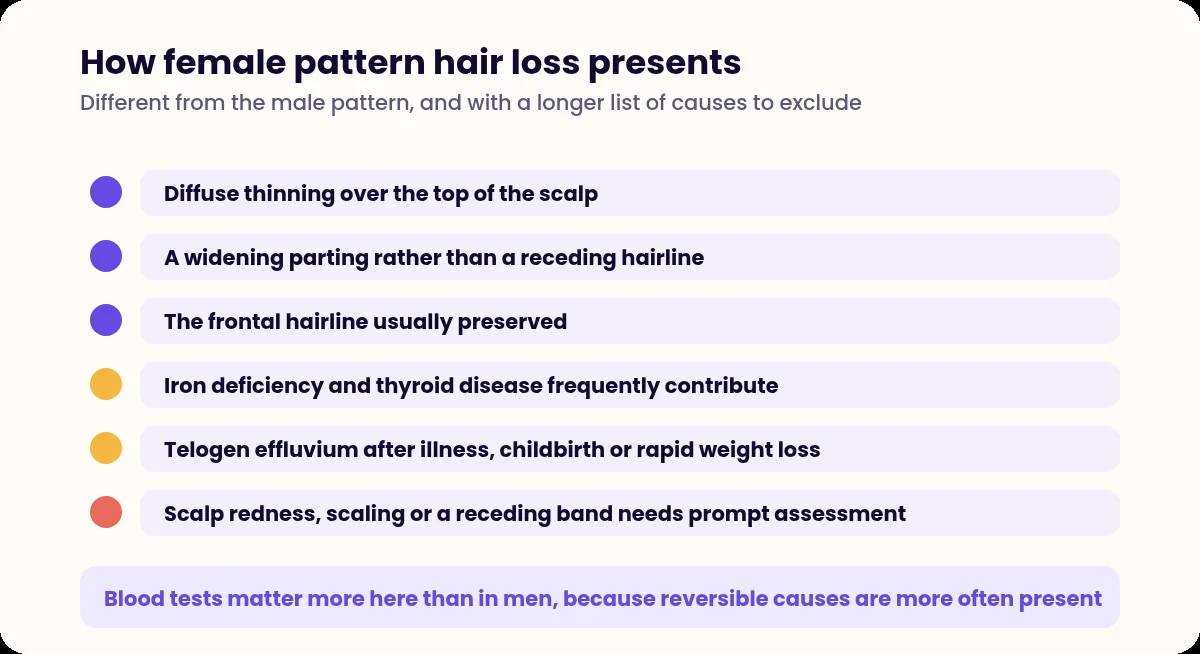
The Ludwig scale describes three grades of diffuse thinning over the crown with a retained frontal hairline. Some women instead show a triangular pattern of thinning behind the hairline, sometimes called the Christmas tree pattern. Complete baldness of an area, as seen in advanced male pattern loss, is uncommon [4].
The underlying process is the same as in men — follicle miniaturisation, with each growth cycle producing a finer hair — but it is distributed differently and generally progresses more slowly.
Why the causes list is longer
In men, thinning in the typical pattern is usually androgenetic and that is usually the end of it. In women, several other conditions produce diffuse thinning, some of them common and most of them treatable, so they are looked for rather than assumed absent [2].
Iron deficiency. Low ferritin is associated with hair shedding, and heavy periods make it common in women of reproductive age. Ferritin is routinely checked.
Thyroid disease. Both under- and overactive thyroid cause diffuse hair loss, and both are more common in women.
Telogen effluvium. A synchronised shed two to four months after a trigger — childbirth, significant illness, surgery, severe stress, rapid weight loss, or starting or stopping a medicine. It presents as handfuls of hair rather than gradual thinning, and it recovers, usually over six to twelve months. Our guide to weight loss and hair shedding touches on the rapid-weight-loss version of this.
Menopause. Falling oestrogen shifts the hormonal balance at the follicle, and thinning around and after menopause is common.
Polycystic ovary syndrome and other causes of androgen excess. Suggested by irregular periods, acne, and unwanted facial or body hair. Worth raising, because the assessment and treatment differ.
Medicines. Several classes can cause hair shedding, including some antidepressants, anticoagulants, retinoids, beta blockers and hormonal treatments. Never stop a prescribed medicine on suspicion — raise it with the prescriber.
Traction alopecia. Sustained tension from tight ponytails, braids, weaves and extensions causes loss along the hairline that becomes permanent if prolonged. Early change is reversible; this is the one where acting quickly genuinely matters.
Scarring alopecias, including frontal fibrosing alopecia, which causes a band of recession at the frontal hairline often with loss of eyebrows, and lichen planopilaris. These need prompt specialist assessment, because the follicle destruction is permanent and treatment aims to stop progression.
What gets tested
More is checked than in men [2]:
- Ferritin and full blood count
- Thyroid function
- Vitamin D in some cases
- Androgens (testosterone, SHBG, sometimes DHEAS) where there are signs of androgen excess
- Prolactin where periods are irregular
Our guide to blood tests for hair loss covers what each one actually tells you.
A clinician will also examine the scalp, which is the step that distinguishes pattern loss from a scarring alopecia — and that distinction changes the urgency completely.
Treatment
Topical minoxidil is the main licensed option and has randomised evidence in women [5]. Products intended for women are licensed at particular strengths and regimens; following those matters, partly for efficacy and partly because higher strengths increase the chance of unwanted facial hair. As in men, expect four to six months before judging, expect an early shedding phase, and expect the benefit to unwind if you stop. See minoxidil explained.
Spironolactone is used off-label in the UK for female pattern hair loss because of its antiandrogen effect. It requires a prescriber, monitoring of potassium and kidney function, and effective contraception, since it can affect a developing foetus.
Other antiandrogens and, in some cases, low-dose oral minoxidil are used in specialist dermatology settings. Both are off-label for this indication and need proper assessment and monitoring.
Finasteride is not licensed for women. It carries a specific warning that women who are or may become pregnant must not handle crushed or broken tablets, because of the risk of abnormalities in a male foetus. It is occasionally used off-label in postmenopausal women under specialist care, but it is not a route to pursue independently.
Treating the contributing cause — correcting iron deficiency, treating thyroid disease, changing a culprit medicine — can improve things on its own, and is why the tests come first.
Hair transplantation is used in women in selected cases, though the diffuse nature of the loss means donor hair is often also affected, which limits suitability more than in men. See hair transplants in the UK.
Cosmetic and practical measures
These are not lesser options. Volumising products, scalp-coloured fibre powders, changing the parting, layered cuts and well-made hair pieces all work immediately in a way medical treatment does not. Avoiding sustained tension — tight styles, extensions, frequent heat and chemical processing — protects what is there.
When to seek help
Sooner rather than later, and particularly if there is scalp redness, scaling, itching or pain, if the hairline is receding in a band, if eyebrows are thinning, if hair comes out in round patches, or if shedding is sudden and heavy. Pattern hair loss is not urgent; several of the things it can be mistaken for are.
Frequently asked questions
Is hair loss normal during menopause?
Thinning around and after menopause is common, and falling oestrogen is thought to contribute by altering the balance of hormonal influence on follicles. Common does not mean it should be dismissed — other causes should still be looked for, and treatment options exist.
Should I have blood tests?
For women with hair thinning, yes — more routinely than for men. Ferritin, full blood count, thyroid function and sometimes vitamin D are checked, with androgen levels added where there are signs of excess androgens such as irregular periods, acne or unwanted facial hair.
Can I use the men's strength minoxidil?
Products are licensed at particular strengths and regimens for women, and using a different strength or frequency is off-label. It also increases the chance of unwanted facial hair. Follow the product information for the product intended for women, or ask a prescriber.
Will hair loss after having a baby grow back?
Postpartum shedding is telogen effluvium — a synchronised shed a few months after delivery — and it typically recovers over six to twelve months without treatment. If it has not recovered by then, or is unusually heavy, get it assessed.
References
- NHS. Hair loss. www.nhs.uk/conditions/hair-loss/
- NICE Clinical Knowledge Summaries. Alopecia, androgenetic – female. cks.nice.org.uk/topics/alopecia-androgenetic-female/
- British Association of Dermatologists. Patient information leaflets. www.skinhealthinfo.org.uk/
- DermNet. Female pattern hair loss. dermnetnz.org/topics/female-pattern-hair-loss
- Summary of Product Characteristics: Regaine for Women. Electronic Medicines Compendium. www.medicines.org.uk/emc/search?q=regaine+women
Medical reviewer
Naeem Teni
Clinical Lead at Manova. Registered pharmacist and independent prescriber, GPhC 2215591. Reviews Manova’s clinical content for accuracy and safety.
Written by
Manova Editorial Team
Researched and written to our editorial policy, using NICE, NHS, MHRA and peer-reviewed sources.
This article is for general information and isn’t a substitute for advice from your own clinician. If you feel unwell, contact your GP or NHS 111. In an emergency, call 999.