

Key takeaways
- The most common explanation is that the deficit is smaller than you think — people under-record intake substantially without meaning to.
- Short stalls are frequently water, not fat: new exercise, salt, carbohydrate and the menstrual cycle all move the scales without changing fat.
- Fitness trackers overestimate calories burned. In one study the best device was out by 27%, the worst by 93%.
- Some medicines and conditions genuinely cause weight gain. If nothing else fits, that is worth a conversation and possibly a blood test.
You’re doing the work. The scales disagree. Before you conclude that your metabolism is broken or that you simply lack discipline, it’s worth working through the list — because the real reason is usually on it, and most of the entries have a fix.
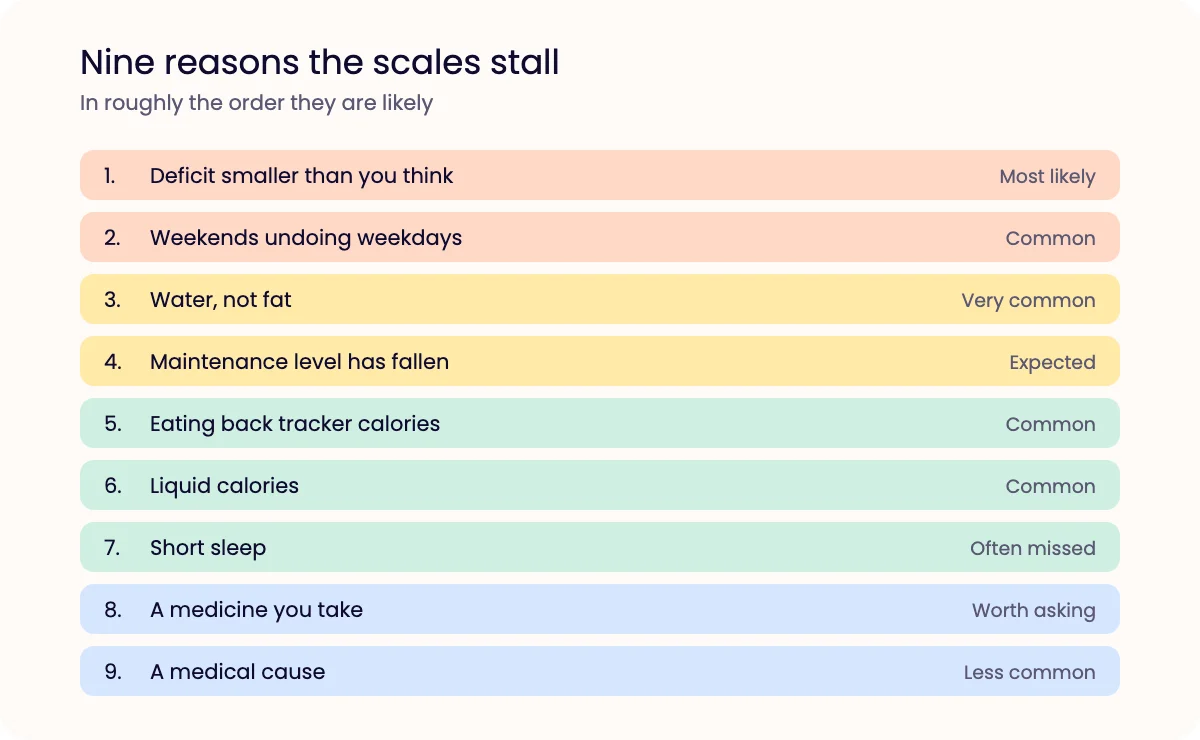
They’re in roughly the order they’re likely.
1. The deficit is smaller than you think
This is the big one, and it isn’t about honesty.
In a classic study, researchers took people who reported being unable to lose weight despite eating very little, and measured their actual energy expenditure using doubly-labelled water — a method you cannot fool. The gap between what people reported eating and what they actually ate was large, and they simultaneously over-reported how much they exercised [1]. These weren’t people lying to researchers. They genuinely couldn’t see it.
What goes missing: cooking oil (a tablespoon is around 120 kcal), the milk in four coffees, tastes while cooking, finishing the children’s plates, portions estimated by eye, and anything eaten standing up.
The fix: weigh and record everything honestly for two weeks — not forever, just long enough to see where your calories actually live. Most people find one or two habits accounting for several hundred calories a day.
2. Weekends are undoing the weekdays
Five good days and two loose ones can net out to nothing. A study tracking weight through the week found people gained weight specifically on weekends — eating more on Saturdays and moving less on Sundays — enough to cancel out weekday losses in some cases [2].
The fix: you don’t need a perfect weekend. You need Saturday to look less like a write-off. Keep breakfast the same as a weekday, decide about alcohol before you’re out, and keep one planned indulgence rather than an unplanned two days.
3. It’s water, not fat
The scales measure everything in your body, most of which isn’t fat.
Things that add water weight without adding any fat: a salty meal, a big carbohydrate meal (stored carbohydrate holds water with it), new or unusually hard exercise, the week before a period, poor sleep, and constipation.
The fix: weigh yourself under the same conditions — first thing, after the toilet, same day of the week — and compare weekly averages over a month. A single reading tells you almost nothing.
4. You’ve already lost weight, so the goalposts moved
A 95 kg body needs more energy than an 88 kg one. The intake that created a deficit at the start creates a smaller one now, and eventually none at all. Modelling of real weight change shows this flattening is expected rather than exceptional [9].
The fix: recalculate. A further modest reduction, or more daily movement, restores the deficit. Our guide to breaking a plateau covers this in detail.
5. You’re eating back exercise you didn’t do
Wrist-worn trackers are good at counting steps and reasonable at heart rate. They are poor at calories. When seven popular devices were tested against laboratory metabolic measurement, the most accurate was off by 27% on energy expenditure and the least accurate by 93% [3].
If you “earn” 600 kcal on a watch and eat 600 kcal, you may well have eaten back double what you actually spent.
The fix: treat exercise calories as a bonus, not a budget. Let the deficit come from food and let exercise do its real jobs — muscle, fitness, mood, appetite regulation.
6. Liquid calories
A large latte, a glass of orange juice and two pints comes to somewhere around 700 kcal, and none of it makes you meaningfully fuller. Drinks are the easiest place to remove a few hundred calories without touching a meal — and alcohol has its own effects, covered in our piece on alcohol and weight.
7. Sleep
Short sleep raises hunger hormones, increases the appeal of calorie-dense food and reduces the amount of movement you do without noticing. A meta-analysis of partial sleep restriction found a consistent increase in energy intake the following day [7].
The fix: it isn’t trivial to fix, but it’s often the highest-value change available. See sleep and weight loss.
8. A medicine you’re taking
Several drug classes are associated with weight gain [4]:
- Some antidepressants (tricyclics most, and gain is more common with long-term SSRI use)
- Some antipsychotics, where gain can be substantial
- Corticosteroids — weight gain is common with long-term use
- Beta blockers — a modest average gain
- Insulin and sulfonylureas for diabetes
- Some antiepileptics and hormonal treatments
Important: never stop a prescribed medicine because of this. Some are the difference between wellness and serious illness. Do ask your prescriber whether a weight-neutral alternative exists — for several of these classes, one does.
9. A medical cause
Less common than the internet suggests, but real.
- Underactive thyroid. Weight gain usually arrives with tiredness, feeling the cold, dry skin and constipation. It’s a simple blood test [5].
- Cushing’s syndrome. Rare, and characterised by fat redistributing to the face, neck, upper back and abdomen while arms and legs stay slim [8].
- Menopause. Often blamed for more than it causes. Cohort data suggests midlife weight gain is largely age-related — around 0.5 kg a year regardless of menopausal status — while menopause mainly shifts where fat is stored, from hips towards the abdomen [6]. That matters: the tape measure may change more than the scales.
What to do this week
- Record everything, weighed, for 14 days.
- Weigh yourself daily, compare weekly averages, and ignore individual days.
- Get protein to roughly 1.2–1.6 g per kg and add two strength sessions.
- Deal with the drinks.
- If several symptoms in section 9 fit, book a blood test rather than cutting your food further.
When to speak to a clinician
If you’ve been genuinely consistent for two months with no change, if you’re gaining weight without a change in habits, or if weight change comes with other symptoms, that’s worth proper assessment — your GP or a Manova clinician can help work out what’s going on.
Frequently asked questions
Why am I not losing weight in a calorie deficit?
Usually because the deficit is smaller than it appears. Research using gold-standard measurement has found people substantially under-report what they eat and over-report activity, without intending to. The next most likely explanations are water retention masking real fat loss, and a maintenance level that has fallen because you have already lost weight.
Can drinking more water help me lose weight?
Indirectly. Water has no calories and replaces drinks that do, and thirst is sometimes mistaken for hunger. It is not a fat-burning strategy in itself, but swapping sugary drinks for water is one of the simplest ways to cut a few hundred calories a day.
Can medication stop me losing weight?
Yes. Several drug classes are associated with weight gain, including some antidepressants and antipsychotics, corticosteroids, beta blockers, insulin and sulfonylureas. Never stop a prescribed medicine on your own — ask your prescriber whether an alternative is suitable.
Could it be my thyroid?
An underactive thyroid can cause weight gain, usually alongside other symptoms such as tiredness, feeling cold, dry skin and constipation. It is a simple blood test, so if several of those fit, it is worth asking your GP rather than wondering.
Why do I gain weight after starting exercise?
New or hard exercise causes temporary fluid retention in muscle as it repairs, which can add a kilo or two on the scales for several days. It is not fat, and it settles as you adapt. Judge progress by the trend over a month, not the week you started training.
References
- Lichtman SW, Pisarska K, Berman ER, et al. Discrepancy between self-reported and actual caloric intake and exercise in obese subjects. New England Journal of Medicine. 1992;327(27):1893-1898. doi.org/10.1056/NEJM199212313272701
- Racette SB, Weiss EP, Schechtman KB, et al. Influence of weekend lifestyle patterns on body weight. Obesity. 2008;16(8):1826-1830. doi.org/10.1038/oby.2008.320
- Shcherbina A, Mattsson CM, Waggott D, et al. Accuracy in wrist-worn, sensor-based measurements of heart rate and energy expenditure in a diverse cohort. Journal of Personalized Medicine. 2017;7(2):3. doi.org/10.3390/jpm7020003
- Verhaegen AA, Van Gaal LF. Drugs that affect body weight, body fat distribution and metabolism. In: Endotext. MDText.com; updated 2019. www.ncbi.nlm.nih.gov/books/NBK537590/
- NHS. Underactive thyroid (hypothyroidism). www.nhs.uk/conditions/underactive-thyroid-hypothyroidism/
- Davis SR, Castelo-Branco C, Chedraui P, et al. Understanding weight gain at menopause. Climacteric. 2012;15(5):419-429. doi.org/10.3109/13697137.2012.707385
- Al Khatib HK, Harding SV, Darzi J, Pot GK. The effects of partial sleep deprivation on energy balance: a systematic review and meta-analysis. European Journal of Clinical Nutrition. 2017;71(5):614-624. doi.org/10.1038/ejcn.2016.201
- NHS. Cushing's syndrome. www.nhs.uk/conditions/cushings-syndrome/
- Hall KD, Sacks G, Chandramohan D, et al. Quantification of the effect of energy imbalance on bodyweight. The Lancet. 2011;378(9793):826-837. doi.org/10.1016/S0140-6736(11)60812-X
Medical reviewer
Naeem Teni
Clinical Lead at Manova. Registered pharmacist and independent prescriber, GPhC 2215591. Reviews Manova’s clinical content for accuracy and safety.
Written by
Manova Editorial Team
Researched and written to our editorial policy, using NICE, NHS, MHRA and peer-reviewed sources.
This article is for general information and isn’t a substitute for advice from your own clinician. If you feel unwell, contact your GP or NHS 111. In an emergency, call 999.