

Key takeaways
- Short sleep shifts appetite hormones, increasing hunger and making high-calorie foods more tempting.
- In a real-world trial, adults with overweight who slept about 1.2 hours longer ate roughly 270 fewer calories a day.
- When dieters slept less, a larger share of the weight they lost came from lean tissue rather than fat.
- Aim for 7–9 hours with a consistent schedule. Loud snoring with daytime sleepiness should be checked for sleep apnoea.
When people think about losing weight, they think about food and exercise. Sleep rarely makes the list. But a growing body of research shows that how long and how well you sleep changes how hungry you feel, what you reach for, and even what kind of weight you lose.
How poor sleep affects your weight
It turns up your hunger hormones
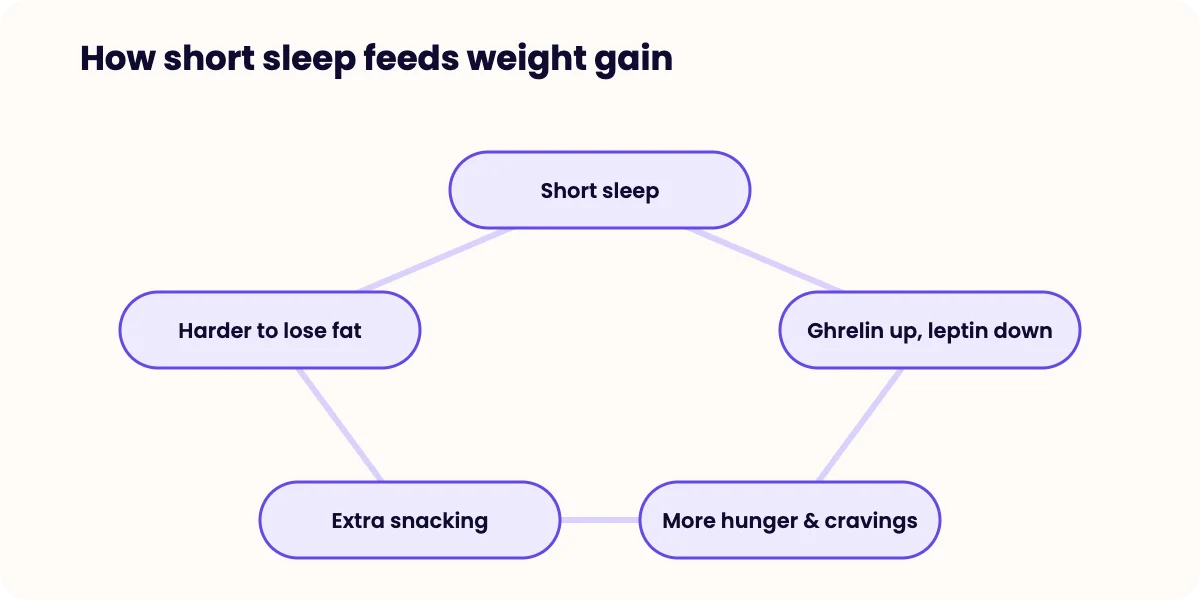
Two hormones help regulate appetite: ghrelin, which signals hunger, and leptin, which signals fullness. In a controlled study, when healthy young men were restricted to 4 hours in bed for two nights, ghrelin rose, leptin fell, and their hunger and appetite increased, especially for calorie-dense, carbohydrate-rich foods [1].
It makes junk food more tempting
Brain-imaging research found that after a night without sleep, the brain’s reward areas responded more strongly to high-calorie foods, while areas involved in self-control were less active [5]. In other words, you’re not imagining it: willpower really is harder after a bad night.
You eat more, without burning more
A meta-analysis of sleep-restriction studies found that when people slept less, they ate around 385 extra calories a day on average, with no meaningful increase in energy used [4]. That’s roughly an extra meal’s worth of snacks.
You lose more muscle and less fat
In a carefully controlled study, adults on the same calorie-reduced diet lost similar amounts of weight whether they slept 8.5 or 5.5 hours. But with short sleep, the amount of fat lost fell by 55%, and more of the weight lost came from lean tissue. They also felt hungrier [3].
The good news: more sleep helps
In a randomised trial in adults with overweight who usually slept less than 6.5 hours, a simple sleep-hygiene session helped the intervention group sleep about 1.2 hours longer. Without any instructions to change their diet, they ate around 270 fewer calories a day compared with the control group [2]. Over time, that alone could make a real difference to weight.
How much sleep do you need?
Most adults need 7 to 9 hours a night. Regularity matters as well as length: similar bed and wake times every day, including weekends, help keep your body clock and appetite rhythms steady.
9 ways to sleep better (and support weight loss)
- Keep a consistent schedule. Same wake-up time daily, even after a late night.
- Protect a wind-down hour. Dim the lights and step away from work and bright screens.
- Keep the bedroom cool, dark and quiet. Blackout blinds and earplugs are cheap and effective.
- Cut caffeine after early afternoon. Its effects can last many hours.
- Limit alcohol. It may help you drop off, but it fragments sleep later in the night.
- Get daylight in the morning. Even 10–20 minutes outside helps set your body clock.
- Move during the day. Regular exercise improves sleep quality, but finish intense workouts a few hours before bed.
- Avoid large meals late at night. If you’re hungry, choose a small protein-based snack.
- Don’t lie awake for ages. If you can’t sleep after about 20 minutes, get up, do something calm, and return when sleepy [6].
Snoring, weight and sleep apnoea
Excess weight, especially around the neck and middle, is a major risk factor for obstructive sleep apnoea, where the airway repeatedly narrows or closes during sleep. It causes loud snoring, gasping, and exhaustion during the day. That tiredness makes weight loss even harder, and untreated sleep apnoea increases the risk of high blood pressure, heart disease and road accidents [7]. Weight loss often improves it.
If you’re struggling to lose weight despite changes, poor sleep could be one reason. See our guide to breaking a weight loss plateau.
When to speak to a clinician
See your GP if you:
- snore loudly and someone has noticed you stop breathing, gasp or choke in your sleep
- feel very sleepy during the day, or have nodded off while driving
- have had trouble sleeping for three months or more
- wake frequently to pass urine
If you drive and are excessively sleepy, don’t drive until you’ve sought advice. Some conditions must be reported to the DVLA.
Frequently asked questions
How many hours of sleep do I need to lose weight?
Most adults need 7 to 9 hours a night. Research suggests that regularly sleeping less than about 6 hours makes weight loss harder by increasing appetite and reducing the proportion of fat lost. Consistency matters too, so try to keep similar bed and wake times, including at weekends.
Does lack of sleep cause weight gain?
It can contribute. Studies show that when people are sleep-deprived they tend to eat more, particularly snacks, without burning enough extra energy to compensate. Over weeks and months, that surplus can lead to weight gain.
Is it bad to eat before bed?
What and how much you eat matters more than the clock. That said, large, heavy or spicy meals and alcohol close to bedtime can disrupt sleep. If you get hungry at night, a small protein-rich snack is a better choice than sugary foods.
Can losing weight improve sleep?
Often, yes, especially for people with obstructive sleep apnoea, where excess weight around the neck and abdomen narrows the airway. Losing weight can reduce snoring and the severity of apnoea.
References
- Spiegel K, Tasali E, Penev P, Van Cauter E. Brief communication: sleep curtailment in healthy young men is associated with decreased leptin levels, elevated ghrelin levels, and increased hunger and appetite. Annals of Internal Medicine. 2004;141(11):846-850. doi.org/10.7326/0003-4819-141-11-200412070-00008
- Tasali E, Wroblewski K, Kahn E, Kilkus J, Schoeller DA. Effect of sleep extension on objectively assessed energy intake among adults with overweight in real-life settings: a randomized clinical trial. JAMA Internal Medicine. 2022;182(4):365-374. doi.org/10.1001/jamainternmed.2021.8098
- Nedeltcheva AV, Kilkus JM, Imperial J, Schoeller DA, Penev PD. Insufficient sleep undermines dietary efforts to reduce adiposity. Annals of Internal Medicine. 2010;153(7):435-441. doi.org/10.7326/0003-4819-153-7-201010050-00006
- Al Khatib HK, Harding SV, Darzi J, Pot GK. The effects of partial sleep deprivation on energy balance: a systematic review and meta-analysis. European Journal of Clinical Nutrition. 2017;71(5):614-624. doi.org/10.1038/ejcn.2016.201
- Greer SM, Goldstein AN, Walker MP. The impact of sleep deprivation on food desire in the human brain. Nature Communications. 2013;4:2259. doi.org/10.1038/ncomms3259
- NHS. Insomnia. www.nhs.uk/conditions/insomnia/
- NHS. Obstructive sleep apnoea. www.nhs.uk/conditions/obstructive-sleep-apnoea/
Medical reviewer
Naeem Teni
Clinical Lead at Manova. Registered pharmacist and independent prescriber, GPhC 2215591. Reviews Manova’s clinical content for accuracy and safety.
Written by
Manova Editorial Team
Researched and written to our editorial policy, using NICE, NHS, MHRA and peer-reviewed sources.
This article is for general information and isn’t a substitute for advice from your own clinician. If you feel unwell, contact your GP or NHS 111. In an emergency, call 999.