
Key takeaways
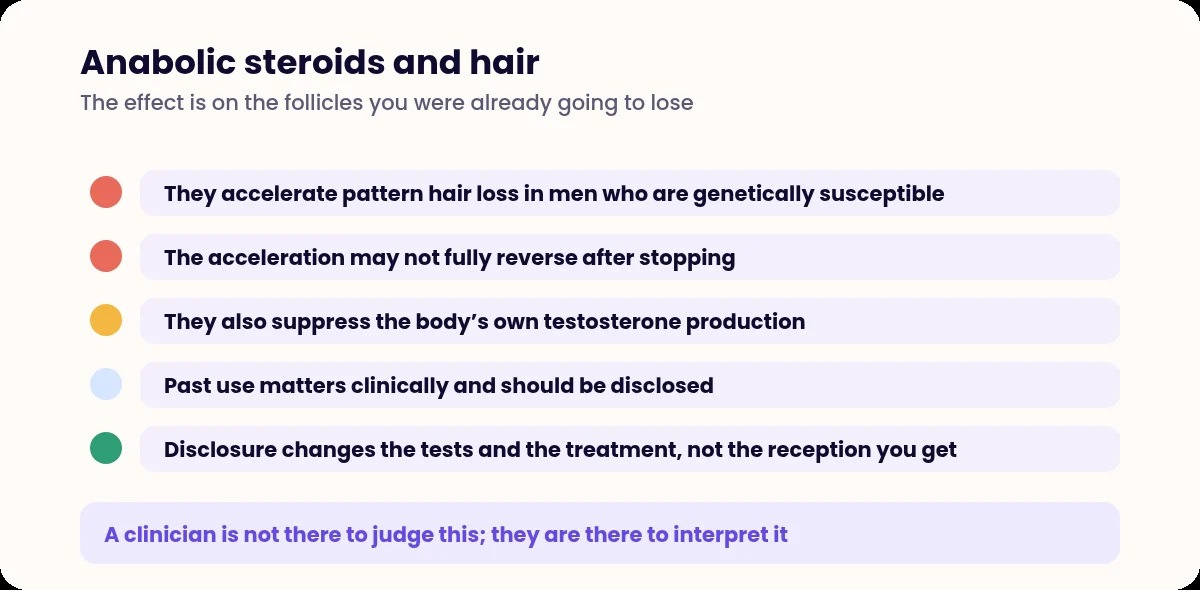
- Anabolic steroids accelerate androgenetic hair loss in men who are genetically susceptible to it, rather than creating a susceptibility that was not there.
- The acceleration may not fully reverse on stopping, because follicles that complete the miniaturisation process do not come back.
- Past use is clinically relevant and worth disclosing to any clinician assessing your hair, your heart, your mood or your fertility, however long ago it was.
- UK harm reduction services, including needle and syringe programmes, will see people using anabolic steroids without judgement and without involving the police.
This is a factual page rather than a lecture. Plenty of men in the UK use anabolic androgenic steroids, most of them know the risks in outline, and being told off is not information. What follows is what happens to hair specifically, what is reversible, and what is worth telling a clinician.
The mechanism, briefly
Male pattern hair loss is androgenetic. Follicles in the frontal hairline and the crown carry an inherited sensitivity to androgens — chiefly dihydrotestosterone, converted from testosterone in the scalp. In susceptible follicles, androgen exposure shortens each growth cycle and produces a progressively shorter, finer, less pigmented hair until it no longer contributes anything visible. That is miniaturisation, and it is covered in more detail in male pattern baldness.
Anabolic steroids raise androgen exposure well above the physiological range, often substantially and often in combination. In a man whose follicles are susceptible, that accelerates the process he was already going to go through.
The important corollary is that steroids do not create a susceptibility that was not there. A man with no inherited androgen sensitivity in his scalp follicles will not develop pattern baldness from a cycle. This is why the experience varies so wildly between users, why the internet contains equally confident accounts of “it destroyed my hairline in six months” and “I ran three cycles and nothing happened”, and why both are true.
What the acceleration looks like in practice
There is no reliable published figure for how much faster it happens, and anyone quoting one is guessing. Qualitatively, what clinicians describe is a process that would have unfolded across a decade or more arriving compressed into a year or two: a hairline that recedes visibly across a single cycle, a crown that opens up between one summer and the next, and shedding heavy enough to be noticeable in the shower for the duration.
Different compounds are discussed as more or less “hair-friendly” in user communities, usually on the basis of how readily they convert to DHT. There is some pharmacological logic to that. There is very little controlled human data behind the specific rankings people cite, and the conclusion that a particular compound is safe for hair is not supported by anything that would count as evidence.
The part that does not reverse
This is the sentence worth taking away. The effect may not fully reverse on stopping.
The reason is mechanical rather than mysterious. Hairs that were shedding but whose follicles had not yet completed miniaturisation can recover once androgen exposure falls. Follicles that finished the process — that were replaced by fibrous tissue — do not come back, because there is nothing left to restart. Any given scalp at the point of stopping contains a mixture of the two, in proportions nobody can determine from the outside.
So the realistic expectation on stopping is partial recovery of recently affected hair, with the more advanced loss retained permanently, and the further the loss progressed, the less there is to recover. This is also why the common plan of “I’ll deal with the hair after the cycle” tends not to work as intended: the ground lost during the cycle is not all recoverable afterwards.
Prescribed testosterone is a different exposure
Worth separating out, because the two get conflated. Prescribed testosterone replacement for diagnosed hypogonadism aims to restore physiological levels, which is not the same exposure as a supraphysiological cycle. It can still accelerate pattern hair loss in susceptible men, and it is a legitimate thing to raise before starting, alongside the reasons the treatment was proposed in the first place. Our guides to testosterone replacement in the UK and low testosterone symptoms cover that properly.
The wider harms, briefly
This page is about hair, and it would be dishonest to discuss only hair. In outline, and without overstating certainty [1, 2]:
- Cardiovascular: adverse effects on cholesterol, blood pressure and cardiac structure are consistently described, and are the effects UK clinicians worry about most.
- Endogenous hormone suppression: the body reduces its own testosterone production, which can be slow to recover and sometimes does not fully.
- Fertility: sperm production is commonly suppressed, often substantially, and recovery times vary.
- Liver: particularly with oral 17-alpha-alkylated compounds.
- Mood: irritability, aggression, low mood during and after use, and a withdrawal period that is frequently difficult.
- Gynaecomastia, acne and skin changes.
- Injecting risks, including blood-borne viruses and injection site infection, where equipment is shared or technique is poor.
Some of these are reversible and some are not, and the evidence base is weaker than it should be because the people affected are under-studied.
Getting help without a lecture
UK harm reduction services see people using anabolic steroids routinely. Needle and syringe programmes, run through pharmacies and local drug services, supply sterile equipment and safe disposal without judgement and without involving the police [1, 2]. Many areas run services specifically for people using image and performance enhancing drugs, with blood pressure checks, bloods and sexual health screening attached.
Talk to Frank is the national information service and is confidential [2]. Your GP is a reasonable person to talk to, and anabolic steroid use is not something clinicians are required to report.
Why disclosure matters clinically
Past use is relevant long after it stops, and this is the practical argument for mentioning it [1]:
- It changes how hormone results are interpreted, sometimes for years.
- It is relevant to cardiovascular risk assessment, particularly at a younger age than would otherwise prompt one.
- It matters for fertility investigation, where an unexplained low sperm count has an explanation nobody has asked about.
- It is relevant to mood assessment, both during use and in withdrawal.
- For hair specifically, it changes the expected trajectory and the conversation about what treatment can realistically achieve.
A clinician who does not know is working with incomplete information, and will occasionally reach a confidently wrong conclusion because of it. “I used anabolic steroids between these years” is one sentence, and it is worth saying.
If you are trying to keep the hair
The general approach is the same as for any pattern hair loss, with two differences worth stating.
The first is that the trajectory is faster, so the window in which treatment protects something is shorter. The second is that treatment is working against ongoing acceleration while use continues, which changes what can reasonably be expected of it.
Topical minoxidil is a pharmacy medicine licensed in the UK for pattern hair loss and is the available starting point without a prescription. Beyond that, anything involving a prescription is a decision for a prescriber after a full assessment — and that assessment is a good deal more useful if it includes an honest account of what you have used. Men in their twenties facing this are covered in hair loss in your 20s.
Frequently asked questions
Do anabolic steroids cause baldness?
They accelerate male pattern hair loss in men who are genetically susceptible to it. Androgenetic alopecia depends on how follicles in certain scalp areas respond to androgens, and raising androgen exposure substantially speeds up that response. A man with no genetic susceptibility will not develop pattern baldness from steroids, which is why some users see dramatic loss and others see none.
Will my hair grow back if I stop?
Partially, sometimes. Hairs that were shedding but not yet fully miniaturised may recover. Follicles that have completed miniaturisation and been replaced by fibrous tissue do not return. In practice most people who lose ground on a cycle keep some of that loss permanently, and nobody can predict in advance which category an individual falls into.
Does TRT cause hair loss too?
Prescribed testosterone replacement raises androgen levels and can accelerate pattern hair loss in susceptible men, though typically to physiological rather than supraphysiological levels, which is a different exposure from a cycle. It is a reasonable thing to raise before starting treatment and should be weighed alongside the reasons the treatment was proposed.
Should I tell my GP I used steroids?
Yes, and it is worth doing even if it was years ago. Past use is relevant to cardiovascular assessment, liver function, mood, fertility and hormone results, and a clinician who does not know may misinterpret findings. UK clinicians are not required to report steroid use to anyone, and consultations are confidential in the normal way.
References
- NHS. Anabolic steroid misuse. www.nhs.uk/conditions/anabolic-steroid-misuse/
- Talk to Frank. Anabolic steroids. www.talktofrank.com/drug/anabolic-steroids
- DermNet. Male pattern hair loss. dermnetnz.org/topics/male-pattern-hair-loss
- NHS. Hair loss. www.nhs.uk/conditions/hair-loss/
- NICE Clinical Knowledge Summaries. Alopecia, androgenetic. cks.nice.org.uk/topics/alopecia-androgenetic/
Medical reviewer
Naeem Teni
Clinical Lead at Manova. Registered pharmacist and independent prescriber, GPhC 2215591. Reviews Manova’s clinical content for accuracy and safety.
Written by
Manova Editorial Team
Researched and written to our editorial policy, using NICE, NHS, MHRA and peer-reviewed sources.
This article is for general information and isn’t a substitute for advice from your own clinician. If you feel unwell, contact your GP or NHS 111. In an emergency, call 999.