

Key takeaways
- Testosterone replacement is licensed in the UK for confirmed testosterone deficiency, not for ageing, tiredness or bodybuilding.
- It suppresses sperm production and is not appropriate for men who want to father children in the near future.
- Monitoring includes haematocrit, PSA in older men, and testosterone levels, on a defined schedule for as long as treatment continues.
- Gels can transfer to other people through skin contact, which is a specific licensed warning, not a theoretical risk.
This page is medicine information rather than an advert. Testosterone is a prescription only medicine and a controlled drug in the UK [1], and whether replacement is appropriate is a clinical decision made after confirmed testing, not something to be chosen from a menu.
It is written for men who have been told their testosterone is low, or who have started treatment and want to understand the monitoring they have been asked to attend.
What it is licensed for
Testosterone replacement is licensed for confirmed testosterone deficiency — hypogonadism — where symptoms are present and low levels have been demonstrated on repeated fasting morning blood tests [1, 2]. It is not licensed for age-related decline in the absence of confirmed deficiency, for tiredness, for improving body composition in men with normal levels, or for athletic performance.
Before starting, UK guidance expects a proper diagnostic work-up (covered in our guide to low testosterone symptoms and testing), a discussion of fertility plans, and baseline bloods [2].
The forms used in the UK
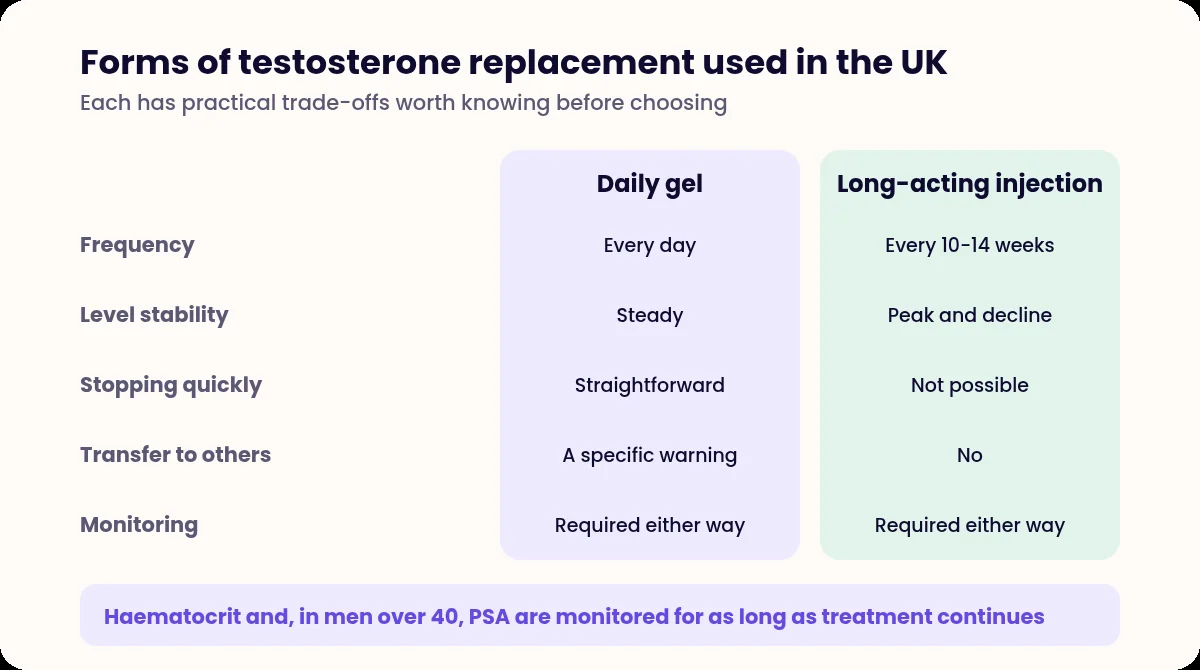
Transdermal gel, applied daily to the shoulders, upper arms or abdomen. Levels are steady and easy to stop quickly if there is a problem, which makes gels a common first choice [3]. The significant practical issue is transfer: the product information carries a specific warning about testosterone being passed to partners and children through skin contact, with reports of virilisation in children. Covering the application site with clothing once dry, and washing hands immediately, are part of using it properly [3].
Long-acting intramuscular injection (testosterone undecanoate), given roughly every ten to fourteen weeks after loading doses [4]. Convenient, but levels cannot be reversed quickly if a problem develops. The product information carries a warning about pulmonary oil microembolism — a rare reaction during or just after injection causing cough, breathlessness or chest tightness — which is why the injection is given slowly and you are observed afterwards [4].
Shorter-acting intramuscular injection (testosterone enantate), given every two to three weeks, produces more of a peak-and-trough pattern. Some men notice mood or energy fluctuating across the cycle.
Oral testosterone preparations and patches exist but are used less commonly in UK practice.
Monitoring
This is the part that is easy to underestimate. Replacement is not a prescription you collect and forget; it comes with a schedule [1, 2].
Haematocrit. Testosterone stimulates red cell production. If haematocrit rises above the threshold in guidance, the dose is reduced, the interval lengthened, or treatment paused — because thickened blood raises clotting risk. This is checked at baseline, during the first year, and at least annually thereafter [1, 2].
PSA and prostate assessment. Men over 40 have PSA checked before starting and during treatment [2]. Testosterone does not appear to cause prostate cancer, but it is not given to men with untreated prostate cancer, and a rising PSA needs investigating.
Testosterone levels, to check the dose is in range — timed according to the preparation (mid-interval for long-acting injections, and as the product information specifies for gels).
Blood pressure, lipids, HbA1c and symptoms, reviewed alongside.
What it does and doesn’t improve
Where deficiency is genuine, replacement commonly improves libido, spontaneous erections, mood and energy, and over months tends to increase lean mass and reduce fat mass, with bone density improving over longer periods [2, 5].
What it is less reliable for: erectile function on its own. Men with erectile dysfunction and normal testosterone should not expect replacement to fix it, and even in deficient men, erectile dysfunction often has a vascular component that testosterone does not address. Our guides to what causes erectile dysfunction and how ED treatments compare cover that ground.
It is also not a weight loss treatment, not a substitute for treating sleep apnoea, and not a performance enhancer in men with normal levels.
Risks and cautions
From the UK product information and guidance [1, 2, 3, 4]:
- Fertility. Replacement suppresses the pituitary signals that drive sperm production. Sperm counts fall, sometimes to zero. Recovery after stopping usually takes months and is not guaranteed. Men who may want children are managed with different approaches.
- Polycythaemia — the haematocrit rise described above.
- Prostate. Contraindicated in known or suspected prostate cancer and male breast cancer.
- Fluid retention, which matters in heart failure, and worsening of obstructive sleep apnoea.
- Acne, oily skin, breast tenderness, and mood changes including irritability.
- Gel transfer to partners and children [3].
- Cardiovascular risk has been debated for years. The large randomised TRAVERSE trial, in men with hypogonadism and cardiovascular risk factors, did not show an increase in major adverse cardiac events compared with placebo, though it did report more atrial fibrillation, acute kidney injury and pulmonary embolism. Discuss your own risk profile with your prescriber.
Stopping
Because replacement suppresses the body’s own production, stopping abruptly after long-term use can leave levels lower than before, with symptoms returning more strongly for a period. Stopping should be planned with your prescriber, not done unilaterally.
Buying safely
Testosterone bought without a prescription — from gyms, social media or overseas websites — is both illegal to supply in the UK and unverifiable. Counterfeit vials, wrong strengths and non-sterile products all circulate. Prescribed treatment comes with the monitoring that makes it safe; the product on its own does not.
Frequently asked questions
Is TRT available on the NHS?
Yes, where testosterone deficiency has been confirmed on repeated morning blood tests and assessed by an appropriate clinician. It is not prescribed on the basis of symptoms alone or for age-related decline without confirmed deficiency.
Does testosterone replacement affect fertility?
It suppresses the body's own production of testosterone and of sperm, and can cause infertility that may take months to reverse after stopping and occasionally does not fully reverse. Men who want children are usually managed differently.
What monitoring is needed?
UK guidance includes baseline bloods before starting, then checks at intervals during the first year and at least annually after that. Haematocrit is monitored because testosterone can thicken the blood, and PSA is monitored in men over 40.
Can I buy testosterone online without a prescription?
Testosterone is a prescription only medicine and a controlled drug in the UK. Products sold without a prescription are illegal, and their contents and sterility cannot be relied on.
References
- British National Formulary. Testosterone. bnf.nice.org.uk/drugs/testosterone/
- British Society for Sexual Medicine. Guidelines on adult testosterone deficiency. www.bssm.org.uk/guidelines/
- Summary of Product Characteristics: Testogel 16.2 mg/g gel. Electronic Medicines Compendium. www.medicines.org.uk/emc/search?q=testogel
- Summary of Product Characteristics: Nebido 1000 mg/4 ml solution for injection. Electronic Medicines Compendium. www.medicines.org.uk/emc/search?q=nebido
- European Association of Urology. Guidelines on Sexual and Reproductive Health. uroweb.org/guidelines/sexual-and-reproductive-health
- The Human Medicines Regulations 2012, regulation 284. www.legislation.gov.uk/uksi/2012/1916/regulation/284
Medical reviewer
Naeem Teni
Clinical Lead at Manova. Registered pharmacist and independent prescriber, GPhC 2215591. Reviews Manova’s clinical content for accuracy and safety.
Written by
Manova Editorial Team
Researched and written to our editorial policy, using NICE, NHS, MHRA and peer-reviewed sources.
This article is for general information and isn’t a substitute for advice from your own clinician. If you feel unwell, contact your GP or NHS 111. In an emergency, call 999.