

Key takeaways
- Fat mass rises and lean mass falls most sharply in the year or so either side of the final period.
- Fat redistributes towards the abdomen, so waist measurement can rise even when weight does not.
- HRT is not associated with weight gain in trial data, and may modestly reduce abdominal fat accumulation.
- Resistance training, protein and sleep address the specific changes of this period better than calorie cutting alone.
A very common description, and an accurate one: nothing about how I eat or move has changed, but my body has.
There is a real mechanism behind this, and separating the parts of it that are hormonal from the parts that are simply age makes it much easier to act on.
What the data shows
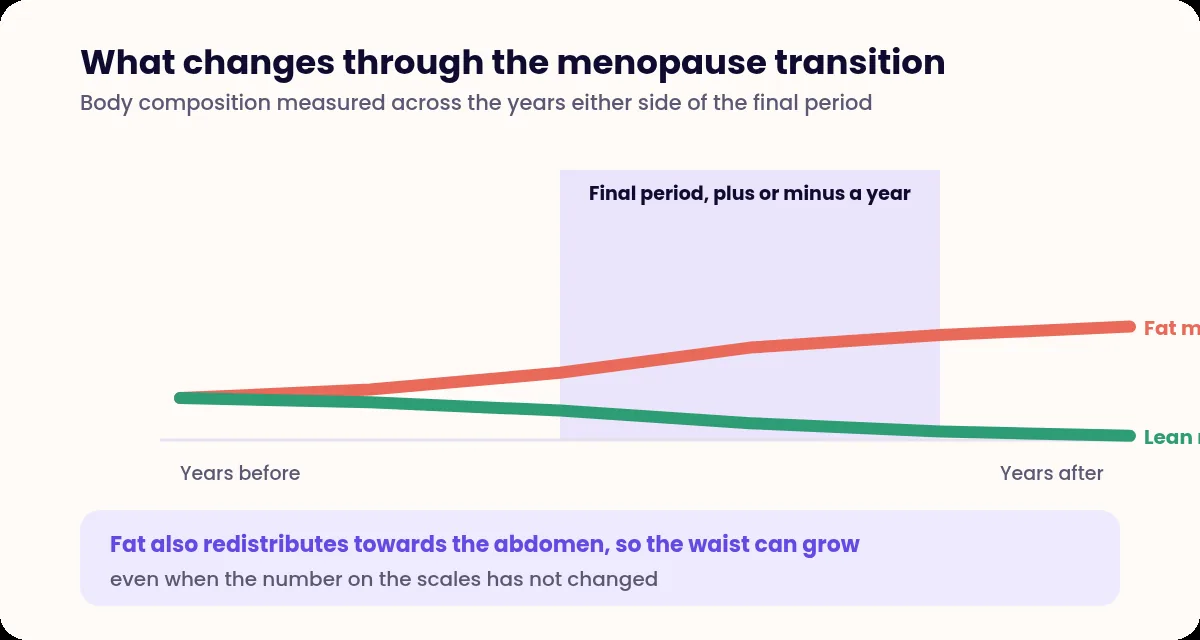
The SWAN study followed women through the menopause transition with repeated body composition measurements. The pattern it found was specific: fat mass rises and lean mass falls most sharply in the roughly two-year window either side of the final menstrual period, then the rate of change slows again afterwards [1].
Alongside that, fat redistributes. Before menopause, fat is preferentially stored around the hips and thighs. As oestrogen falls, storage shifts towards the abdomen, including visceral fat around the organs.
This is why so many women describe a change in shape rather than a change on the scales. It is also why the scales alone are a poor instrument here.
Hormones versus age
It is worth being precise, because the two get conflated.
Attributable mainly to the hormonal transition: the redistribution of fat towards the abdomen, and an acceleration of lean mass loss around the final period.
Attributable mainly to ageing and circumstance: most of the total weight gain. Muscle loss from disuse, less incidental movement, broken sleep, and the general midlife pattern covered in why weight creeps up in your 40s and 50s [3].
That distinction matters because the second list is far more modifiable than the first.
Why abdominal fat specifically matters
Visceral fat is more metabolically active than fat stored under the skin. Its accumulation is associated with higher blood pressure, less favourable cholesterol, and increased risk of type 2 diabetes and cardiovascular disease. This is the reason the change in distribution is clinically relevant and not only a cosmetic one.
Practically: measure your waist. Halfway between the lowest rib and the top of the hip bone, after breathing out normally. For women, 80 cm or above indicates increased risk and 88 cm or above indicates high risk.
Does HRT cause weight gain?
This is one of the most common reasons women decline it, and the trial evidence does not support it. Randomised data do not show hormone replacement therapy causing weight gain, and some studies suggest it modestly reduces the accumulation of abdominal fat during this period [3].
Some women do experience bloating or fluid retention in the first weeks of starting, which is real but is not fat gain and usually settles. Whether HRT is right for you depends on your symptoms, your history and your preferences — NICE guidance NG23 covers the assessment [2], and it is a conversation with a clinician rather than a weight-management decision.
What actually helps
Resistance training, twice a week. This is the highest-value change available, because it acts directly on the lean mass loss that is accelerating in this window. See strength training over 40.
Protein at every meal. Around 25–30 g per meal, totalling roughly 1.2–1.6 g per kg of body weight per day.
Deal with sleep. Night sweats and broken sleep are not a minor inconvenience here — short sleep reliably raises appetite and makes food choices worse. If vasomotor symptoms are wrecking your nights, that is itself worth treating.
Check the alcohol. It disrupts sleep, worsens hot flushes for many women, and adds calories that do not fill you.
Track the waist, not only the weight. Otherwise you will miss both the problem and the progress.
Do not respond by eating much less. Aggressive calorie restriction with no resistance training accelerates exactly the lean mass loss that is already happening. It is the intuitive response and close to the wrong one.
When to speak to a clinician
Speak to your GP if you:
- have menopausal symptoms affecting your sleep, mood or daily life
- have bleeding after 12 months without a period, which always needs assessment
- have a waist measurement of 80 cm or more, particularly with other risk factors
- have new or worsening blood pressure, cholesterol or blood glucose readings
- want to discuss HRT and whether it is suitable for you
Perimenopausal symptoms and weight change are commonly dismissed. They are worth raising specifically.
Frequently asked questions
Does menopause cause weight gain?
Menopause itself is more strongly associated with a change in where fat is stored than with a large increase in total weight. Weight gain through this period is driven mainly by ageing, falling muscle mass and reduced activity, with the hormonal transition shifting fat towards the abdomen.
Does HRT make you put on weight?
Randomised trial evidence does not show that hormone replacement therapy causes weight gain. Some data suggest it slightly reduces the accumulation of abdominal fat. Some women experience fluid retention or bloating when starting, which usually settles.
Why has my waist got bigger when my weight hasn't changed?
Falling oestrogen shifts fat storage from hips and thighs towards the abdomen, and lean mass tends to fall at the same time. The net result can be a larger waist at an unchanged weight. Measuring your waist as well as weighing is worthwhile through this period.
Is it harder to lose weight after menopause?
Many women find it slower, largely because of reduced muscle mass, poorer sleep and lower activity rather than a dramatic metabolic change. The same approaches work, but resistance training and protein matter more than they did previously.
References
- Greendale GA, Sternfeld B, Huang M, et al. Changes in body composition and weight during the menopause transition. JCI Insight. 2019;4(5):e124865. doi.org/10.1172/jci.insight.124865
- NICE. Menopause: diagnosis and management. NG23. www.nice.org.uk/guidance/ng23
- Davis SR, Castelo-Branco C, Chedraui P, et al. Understanding weight gain at menopause. Climacteric. 2012;15(5):419-429. doi.org/10.3109/13697137.2012.707385
- NHS. Menopause. www.nhs.uk/conditions/menopause/
Medical reviewer
Naeem Teni
Clinical Lead at Manova. Registered pharmacist and independent prescriber, GPhC 2215591. Reviews Manova’s clinical content for accuracy and safety.
Written by
Manova Editorial Team
Researched and written to our editorial policy, using NICE, NHS, MHRA and peer-reviewed sources.
This article is for general information and isn’t a substitute for advice from your own clinician. If you feel unwell, contact your GP or NHS 111. In an emergency, call 999.