
Key takeaways
- Adults lose roughly 3–8% of muscle mass per decade from around 30, and the rate accelerates after 60.
- Resistance training two or more times a week is the single most effective way to slow that loss.
- Muscle is where most of your dietary glucose is stored, so keeping it helps blood sugar as well as strength.
- Two 30-minute sessions a week covering the major muscle groups is enough to see real change in 8–12 weeks.
Most people in their forties notice the same thing. The same clothes fit differently even though the scales have barely moved. Stairs feel a bit longer. A heavy suitcase feels heavier than it used to.
What has usually changed is not fat alone. It is the ratio of muscle to fat.
What actually happens to muscle with age
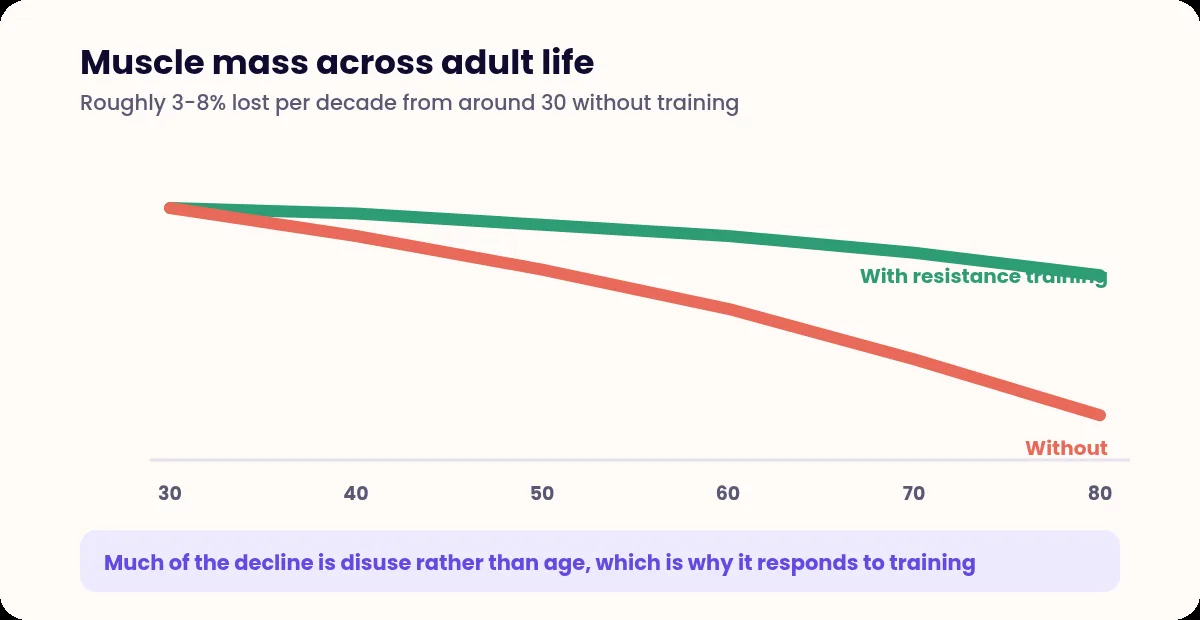
From around the age of 30, adults lose somewhere in the region of 3 to 8% of muscle mass per decade, with the rate picking up after 60 [2]. This is not a fixed biological sentence. A large part of it is disuse: as jobs, commutes and hobbies get more sedentary, the body quietly sheds tissue it is no longer being asked to use.
That matters for three reasons.
Strength and independence. Muscle is what gets you off the floor, up the stairs and out of a chair without thinking about it.
Blood sugar. Skeletal muscle is the largest site of glucose disposal in the body. When there is less of it, and when it is less active, blood glucose stays higher for longer after meals [4].
Body shape. Two people at the same weight can look very different depending on how much of that weight is muscle.
Does strength training help you lose weight?
Not in the way people expect. A weights session burns fewer calories than a run of the same length. What resistance training does is change what you lose.
When people lose weight without training, a meaningful share of that loss comes from lean tissue. Adding resistance training and enough protein shifts the balance towards fat. This matters even more for anyone losing weight quickly, including on weight-loss medication — we cover that in losing weight without losing muscle.
How to start
The UK guidelines ask for muscle-strengthening activity on at least two days a week, working all the major muscle groups [1]. That is the target. Here is a way to get there.
Pick one movement from each pattern
- Push — press-ups (against a wall or worktop if needed), dumbbell chest press, overhead press
- Pull — resistance-band row, dumbbell row, assisted pull-up
- Squat — bodyweight squat, goblet squat, sit-to-stand from a chair
- Hinge — Romanian deadlift, hip thrust, glute bridge
- Carry or core — suitcase carry, plank, dead bug
Two or three sets of 8 to 12 repetitions of each. That is a 30-minute session.
Make it harder over time
This is the part most people skip. The stimulus is not the exercise, it is the increase. Each week, add a repetition, a small amount of weight, or a slower lowering phase. If the last two repetitions of a set feel easy, the set was too light.
Leave a day between sessions
Muscle adapts during recovery, not during the session. Monday and Thursday works well.
What about protein?
Resistance training without enough protein is half a plan. Most adults trying to preserve muscle while losing weight do better at roughly 1.2 to 1.6 g of protein per kilogram of body weight per day, spread across meals rather than loaded into dinner.
If you are over 60
Start, and start now. The landmark work here trained nursing-home residents with an average age of 87 and still produced large gains in strength and walking speed [3]. Age changes the pace of progress, not the direction.
When to speak to a clinician
Get advice before starting if you:
- have chest pain, or breathlessness that is new or worsening
- have had a recent operation, joint replacement or hernia repair
- have uncontrolled high blood pressure
- have osteoporosis or a history of fragility fracture
- feel dizzy or faint on exertion
Otherwise, start light, learn the movements, and let the weight follow.
Frequently asked questions
Is it too late to build muscle at 50 or 60?
No. Trials in adults in their 60s, 70s and even 80s show meaningful gains in strength and muscle size from supervised resistance training. Progress may be slower than at 25, but the response is still there.
How many times a week should I lift weights?
The UK Chief Medical Officers recommend muscle-strengthening activity on at least two days a week. Two full-body sessions is a sensible target for most people starting out, rising to three if you enjoy it and recover well.
Do I need a gym?
No. Resistance bands, adjustable dumbbells and bodyweight movements such as squats, press-ups against a worktop and step-ups all provide resistance. What matters is that the effort increases over time.
Will lifting weights make me bulky?
Very unlikely. Building large amounts of muscle takes years of deliberate training and a calorie surplus. Most people training twice a week in a calorie deficit get firmer and stronger rather than bigger.
References
- UK Chief Medical Officers. Physical activity guidelines. Updated 10 July 2026. www.gov.uk/government/publications/physical-activity-guidelines-uk-chi
- Volpi E, Nazemi R, Fujita S. Muscle tissue changes with aging. Current Opinion in Clinical Nutrition and Metabolic Care. 2004;7(4):405-410. doi.org/10.1097/01.mco.0000134362.76653.b2
- Fiatarone MA, O'Neill EF, Ryan ND, et al. Exercise training and nutritional supplementation for physical frailty in very elderly people. New England Journal of Medicine. 1994;330(25):1769-1775. doi.org/10.1056/NEJM199406233302501
- DeFronzo RA, Tripathy D. Skeletal muscle insulin resistance is the primary defect in type 2 diabetes. Diabetes Care. 2009;32(Suppl 2):S157-S163. doi.org/10.2337/dc09-S302
- NHS. Strength and flexibility exercises. www.nhs.uk/live-well/exercise/strength-and-flex-exercise-plan/
Medical reviewer
Naeem Teni
Clinical Lead at Manova. Registered pharmacist and independent prescriber, GPhC 2215591. Reviews Manova’s clinical content for accuracy and safety.
Written by
Manova Editorial Team
Researched and written to our editorial policy, using NICE, NHS, MHRA and peer-reviewed sources.
This article is for general information and isn’t a substitute for advice from your own clinician. If you feel unwell, contact your GP or NHS 111. In an emergency, call 999.