

Key takeaways
- An erection lasting more than three to four hours is a medical emergency — call 999 or go to A&E, and go within one hour if you have sickle cell disease.
- Sudden severe testicular pain needs emergency assessment, because a twisted testicle is usually salvageable only within about six hours.
- New erectile dysfunction in a man with cardiovascular risk factors is a same-week appointment, not a prescription request — it precedes cardiac events by three to five years.
- Sexual health clinics in the UK are free, confidential and take self-referrals without going through your GP, which most men do not realise.
Most sexual problems are not urgent. They are gradual, embarrassing, and made worse by the several months people spend deciding whether to mention them.
A small number are the opposite: time-critical, with outcomes that depend on hours rather than weeks. This page exists to tell those apart, and to say which UK service to use for each.
Go to A&E or call 999 now
An erection lasting more than three to four hours. This is priapism. It is usually painful, is not related to arousal, and does not resolve on its own. NHS advice is to call 999 or go to A&E, and not to drive yourself [1]. The risk of permanent erectile dysfunction rises steeply after 24 to 48 hours; with delayed treatment, permanent inability to get an erection occurs in roughly 1 in 10 to 1 in 50 men [5]. If you have sickle cell disease, the threshold is one hour, not four.
Sudden severe testicular pain, with or without swelling and nausea. The concern is testicular torsion, a twisted testicle that loses its blood supply. It is usually salvageable within about six hours. Waiting to see if it settles is how testicles are lost.
A crack or pop during sex, followed by immediate loss of the erection, pain, swelling and bending. This is a penile fracture. It needs same-day urology assessment, and surgical repair within 24 hours gives the best chance of preserving erectile function.
A retracted foreskin that cannot be pulled forward again, with swelling behind the glans. This is paraphimosis and it is an emergency — the swelling worsens with time.
Chest pain, breathlessness or collapse during or after sex. Treat it exactly as you would at any other moment.
See someone this week
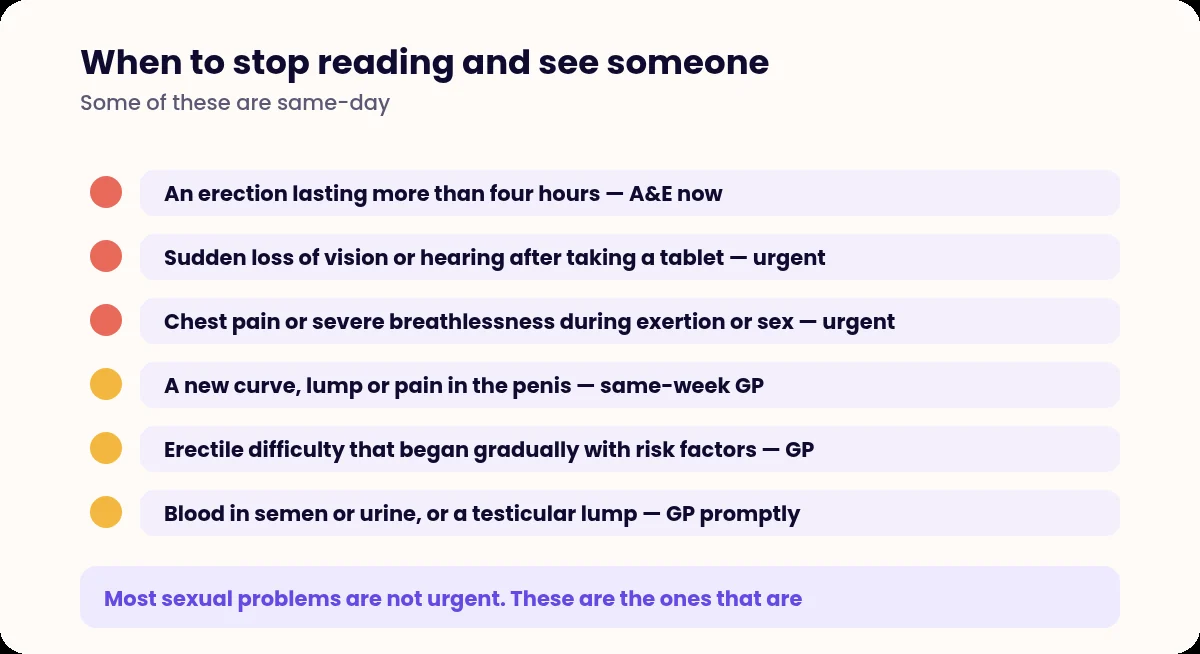
These do not need A&E, but they should not wait for a routine appointment in several weeks.
New or sudden-onset erectile dysfunction, especially with cardiovascular risk factors. This is the single most under-appreciated item on the list. Erectile dysfunction typically precedes a cardiac event by three to five years and carries a risk comparable to moderate current smoking [3]. What is needed is blood pressure, lipids, HbA1c or glucose and a cardiovascular risk assessment — not simply a prescription. Our guide to erectile dysfunction and heart disease explains the mechanism.
A lump in the testicle, a testicular swelling, or a testis that feels hard or irregular. This normally prompts an urgent suspected cancer referral, seen within two weeks [2].
New erectile dysfunction after starting a medicine, or any erectile dysfunction accompanied by chest pain on exertion.
Blood in the semen in a man over 40, or persistent or recurrent at any age.
Visible blood in the urine. Urgent suspected cancer referral, regardless of whether it is painful.
A new penile lesion, ulcer, non-healing sore, or a change in the appearance of the glans or foreskin. This is either an infection or, less commonly, penile cancer. Both are reasons to be seen quickly.
Rapidly progressive penile curvature, or a painful lump in the shaft. This is the acute phase of Peyronie’s disease, and earlier referral gives more treatment options — see our guide to Peyronie’s disease.
Worsening urinary symptoms with difficulty passing urine, or being unable to pass urine at all. Acute retention is an emergency; rapidly worsening symptoms short of that need urgent assessment.
A foreskin that has newly become non-retractile, with bleeding or scarring.
New erectile dysfunction with neurological symptoms — numbness in the saddle area, new bowel or bladder change, leg weakness. Consider cauda equina syndrome, which is an emergency, or new neurological disease.
New erectile dysfunction with low libido, breast enlargement, headache or loss of peripheral vision. This combination raises the question of a prolactin-secreting pituitary tumour.
Any sexual problem alongside low mood, hopelessness or thoughts of self-harm. The mental health takes priority — urgent GP appointment, or the crisis team.
Any possible sexual assault. Sexual Assault Referral Centres operate 24 hours a day, accept self-referral, and do not require police involvement [7].
Which UK service does what
| Route | How to access | What it is for |
|---|---|---|
| GP | Registered patients, NHS | Erectile dysfunction, low libido, urinary symptoms, fertility, medication review; the gateway to NHS prescribing and all referrals |
| Sexual health / GUM clinic | Self-referral, free, confidential, no GP needed [4] | STI and HIV testing, PrEP, genital lumps, ulcers or discharge, chemsex support; some offer psychosexual services |
| Urology / andrology | GP referral | Second- and third-line erectile dysfunction, Peyronie’s, priapism, testicular and penile lumps, complex urinary symptoms, male fertility |
| Fertility unit | GP referral, funding criteria vary by ICB | Male factor infertility, azoospermia, surgical sperm retrieval |
| Psychosexual therapy | GP referral, or self-refer privately | Performance anxiety, situational erectile dysfunction, desire mismatch, distressing pornography use, size anxiety |
| NHS Talking Therapies | Self-referral in England | Anxiety or depression driving or maintaining a sexual problem |
| A&E / 999 | Direct | Everything in the first section above |
Two points that catch people out. First, sexual health clinics do not need a GP referral and do not report back to your GP unless you ask them to — a lot of men delay for months without knowing this. Second, UK psychosexual therapy is only patchily NHS-commissioned, so most access is private; it is better to know that at the start than after a long wait.
What the appointment is actually like
The commonest reason men delay is an imagined examination. In practice, a first GP appointment for a sexual problem is mostly a conversation: when it started, whether it is constant or situational, whether morning erections are still happening, what medicines you take, how much you drink, how you sleep, and how your mood is. Examination is not always needed, and where it is, it is brief and you can ask for a chaperone.
Bring the awkward details rather than editing them out. Recreational drug use, anabolic steroids, medicines bought online and relationship difficulties all change the assessment, and none of them will produce a reaction you should be worried about.
What does not need urgent attention
For balance, because anxiety is itself a cause of sexual problems: a single occasion of erectile failure after alcohol, exhaustion or a stressful week is not a red flag. Nor is a gradual change in firmness or recovery time over years, or a difference in desire between you and your partner. Those are worth understanding — what causes erectile dysfunction is the place to start — but they are not emergencies.
The dividing line is pattern and change: something new, something sudden, something painful, or something that has persisted for weeks and is distressing you.
Frequently asked questions
Is an erection that will not go down really an emergency?
Yes. Priapism — an erection lasting more than three to four hours, usually painful and not related to arousal — is time-critical. NHS advice is to call 999 or go to A&E, and not to drive yourself. The risk of permanent erectile dysfunction rises steeply after 24 to 48 hours, and delayed treatment leaves roughly 1 in 10 to 1 in 50 men permanently unable to get an erection.
Do I have to see my GP for a sexual health problem?
Not always. Sexual health and GUM clinics in the UK take self-referrals, are free and confidential, and do not need to involve your GP. They are the right route for anything infection-related: lumps, ulcers, discharge, STI or HIV testing, PrEP. For erectile dysfunction, low libido, fertility or medication review, the GP is the better starting point and the gateway to referral.
How quickly should I be seen for a testicular lump?
Promptly. A lump in the testicle, a testicular swelling or a hard or irregular testis should prompt a GP appointment within days, and would normally lead to an urgent suspected cancer referral seen within two weeks. Testicular cancer is highly treatable, and the outcome depends heavily on not waiting.
Can I get psychosexual therapy on the NHS?
Sometimes, but availability is patchy — NHS psychosexual services are only partially commissioned across the UK, so most access is private. Your GP can tell you what exists locally. COSRT-accredited therapists can be found directly, and NHS Talking Therapies accepts self-referral in England where anxiety or low mood is central.
References
- NHS. Priapism (painful erections). www.nhs.uk/symptoms/priapism-painful-erections/
- NHS. Testicular lumps and swellings. www.nhs.uk/conditions/testicular-lumps-and-swellings/
- British Society for Sexual Medicine. Guidelines on the management of erectile dysfunction in men. www.bssm.org.uk/guidelines/
- NHS. Find a sexual health clinic. www.nhs.uk/service-search/sexual-health/find-a-sexual-health-clinic
- British Association of Urological Surgeons. Patient information. www.baus.org.uk/patients/
- College of Sexual and Relationship Therapists. Find a therapist. www.cosrt.org.uk/
- NHS. Help after rape and sexual assault — Sexual Assault Referral Centres. www.nhs.uk/service-search/other-services/Rape-and-sexual-assault-refer
Medical reviewer
Naeem Teni
Clinical Lead at Manova. Registered pharmacist and independent prescriber, GPhC 2215591. Reviews Manova’s clinical content for accuracy and safety.
Written by
Manova Editorial Team
Researched and written to our editorial policy, using NICE, NHS, MHRA and peer-reviewed sources.
This article is for general information and isn’t a substitute for advice from your own clinician. If you feel unwell, contact your GP or NHS 111. In an emergency, call 999.