

Key takeaways
- Peyronie's disease has an acute phase lasting roughly six to eighteen months, during which pain is present and the curvature is still changing, followed by a stable phase.
- Early referral to urology matters, even during the acute phase when surgery is not yet appropriate.
- Collagenase injection, which US guidance recommends for stable disease, was withdrawn from the European market in 2019-2020 for commercial reasons, so UK men largely cannot access it.
- Vitamin E is not endorsed by UK or European guidance; penile traction therapy currently has the most encouraging evidence among non-surgical options.
Peyronie’s disease is fibrosis of the tunica albuginea, the tough sheath around the erectile bodies. A patch of that sheath scars, stops stretching with the rest, and the penis bends towards the scar on erection. Men usually notice one of three things first: a bend that was not there before, a firm lump they can feel through the skin, or pain when erect.
Estimates of how common it is range from roughly 0.5% to 9% of adult men, and the spread tells you something — it is under-diagnosed, because men wait. The single most useful thing in this article is that waiting is counterproductive.
The two phases, and why they matter
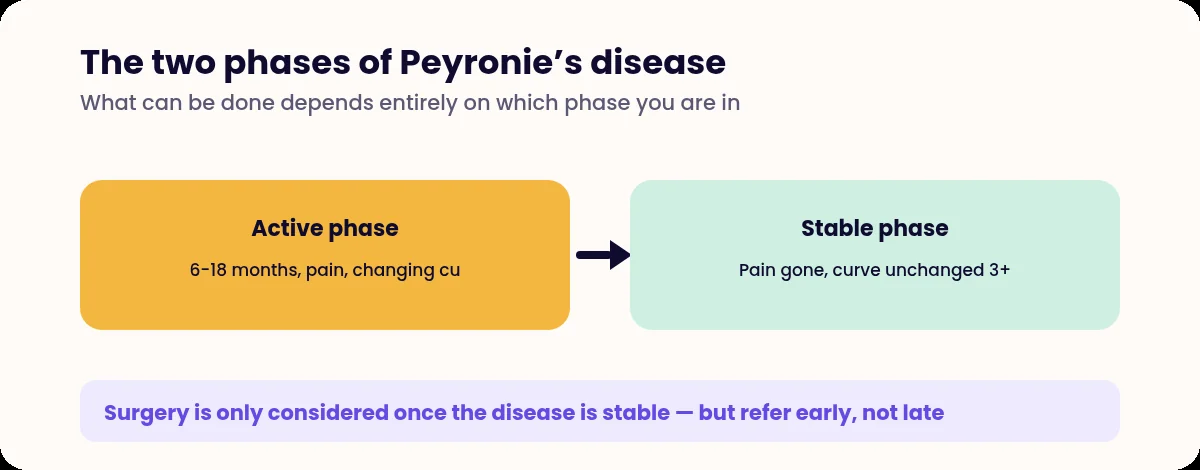
Peyronie’s disease runs in two recognised phases, and almost every treatment decision hangs on which one you are in.
The acute or active phase typically lasts six to eighteen months. Pain is present, often only on erection. The curvature is still evolving, sometimes month to month. This is the phase in which men most often present, and it is the phase in which surgery is explicitly not appropriate, because operating on a deformity that is still changing invites recurrence [2].
The stable phase is defined by pain having resolved and the curvature having been unchanged for at least three months. Some guidance requires six months of stability, and a total disease duration of twelve months, before surgical correction [2, 4].
A word of caution about the pain settling. Men frequently read the disappearance of pain as the condition getting better. It usually is not. Pain resolution is the transition into the stable phase, which means the deformity you have is likely the deformity you will keep.
What it actually looks like
Beyond a simple bend, the deformity can take several forms:
- Curvature in any direction, most often dorsal (upwards)
- Hourglass narrowing or a waist at the plaque
- Indentation on one side
- Shortening, which many men find more distressing than the bend itself
- Instability or hinging at the plaque during penetration
Erectile dysfunction affects a substantial minority. It can be mechanical, it can be from associated vascular disease, and it can be psychological — losing confidence in what your penis is going to do is itself a reliable route into difficulty, as our guide to what causes erectile dysfunction sets out.
Associations worth mentioning to a clinician include Dupuytren’s contracture of the hand, diabetes, previous penile trauma (sometimes a bend or buckle during sex that seemed minor at the time), and previous prostate surgery — which is also covered in our guide to erections after prostate surgery.
Treatment in the acute phase
There is no UK treatment that reliably reverses established plaque. What the acute phase offers is symptom control and, possibly, some influence on how the curvature settles.
Analgesia for the pain, which does settle with time regardless.
Oral agents including potassium para-aminobenzoate, pentoxifylline and vitamin E have all been used. The evidence for each is weak or negative. Vitamin E in particular has a long history and essentially no supportive controlled data, and neither NICE nor the European guidance endorses it [2]. If a clinician offers it, it should be with that caveat attached.
Penile traction therapy has the most encouraging recent evidence of the non-surgical options, with some trials reporting improvements in curvature and length. Trial quality is modest, treatment requires substantial daily commitment over months, and the devices are not routinely funded on the NHS. It is nonetheless the option most likely to be raised by a UK andrologist in the acute phase.
Shockwave therapy may help with pain. It does not reliably correct curvature and should not be sold to you as if it does.
The collagenase problem, which is specific to the UK
Here is the thing that genuinely separates UK from US practice, and which no amount of reading American websites will tell you.
Collagenase clostridium histolyticum, marketed as Xiapex in Europe, is injected directly into the plaque to break down collagen. American Urological Association guidance recommends it as a mainstream option for stable-phase disease with curvature in the treatable range [4]. It is the single best-evidenced non-surgical intervention in the field.
The marketing authorisation holder withdrew it from the European market in 2019-2020. The withdrawal was for commercial reasons, not safety reasons — the European Medicines Agency documentation is explicit that it was not related to any concern about the product’s safety or efficacy [3].
The practical consequence is that a UK man reading US guidance will find a recommended treatment he cannot obtain through normal licensed supply, and is not routinely available on the NHS. NICE has never published a technology appraisal on Peyronie’s disease, so there is no UK cost-effectiveness verdict either way. This is a supply gap, not a clinical judgement, and it is worth knowing before you spend money chasing it privately or abroad.
Surgery, in the stable phase only
Where the deformity interferes with intercourse and the disease has been stable, surgery is the most reliable option in the UK.
Tunical shortening procedures — the Nesbit procedure and various plication techniques — shorten the longer side to match the scarred side. They suit curvature under about 60 degrees in men with good erections and adequate length. They cost some length, which is the trade-off to understand before consenting.
Grafting procedures open the plaque and patch the defect. They are used for severe curvature, hourglass deformity or where length loss is already significant. They preserve more length but carry a higher risk of postoperative erectile dysfunction.
Penile prosthesis is the option where refractory erectile dysfunction coexists with the deformity, correcting both at once.
When to be seen
Refer early. Any new penile curvature, any palpable plaque, painful erections or a change in penile shape warrants a urology or andrology referral — during the acute phase, not after it [2, 5]. The reasons are practical: the diagnosis gets confirmed rather than assumed, non-surgical options are only meaningful while the disease is active, the curvature gets objectively documented so that later change is measurable, and associated erectile dysfunction gets assessed rather than ignored.
Ask your GP for a urology referral. If the deformity appeared suddenly after an injury during sex, with bruising, swelling and a popping sensation, that is a possible penile fracture and needs same-day emergency assessment at A&E, not a routine referral.
The other thing worth doing early is talking about it. Peyronie’s disease changes sex, and partners left to guess tend to reach for the wrong explanation — our guide to talking to your partner about erection problems applies almost word for word here.
Frequently asked questions
Will the curvature go away on its own?
A minority of men see some spontaneous improvement, but most do not. The more typical course is that curvature progresses during the acute phase, then settles and remains. Pain, by contrast, usually does resolve as the disease stabilises, which is why pain settling is not the same as the condition improving.
Should I take vitamin E?
Neither NICE nor European urological guidance endorses vitamin E for Peyronie's disease. It was widely used historically on the strength of early uncontrolled reports, and better-designed studies have not supported it. It is cheap and generally well tolerated, which is why it persists, but it should not delay a urology referral.
Is Peyronie's disease linked to cancer?
No. The plaque is scar tissue in the tunica albuginea, not a tumour. It is associated with Dupuytren's contracture of the hand, diabetes, penile trauma and prostate surgery. Any new penile lump should still be examined by a clinician so the diagnosis is actually confirmed rather than assumed.
How long before surgery can be considered?
Surgery is offered only in the stable phase. Most guidance asks for pain to have resolved and curvature to have been unchanged for at least three months, with some requiring six, and a total disease duration of at least twelve months. Operating on evolving disease risks the curvature recurring afterwards.
References
- NHS. Peyronie's disease. www.nhs.uk/conditions/peyronies-disease/
- European Association of Urology. Guidelines on Sexual and Reproductive Health. uroweb.org/guidelines/sexual-and-reproductive-health
- European Medicines Agency. Xiapex (collagenase clostridium histolyticum): withdrawal of the marketing authorisation in the European Union. www.ema.europa.eu/en/medicines/human/EPAR/xiapex
- American Urological Association. Peyronie's Disease: AUA Guideline. www.auanet.org/guidelines-and-quality/guidelines/peyronies-disease-gui
- British Association of Urological Surgeons. Patient information: conditions. www.baus.org.uk/patients/conditions/
- British Society for Sexual Medicine. Guidelines. www.bssm.org.uk/guidelines/
Medical reviewer
Naeem Teni
Clinical Lead at Manova. Registered pharmacist and independent prescriber, GPhC 2215591. Reviews Manova’s clinical content for accuracy and safety.
Written by
Manova Editorial Team
Researched and written to our editorial policy, using NICE, NHS, MHRA and peer-reviewed sources.
This article is for general information and isn’t a substitute for advice from your own clinician. If you feel unwell, contact your GP or NHS 111. In an emergency, call 999.