

Key takeaways
- Shaving is a legitimate option in its own right, not what is left when treatment fails — and it is the only approach that removes the daily monitoring entirely.
- Start with clippers without a guard for a few weeks before going to a razor; most people find the clippered look is what they actually wanted.
- A scalp that has been under hair for decades has had no sun exposure and burns quickly, so sun protection is not optional from the first week.
- Shaving does not affect the follicle, does not make hair grow back thicker, and does not change the underlying pattern of loss in either direction.
Shaving your head is a choice, not a concession. It is worth saying plainly at the start, because almost everything written about it frames it as the thing you do when the treatments have not worked, and that is not how the people who do it describe it afterwards.
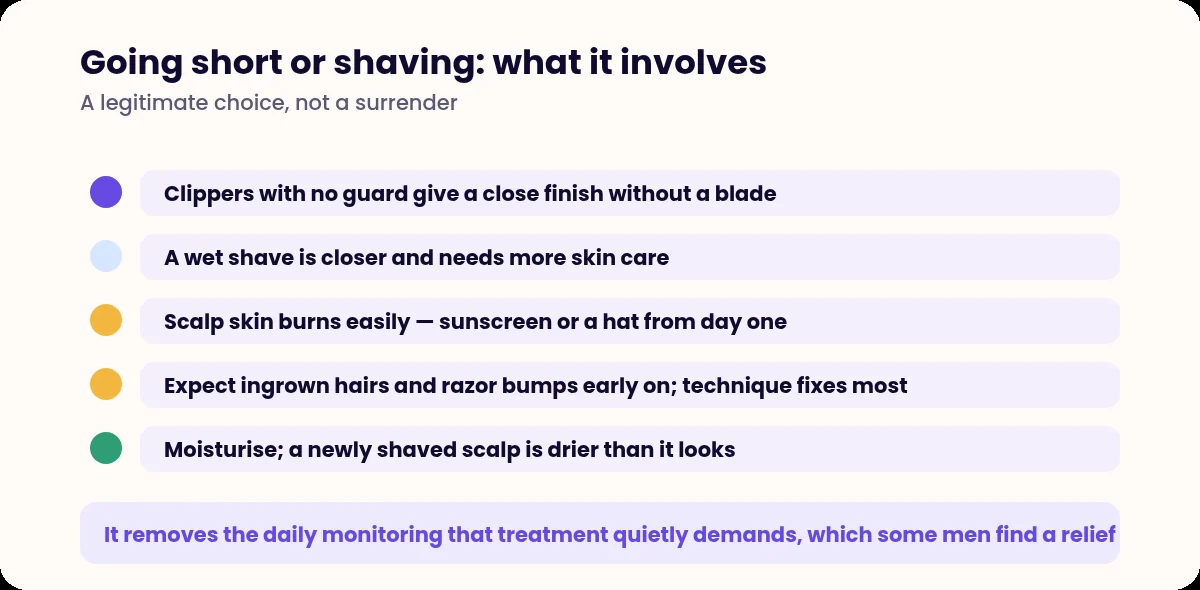
What it offers that no treatment offers is an end to the monitoring. There is no six-month assessment, no photographing the crown under the bathroom light, no wondering whether this week’s parting looks worse than last week’s. A lot of men describe that as the main benefit, well ahead of how it looks.
What it does not do is fix everything. It changes the look; it does not change how you feel about having lost your hair, and it is not a substitute for dealing with that if it is bothering you.
What shaving does and does not do to hair
Two persistent myths, both easily dismissed.
Shaving does not make hair grow back thicker. Cutting the shaft above the skin has no effect on the follicle below it. Regrowth feels coarser because a cut hair ends bluntly rather than tapering, and looks darker because uniform stubble against skin reads differently from long hair. The follicle, the rate of growth and the eventual thickness are unchanged.
Shaving does not accelerate or slow hair loss. The pattern continues underneath exactly as it would have. If you shave for two years and grow it back out, you will find the loss where it would have been anyway, which is occasionally a shock to people who half-believed the pause was doing something. Our page on hair loss myths covers the rest of that family of claims.
Start with clippers
The single most useful piece of practical advice: do not go straight to a razor.
Run clippers over with no guard. That leaves a very short, even stubble — visible enough to show the shape of your head and the outline of where hair still grows, short enough that pattern loss is no longer the thing anyone sees. It takes ten minutes, needs redoing roughly weekly, and carries essentially no risk of irritation.
Spend three or four weeks like that. Two things usually happen. You find out how you feel about it with nothing at stake, because it grows back in a fortnight if you hate it. And a good proportion of people discover that the clippered look is the one they actually wanted, and never go further.
If you do want to go shorter, working down through guard sizes over a few weeks is gentler on the adjustment than going from a full head of hair to bare scalp in one afternoon.
Razor technique
If you want a genuinely bare scalp, the details matter more than the equipment.
Prepare properly. Shave after a warm shower, or spend a couple of minutes with a hot flannel on the scalp. Soft, hydrated hair cuts with far less pull. Never dry shave a head.
Clipper first, every time. A razor is for stubble, not for length. Take it down with clippers before the blade comes out.
Use a proper lubricant. Shaving cream, gel or oil, not soap, not conditioner. The scalp has more contour than a face and the blade needs the glide.
Go with the grain first. Hair on the scalp grows in several directions and the whorl at the crown changes direction entirely. Learning the map takes a few attempts. Going against the grain gives the closest result and causes the most irritation, so if you get ingrowing hairs or bumps, that is the first thing to stop doing.
Short strokes, no pressure. Let the blade do it. Pressure is what produces nicks on the bony areas — around the ears, the occipital ridge at the back, the temples.
Change the blade often. A dull blade drags, and dragging is what produces irritation and cuts. This is the most common mistake and the easiest to fix.
Rinse cool and moisturise. A plain unscented moisturiser or an alcohol-free balm. Alcohol-heavy aftershaves on a freshly shaved scalp sting for a reason.
Expect to do it every one to two days for a consistently bare look. Plenty of people settle on shaving twice a week and accepting a little stubble in between.
Skin problems and how to avoid them
Razor burn — diffuse stinging redness after shaving — usually means too much pressure, a dull blade, insufficient lubrication, or going against the grain. It settles within a day and the fix is technique.
Ingrowing hairs and razor bumps occur when a cut hair re-enters the skin, and they are considerably more common in people with tightly curled hair, where the hair curves back naturally [4]. If this affects you, stop shaving against the grain, keep the hair slightly longer with clippers rather than a razor, and exfoliate gently rather than picking. Persistent, painful or spreading bumps are worth a clinician’s opinion.
Folliculitis — small tender pustules around the follicles — can follow shaving, particularly with shared equipment or a dirty blade [3]. Keep the razor clean and dry between uses. Widespread, painful or recurrent folliculitis needs assessing rather than managing with more products.
Dryness and flaking are common in the first few weeks as a scalp that has lived under hair adjusts to daylight, air and washing. A simple moisturiser usually settles it. A persistently flaky, itchy scalp is a different problem, covered in dandruff and seborrhoeic dermatitis.
Sun protection is not optional
This is the part people underestimate, and it is the one with lasting consequences.
Your scalp has been shaded by hair for decades. It has no accumulated tolerance, it sits at the highest point of the body facing directly upwards, and it is an area where sun damage and skin cancers are both common and easily missed under hair [5].
From the first week: high-factor broad-spectrum sunscreen on the whole scalp, applied generously and reapplied, or a hat [2]. British weather is not protective — a bright overcast day in May will burn a new scalp comfortably. Be particularly deliberate about the crown, which is at the worst angle and which you cannot see.
The long-term habit is a hat for extended time outdoors and sunscreen the rest of the time, permanently rather than seasonally. It is also worth having anything new, changing or persistently scaly on the scalp looked at, since you can now see the skin you could not see before.
The bit nobody puts in the guide
There is usually a fortnight that feels strange. You will catch your reflection and not recognise it, you will feel conspicuous walking into work, and somebody will make the same joke twice. That passes, reliably and faster than people expect.
The physical adjustments settle sooner. A cold head in winter — a hat becomes genuinely necessary rather than decorative. Feeling rain and wind directly. Sunglasses and hats sitting differently. The odd sensation of a pillow.
The thing worth naming honestly is that shaving addresses the appearance and not necessarily the feeling. If hair loss has been affecting your mood, your confidence or how much you go out, that is worth dealing with in its own right, and a haircut is not the treatment for it. Plenty of men find the shave helps enormously with exactly that; some find it does not, and for them the useful step is talking to someone rather than trying the next product.
If you are still weighing your options, male pattern baldness covers what is happening and what can be done about it, the Norwood scale gives you a way of describing where you are, and hair transplants in the UK covers the surgical route. Deciding to shave does not close any of those doors — hair grows back.
Frequently asked questions
Does shaving your head make hair grow back thicker?
No. Shaving cuts the shaft above the skin and has no effect on the follicle beneath it. Regrowth feels coarser because a cut hair has a blunt end rather than a tapered one, and looks darker because the stubble is uniform length against the skin. The rate, thickness and pattern of growth are unchanged.
Clippers or a razor?
Start with clippers with no guard. That gives a very short, uniform look with no razor irritation and no daily maintenance beyond a weekly run-through, and a large proportion of people find it is what they wanted all along. A razor gives a genuinely bare scalp, needs doing every one to two days, and carries a real risk of irritation until your technique settles.
Will I need to protect my scalp from the sun?
Yes, from the first week. Skin that has been shaded by hair for decades has effectively no accumulated tolerance and burns quickly, and the scalp is one of the areas where sun damage accumulates most. A high-factor sunscreen applied properly, or a hat, is a permanent addition to the routine rather than a summer one.
How long does it take to get used to?
Most people describe roughly two weeks of feeling conspicuous, followed by it becoming unremarkable. The physical sensations settle faster than that — temperature awareness, feeling wind and rain, the odd sensation of a hat or a pillow. Almost nobody notices as much as you expect them to, and the people who comment do so once.
References
- NHS. Hair loss. www.nhs.uk/conditions/hair-loss/
- NHS. Sunscreen and sun safety. www.nhs.uk/live-well/seasonal-health/sunscreen-and-sun-safety/
- DermNet. Folliculitis. dermnetnz.org/topics/folliculitis
- DermNet. Pseudofolliculitis barbae. dermnetnz.org/topics/pseudofolliculitis-barbae
- British Association of Dermatologists. Sun awareness. www.skinhealthinfo.org.uk/sun-awareness/
Medical reviewer
Naeem Teni
Clinical Lead at Manova. Registered pharmacist and independent prescriber, GPhC 2215591. Reviews Manova’s clinical content for accuracy and safety.
Written by
Manova Editorial Team
Researched and written to our editorial policy, using NICE, NHS, MHRA and peer-reviewed sources.
This article is for general information and isn’t a substitute for advice from your own clinician. If you feel unwell, contact your GP or NHS 111. In an emergency, call 999.