

Key takeaways
- Transplants relocate follicles from androgen-insensitive areas at the back and sides; they do not create new hair or stop ongoing loss.
- Because native hair continues to thin, surgeons usually advise continuing medical treatment afterwards to avoid an isolated-looking result.
- Transplanted hair sheds within weeks and regrows over months — the final result is judged at around twelve months.
- In England, surgeons should be on the GMC specialist register and clinics registered with the CQC; check both before booking, including abroad.
Hair transplantation works on one biological fact: follicles at the back and sides of the scalp are largely insensitive to DHT, and they keep that insensitivity when moved. Relocate them to a thinning area and they carry on growing there [5].
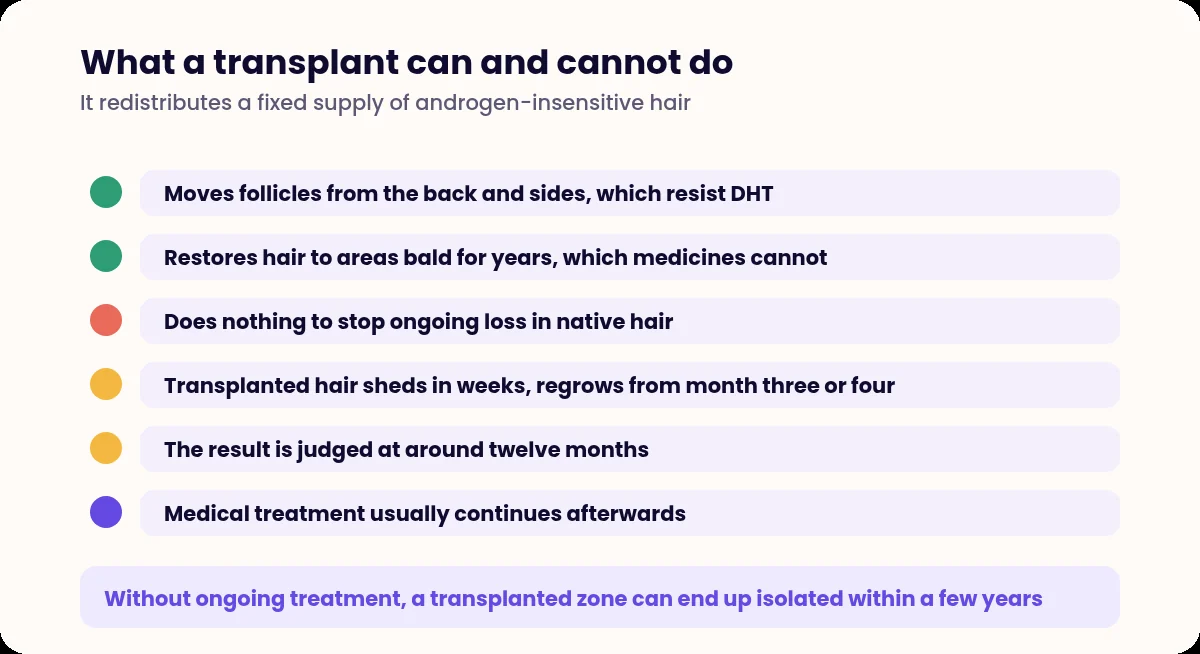
That fact also sets the limits. Surgery redistributes a fixed supply of hair. It does not create more, and it does nothing to the native hair around the grafts, which continues to thin on its own schedule.
FUE and FUT
FUE (follicular unit excision) removes individual follicular units directly from the donor area with a small punch. No linear scar; instead many tiny circular scars, usually invisible unless the head is shaved very short. The donor area is typically trimmed or shaved. Recovery is generally quicker.
FUT (follicular unit transplantation), or strip) removes a strip of scalp from the back of the head, which is closed with sutures, and the follicular units are dissected from it under magnification. It leaves a linear scar, which matters if you might want very short hair, but it can yield a large number of grafts in one session and preserves donor supply efficiently in some patients.
Neither is universally better. The choice depends on donor density, scar characteristics, how short you wear your hair, and how many grafts are needed. A surgeon who offers only one technique will recommend that one.
What the procedure involves
Local anaesthetic, a long day — often six to eight hours for a large session — and usually one or two days off afterwards. Grafts are placed into small sites made in the recipient area, and the angle and density of those sites is most of the artistry: a hairline that looks natural is irregular, finer at the front, and angled the way hair actually grows.
An important question to ask directly: who does what? In many clinics, technicians perform graft harvesting and placement under a surgeon’s supervision. That can be entirely appropriate — but you should know who is doing which part, and their qualifications, before you consent.
The timeline
- Week 1: scabbing and redness at the recipient sites; swelling is common and settles.
- Weeks 2 to 4: transplanted hairs shed. This is expected. The follicle stays; the hair shaft goes. Almost everyone finds this alarming and it is normal.
- Months 3 to 4: new growth begins.
- Months 8 to 12: most of the result is visible.
- Beyond 12 months: continued thickening and maturation.
A surrounding shock loss of native hair in the recipient area can occur in the first weeks and usually recovers.
Judging a transplant before six months is judging nothing.
Why medical treatment usually continues
This is the point that separates satisfying results from disappointing ones.
Transplanted follicles resist DHT. The native hair around them does not. If pattern loss continues unchecked, the transplanted zone stays while the area behind it thins, and within a few years the result can look like a band of hair in an otherwise thinning scalp — the classic marker of a transplant done in isolation.
Surgeons therefore usually recommend continuing finasteride, topical minoxidil or both afterwards [4]. Our finasteride vs minoxidil guide compares them. This is also why surgeons are cautious about operating on very young men whose pattern has not declared itself — planning a hairline at 23 for a pattern that will still be progressing at 40 is how people end up needing further surgery they cannot supply the donor hair for.
Who is and isn’t a good candidate
Better candidates: a stable or medically controlled pattern, good donor density, realistic expectations, and a defined area to treat — a receded hairline or a crown rather than the whole scalp.
Poorer candidates: diffuse thinning including the donor area (which is why it is less often suitable in women — see female pattern hair loss), active scarring alopecia (which can recur in the grafts, so it must be quiescent and specialist-assessed first), unrealistic expectations, and very early-stage loss that has not yet declared its pattern.
Checking a clinic
In England, clinics carrying out surgical procedures should be registered with the CQC, and inspection reports are public [1]. Equivalent regulators cover Scotland, Wales and Northern Ireland.
Check the surgeon on the GMC register [2], including whether they hold a relevant specialist registration. Ask:
- Who performs the extraction and the placement, and what are their qualifications?
- How many grafts, and what does the price include?
- Can I see photographs of your own patients at twelve months, including a case similar to mine?
- What is the plan for my ongoing hair loss?
- What happens if I am unhappy, and is a revision included?
- What aftercare is provided, and by whom?
Be wary of pressure to book on the day, discounts with deadlines, results promised in weeks, and before-and-after photographs where the lighting, hairstyle and camera angle have all changed.
Going abroad
Plenty of people have good outcomes overseas at lower cost, and plenty of very experienced surgeons work outside the UK. The real difference is what happens if something goes wrong: infection, poor growth, an unnatural hairline, or over-harvested donor area are far harder to address from another country, and UK clinics are often reluctant to take on the correction of someone else’s work.
If you go, apply the same checks to the surgeon’s qualifications, ask who is actually operating, confirm what follow-up exists after you fly home, and arrange a UK clinician who will see you if there is a problem. Consider travel insurance carefully, since elective surgery abroad is frequently excluded.
The alternative worth naming
Some men who spend a year researching transplants shave their heads instead and are notably happier for it. That is not a consolation prize; it is a legitimate option with no recovery period and no ongoing cost. It is worth sitting with before committing several thousand pounds and a decade of maintenance.
Frequently asked questions
How much does a hair transplant cost in the UK?
Costs vary widely with the number of grafts and the clinic, and are typically in the thousands of pounds. Quotes should state the number of grafts, who performs each part of the procedure, and what follow-up and revision are included.
Is it worth going abroad for a cheaper transplant?
Many people have good results abroad, but follow-up and redress are harder if something goes wrong, and standards vary. The same checks apply: who is performing the surgery, what their qualifications are, what happens if there is a complication, and what aftercare is available once you are home.
Will I need to keep taking medication afterwards?
Usually, yes. Transplanted follicles resist DHT, but the surrounding native hair does not and continues to thin. Stopping treatment often produces a result that looks increasingly isolated over a few years.
How long until I see results?
Transplanted hairs shed within two to four weeks, then regrow from around three to four months. Most of the result is visible at eight to twelve months, with continued thickening beyond that.
References
- Care Quality Commission. Find and check services. www.cqc.org.uk/
- General Medical Council. Check the medical register. www.gmc-uk.org/registration-and-licensing/the-medical-register
- NHS. Cosmetic procedures. www.nhs.uk/conditions/cosmetic-procedures/
- British Association of Dermatologists. Patient information leaflets. www.skinhealthinfo.org.uk/
- DermNet. Hair transplant. dermnetnz.org/topics/hair-transplantation
Medical reviewer
Naeem Teni
Clinical Lead at Manova. Registered pharmacist and independent prescriber, GPhC 2215591. Reviews Manova’s clinical content for accuracy and safety.
Written by
Manova Editorial Team
Researched and written to our editorial policy, using NICE, NHS, MHRA and peer-reviewed sources.
This article is for general information and isn’t a substitute for advice from your own clinician. If you feel unwell, contact your GP or NHS 111. In an emergency, call 999.