
Key takeaways
- The body defends against weight loss: appetite hormones and energy expenditure both shift in ways that favour regain.
- Regain is a physiological response, not a character flaw, and understanding that changes how people respond to it.
- Consistent self-monitoring, regular activity, high protein and a plan for lapses are the strongest predictors of maintenance.
- Weight regain after stopping weight-loss medication is expected, which is why stopping should be a planned conversation.
Almost all the attention in weight management goes to losing. Almost all the difficulty is in keeping it off.
That is not a motivational observation. It is a description of the biology, and knowing about it in advance changes how people respond when it happens.
What your body does after you lose weight
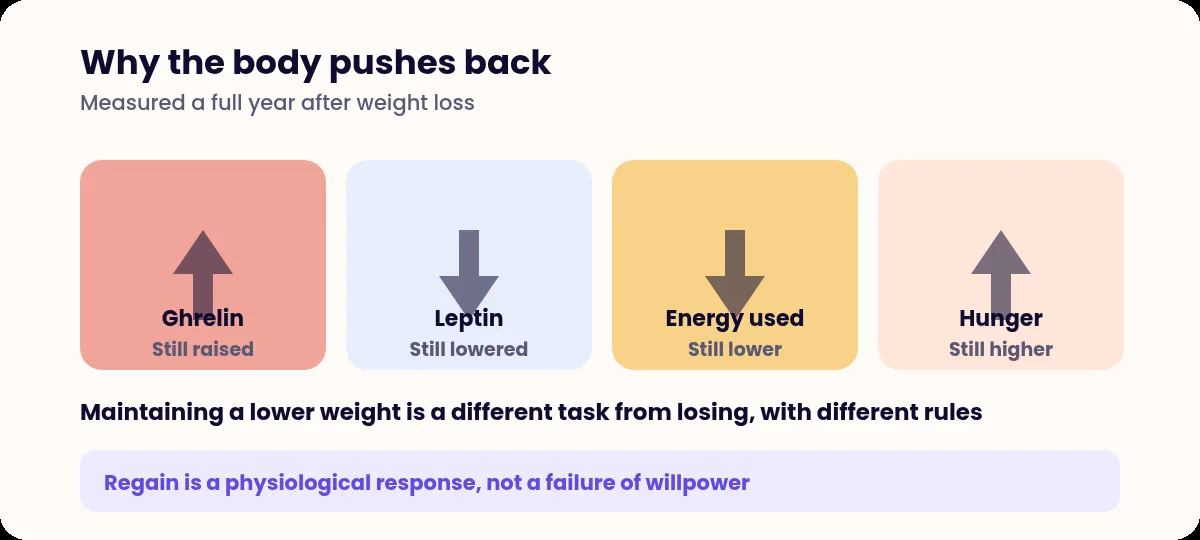
In a study that followed people after a ten-week very low calorie diet, researchers measured appetite hormones and hunger at baseline, at the end of the diet, and a year later. One year on, with much of the weight still lost, ghrelin (which drives hunger) remained elevated, several satiety hormones remained suppressed, and subjective hunger was still higher than at baseline [1].
Alongside that, energy expenditure falls — partly because a smaller body costs less to run, and partly by a further amount beyond what size alone predicts.
So a person maintaining a 15 kg loss is not in the same position as someone who has always been at that weight. They are hungrier and burning slightly less. Indefinitely, or at least for a long time.
This is the single most important thing to understand about maintenance. Regain is not evidence that someone stopped caring. It is what happens when a persistent physiological push meets an environment designed to accommodate it.
What the people who succeed do
Research on long-term maintainers — people who have kept significant weight off for years — finds a consistent cluster of behaviours [2].
They weigh themselves regularly. Not obsessively; consistently. Weekly or more. The point is catching a 3 kg drift at 3 kg rather than at 10.
They are physically active, often more than average. High levels of activity show up repeatedly in maintenance cohorts, which makes sense given the reduced energy expenditure.
They eat a consistent pattern. Less variation between weekdays and weekends, and less variation between “on plan” and “off plan” periods.
They eat breakfast, mostly. A common finding, though probably a marker of pattern consistency rather than a mechanism in itself.
They have a plan for lapses. The response to a bad weekend is the next meal, not the next January.
The things that matter most, in order
1. Decide what you are maintaining
Pick a range, not a number. Two or three kilograms of ordinary fluctuation is normal, and treating every upward day as a failure is exhausting and counterproductive.
2. Set a trigger weight
Choose a number — commonly 3 to 4 kg above your maintenance weight — at which you go back to what worked during the loss phase, deliberately and without drama. Having decided this in advance is far more effective than deciding it in the moment.
3. Keep resistance training
Muscle is the tissue most at risk during loss and the one that most supports maintenance. Twice a week.
4. Keep protein high
The satiety benefit does not stop being useful once the loss stops.
5. Do not stop measuring
The most common maintenance failure is not a dramatic relapse. It is the quiet withdrawal of every monitoring habit, followed by a slow return over eighteen months.
Stopping weight-loss medication
If weight was lost with the help of medication, the same biology applies, and the trial evidence is consistent: in the STEP 1 extension, participants regained roughly two-thirds of the weight they had lost within a year of stopping, with cardiometabolic improvements largely reversing alongside it [3].
That is not a reason never to stop. It is a reason for stopping to be a planned clinical conversation rather than something that happens because a repeat order lapsed. Things worth discussing with a prescriber: whether a lower maintenance dose is appropriate, what the taper looks like, what to put in place beforehand, and how you will monitor afterwards.
Obesity is managed as a long-term condition in current guidance [4]. Most long-term conditions are not treated with a fixed course.
A more useful definition of success
Clinical guidance generally treats a sustained 5% loss as a meaningful outcome, and 10% as a substantial one. Holding a 10% loss for five years is a better result than losing 25% and regaining it twice.
When to speak to a clinician
Get in touch if you:
- have regained more than around 5% of your body weight and want support before it goes further
- are thinking about stopping weight-loss medication
- have noticed blood pressure, cholesterol or blood glucose rising again after regain
- are finding eating or weight is occupying an unhealthy amount of your attention
- have had bariatric surgery and are experiencing regain, which needs specialist input
Coming back after regain is not starting from zero. You know considerably more than you did the first time.
Frequently asked questions
Why do people regain weight after losing it?
Weight loss triggers adaptive responses: appetite-stimulating hormones rise, satiety hormones fall, and energy expenditure drops slightly more than body size alone predicts. These changes persist for a long time, so maintaining a lower weight requires ongoing effort against a real biological push.
How long does it take for weight to stabilise?
The adaptive changes in appetite and expenditure can persist for a year or more after weight loss. Most maintenance research suggests the first year is the highest-risk period, and that people who hold their weight for two to five years have a much better long-term outlook.
Will I put the weight back on if I stop weight-loss medication?
Most people regain a substantial proportion of the weight after stopping, which is consistent with obesity being a long-term condition rather than a course of treatment. If you are considering stopping, discuss it with your prescriber so there is a plan rather than a cliff edge.
What is the single best predictor of keeping weight off?
There is no single one, but regular self-monitoring — weighing consistently and noticing an upward trend early — appears repeatedly across maintenance research, alongside high levels of physical activity and a consistent eating pattern.
References
- Sumithran P, Prendergast LA, Delbridge E, et al. Long-term persistence of hormonal adaptations to weight loss. New England Journal of Medicine. 2011;365(17):1597-1604. doi.org/10.1056/NEJMoa1105816
- Wing RR, Phelan S. Long-term weight loss maintenance. American Journal of Clinical Nutrition. 2005;82(1 Suppl):222S-225S. doi.org/10.1093/ajcn/82.1.222S
- Wilding JPH, Batterham RL, Davies M, et al. Weight regain and cardiometabolic effects after withdrawal of semaglutide: the STEP 1 trial extension. Diabetes, Obesity and Metabolism. 2022;24(8):1553-1564. doi.org/10.1111/dom.14725
- NICE. Overweight and obesity management. NG246. www.nice.org.uk/guidance/ng246
Medical reviewer
Naeem Teni
Clinical Lead at Manova. Registered pharmacist and independent prescriber, GPhC 2215591. Reviews Manova’s clinical content for accuracy and safety.
Written by
Manova Editorial Team
Researched and written to our editorial policy, using NICE, NHS, MHRA and peer-reviewed sources.
This article is for general information and isn’t a substitute for advice from your own clinician. If you feel unwell, contact your GP or NHS 111. In an emergency, call 999.