

Key takeaways
- Malassezia colonisation is necessary but not sufficient — seborrhoeic dermatitis reflects host susceptibility in sebum composition, skin barrier and immune response, so calling it a fungal infection of the scalp is inaccurate.
- Ketoconazole 2% shampoo is available from UK pharmacies without a prescription, and the dosing genuinely differs between products, so follow the leaflet in the box rather than a generic instruction.
- There is no good evidence that dandruff causes androgenetic hair loss, though inflammation and scratching can increase shedding and breakage, and severe scalp inflammation can precipitate a telogen effluvium.
- Alopecia and abnormal hair texture are themselves listed as adverse reactions of ketoconazole 2% shampoo in UK product information, at unknown frequency.
Dandruff and seborrhoeic dermatitis sit on the same spectrum. Dandruff is the mild end — flaking and itch without much visible redness. Seborrhoeic dermatitis is the same process with inflammation you can see, and it can extend beyond the scalp to the eyebrows, the sides of the nose, behind the ears and the chest.
Two things are said about it constantly and both are wrong. It is not a hygiene problem, and it is not, in any useful sense, an infection.
Why “fungal infection of the scalp” is the wrong description
Malassezia yeasts live on the skin of essentially every adult. In seborrhoeic dermatitis they are necessary but not sufficient — you do not get the condition without them, but their presence does not explain who gets it. What separates an affected scalp from an unaffected one is host susceptibility: the composition of the sebum the skin produces, the integrity of the barrier, and how the immune system responds to the yeast’s metabolic by-products [5].
That distinction is not pedantry, because it explains the clinical picture. It is why the condition relapses when treatment stops rather than being cured, why it flares with stress, cold weather and illness, and why the most useful antifungal for it also works in another way entirely.
Ketoconazole is the case in point. Its UK product information records that it is active against Malassezia and “also has a direct anti-inflammatory action independent from its antifungal activity” [2]. A medicine that treats this condition through two mechanisms, one of which is not antifungal at all, is a clue that the condition is not simply an infection.
What UK self-care actually looks like
NHS guidance is that dandruff is not caused by poor hygiene and is not contagious, and that the first step is an anti-dandruff shampoo containing ketoconazole, coal tar or salicylic acid, used for up to four weeks [1]. See a GP if there is no improvement after four weeks, if the scalp is very itchy, red or swollen, or if flaky patches appear on the face or body [1].
Zinc pyrithione is first line in most NHS formularies and is the active ingredient in a large share of supermarket anti-dandruff shampoos. Selenium sulfide and coal tar are the other widely available options. For more marked redness, clinicians add prescribed preparations — a betamethasone scalp application, or hydrocortisone 1% combined with miconazole 2% — but that is a step beyond self-care.
There is a genuine UK-versus-US divergence here. PrescQIPP and several NHS area prescribing committees advise against routine NHS prescribing of shampoos for simple dandruff on the grounds that it is a self-care condition with effective products available from any pharmacy [4]. American readers will find advice to get a prescription shampoo that UK readers should ignore; here the equivalent product is on the shelf.
Ketoconazole 2%: the detail people get wrong
Ketoconazole 2% shampoo is available from UK pharmacies without a prescription. Nizoral Dandruff Treatment 2% and Boots Anti-Dandruff Ketoconazole 2% (also marketed as Ketopine) are both pharmacy products [2, 3]. A separate prescription-only presentation of ketoconazole 2% shampoo also exists, which is why you will find contradictory statements online about whether it needs a prescription. Both are true, of different products.
The dosing differs between products, and this matters. Nizoral’s product information directs twice-weekly use for two to four weeks, then once every one to two weeks for prophylaxis, with the lather left on for three to five minutes [2]. The 2025 revision of the Ketopine product information directs application every three to four days for two to four weeks, with a minimum of three days between applications [3].
Those are not interchangeable schedules. Read the leaflet that came in the box, not the one you remember from the last brand.
The adverse reaction nobody mentions
Here is the counterpoint that hair clinics marketing ketoconazole almost never include. “Alopecia” and “hair texture abnormal” are themselves listed adverse reactions of ketoconazole 2% shampoo, at frequency “not known”, in every UK product information document for it [2, 3].
Frequency “not known” means it cannot be estimated from the available data, and these are post-marketing reports rather than trial findings, so this is not a reason to avoid a shampoo that works well for a condition you have. It is a reason to be sceptical of anyone selling ketoconazole as a hair-growth product, and a reason to mention it to a clinician if your hair changes after you start.
Does it cause hair loss?
This needs answering carefully, because both the alarmist and the dismissive versions are wrong.
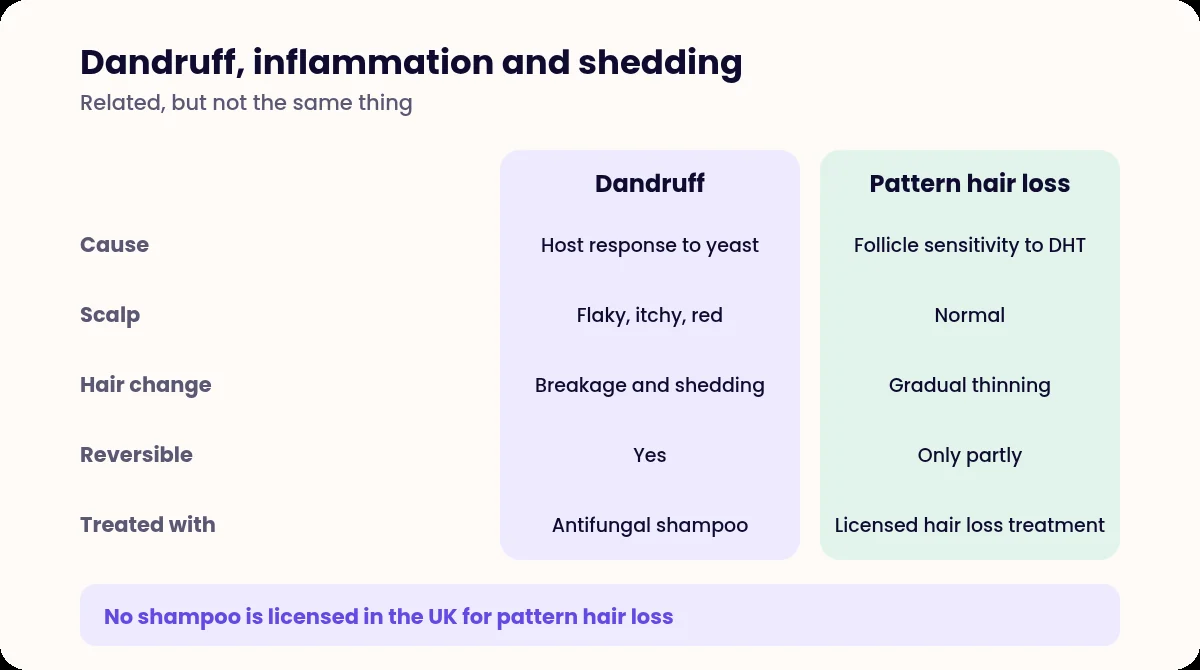
There is no good evidence that seborrhoeic dermatitis causes androgenetic hair loss. Pattern baldness is driven by follicular sensitivity to androgens, and a flaky scalp does not create that. If your hairline is receding or your crown is thinning in a pattern, dandruff is a coincidence rather than a cause — see male pattern baldness.
Inflammation and scratching can increase shedding and breakage. That is a mechanistic and observational claim rather than a trial finding, and it should be held loosely, but it is plausible and consistent with what clinicians see. Vigorous scratching breaks shafts; sustained inflammation is not a good environment for a follicle.
Severe scalp inflammation can precipitate a telogen effluvium — a diffuse shed of hairs pushed prematurely into the resting phase. This is the mechanism behind the “my hair fell out while my scalp was terrible” story, and the important part is that it is not scarring. Hair regrows once the inflammation is controlled, though as with any telogen effluvium the visible recovery lags months behind the trigger resolving.
So: treat the scalp because an inflamed, itchy scalp is worth treating on its own terms, and because controlling it removes a contributor to shedding. Do not treat it expecting a receding hairline to stop.
The ketoconazole-for-baldness claim
You will find ketoconazole shampoo marketed as a treatment for androgenetic alopecia, usually citing a small number of studies suggesting an effect on hair density.
Two things are worth knowing. A 2025 review in JEADV Clinical Practice promoting this use should be read as likely industry-linked, and the underlying trials it draws on are small, old and mostly non-randomised [6]. And, decisively for a UK reader: no UK product is licensed for androgenetic alopecia in this class. That is not a technicality. It means no regulator has assessed the evidence and concluded it supports the claim.
If you want a licensed option for pattern hair loss, topical minoxidil is the pharmacy medicine with a UK licence for it. Our guide to hair loss shampoos goes through what the shelf actually contains.
Frequently asked questions
Is dandruff caused by poor hygiene?
No. NHS guidance is explicit that dandruff is not caused by poor hygiene and is not contagious, though washing can make the flaking more obvious or less obvious depending on frequency. It reflects how your scalp responds to a yeast that lives on everyone's skin, which is why some people get it and others never do regardless of how they wash.
How long should I use an anti-dandruff shampoo before seeing a GP?
NHS advice is to use an anti-dandruff shampoo containing ketoconazole, coal tar or salicylic acid for up to four weeks. See a GP if it has not improved by then, if the scalp is very itchy, red or swollen, or if flaky patches start appearing on your face or body.
Does dandruff make you go bald?
Not in the pattern sense. There is no good evidence linking seborrhoeic dermatitis to androgenetic alopecia. What it can do is increase shedding and breakage through inflammation and scratching, and a severe inflammatory flare can trigger a telogen effluvium. That kind of loss is not scarring and regrows once the inflammation is controlled.
Will the NHS prescribe me an anti-dandruff shampoo?
Usually not for simple dandruff. PrescQIPP and several NHS area prescribing committees advise against routine NHS prescribing of shampoos for conditions treatable with self-care products bought from a pharmacy. More severe or extensive seborrhoeic dermatitis, particularly with marked redness, is treated differently and may involve prescribed preparations.
References
- NHS. Dandruff. www.nhs.uk/conditions/dandruff/
- Summary of Product Characteristics: Nizoral Dandruff Treatment 2% shampoo. Electronic Medicines Compendium, revised 17 August 2023. www.medicines.org.uk/emc/
- Summary of Product Characteristics: Ketoconazole 2% shampoo (Ketopine). Electronic Medicines Compendium, revised 6 October 2025. www.medicines.org.uk/emc/
- PrescQIPP. Self-care and items of limited clinical value: shampoos and scalp preparations. www.prescqipp.info/
- DermNet. Seborrhoeic dermatitis. dermnetnz.org/topics/seborrhoeic-dermatitis
- Gupta AK et al. Ketoconazole in androgenetic alopecia. JEADV Clinical Practice, 2025. onlinelibrary.wiley.com/guides/27682242
Medical reviewer
Naeem Teni
Clinical Lead at Manova. Registered pharmacist and independent prescriber, GPhC 2215591. Reviews Manova’s clinical content for accuracy and safety.
Written by
Manova Editorial Team
Researched and written to our editorial policy, using NICE, NHS, MHRA and peer-reviewed sources.
This article is for general information and isn’t a substitute for advice from your own clinician. If you feel unwell, contact your GP or NHS 111. In an emergency, call 999.