

Key takeaways
- No shampoo is licensed in the UK as a treatment for androgenetic alopecia, and none reverses follicular miniaturisation.
- The ketoconazole evidence rests largely on one small non-randomised study from 1998 that has never been adequately replicated.
- Most caffeine shampoo research is manufacturer-funded and uses surrogate endpoints, and around two minutes of contact time is the core plausibility problem.
- Shampoos genuinely help by treating scalp inflammation and seborrhoeic dermatitis, removing build-up and reducing breakage, which improves how hair looks and behaves.
Start with the constraint that governs the whole category. A shampoo is lathered, left for a minute or two, and rinsed off. Whatever an ingredient does in a laboratory, it has to do it in about two minutes of contact with a surface it was designed to be washed from.
That is not a reason to dismiss shampoos. It is a reason to be precise about what they are for.
Ketoconazole
Ketoconazole 2% is the ingredient with the most credible case, which tells you something about the strength of the field.
The foundational study is Piérard-Franchimont and colleagues, published in Dermatology in 1998 [1]. It compared 2% ketoconazole shampoo with an unmedicated shampoo over 21 months in around 39 men, with some participants also using 2% minoxidil. It reported increases in hair density, in the size of the pilosebaceous unit, and in the proportion of follicles in the growth phase.
Read that description again. It was small, non-randomised, methodologically limited, and now more than twenty-five years old, and it has never been adequately replicated. A 2025 review has revisited ketoconazole’s dermatological uses beyond seborrhoeic dermatitis [2], but the underlying clinical evidence base in pattern hair loss has not materially improved.
The proposed mechanisms are plausible: local anti-androgenic activity, and reduction of the Malassezia-driven inflammation that underlies seborrhoeic dermatitis. The second is the more convincing, and it points to where ketoconazole genuinely earns its place.
The honest position: ketoconazole 2% is reasonable adjunctive treatment, particularly where seborrhoeic dermatitis coexists with pattern hair loss, which is a common combination. Treating an inflamed, flaky scalp is worth doing on its own terms and may reduce shedding that the inflammation was contributing to. It is not a treatment for androgenetic alopecia in its own right, and it is not licensed for that purpose in the UK.
Caffeine
Caffeine shampoos are the most heavily marketed part of the category and the least well supported.
A 2025 systematic review of caffeine in cosmetic preparations against hair loss found only a handful of clinical studies [3]. The frequently cited ones are a 2017 trial comparing a 0.2% caffeine solution against 5% minoxidil, which claimed non-inferiority, and a trial of a phyto-caffeine shampoo in female pattern hair loss.
Three problems run through this literature and should be stated plainly.
Funding. The great majority of caffeine hair studies are manufacturer-funded. That does not make them wrong, but it is the single most important thing to know when a field is small and the results are uniformly positive.
Endpoints. Many use surrogate measures — caffeine’s effect on follicles in ex-vivo organ culture, or hair tensile force — rather than hair count on a human scalp over months. An effect on an isolated follicle in a dish is a hypothesis, not a result.
Contact time. This is the core plausibility problem and it is independent of the biology. Even taking the laboratory work at face value, around two minutes on the scalp before rinsing is not obviously comparable to a leave-on solution applied twice daily. Note that the trial most often cited in caffeine’s favour used a solution, not a shampoo.
The UK Advertising Standards Authority has previously restricted claims made in advertising for products in this category, which is a reasonable indication of how the evidence has been characterised.
None of that makes caffeine inert on a follicle. It makes the leap from a laboratory observation to a bottle in a supermarket aisle a much longer one than the packaging suggests, and the burden of proof sits with the people selling it rather than with the person deciding whether to buy.
Saw palmetto
Saw palmetto appears in shampoos, supplements and combination products, marketed on the basis of a mild anti-androgenic effect.
A systematic review covering five randomised trials and two prospective cohorts reported improvements: 60% improvement in overall hair quality, a 27% increase in total hair count, increased density in 83.3% of participants and stabilisation in 52% [4]. Those numbers look impressive until you read the authors’ own conclusion, which is that “robust high-quality data are lacking”.
Where direct comparison has been made, the effect size is substantially smaller than that of the prescribed treatments with randomised evidence behind them. Saw palmetto is also not licensed or regulated as a medicine in the UK, so content varies between products and there is no requirement to demonstrate anything before selling it. Our guide to hair supplements and the evidence covers the wider supplement category.
What shampoos genuinely do
There is a real list here, and it is worth taking seriously rather than treating shampoos as entirely cosmetic theatre.
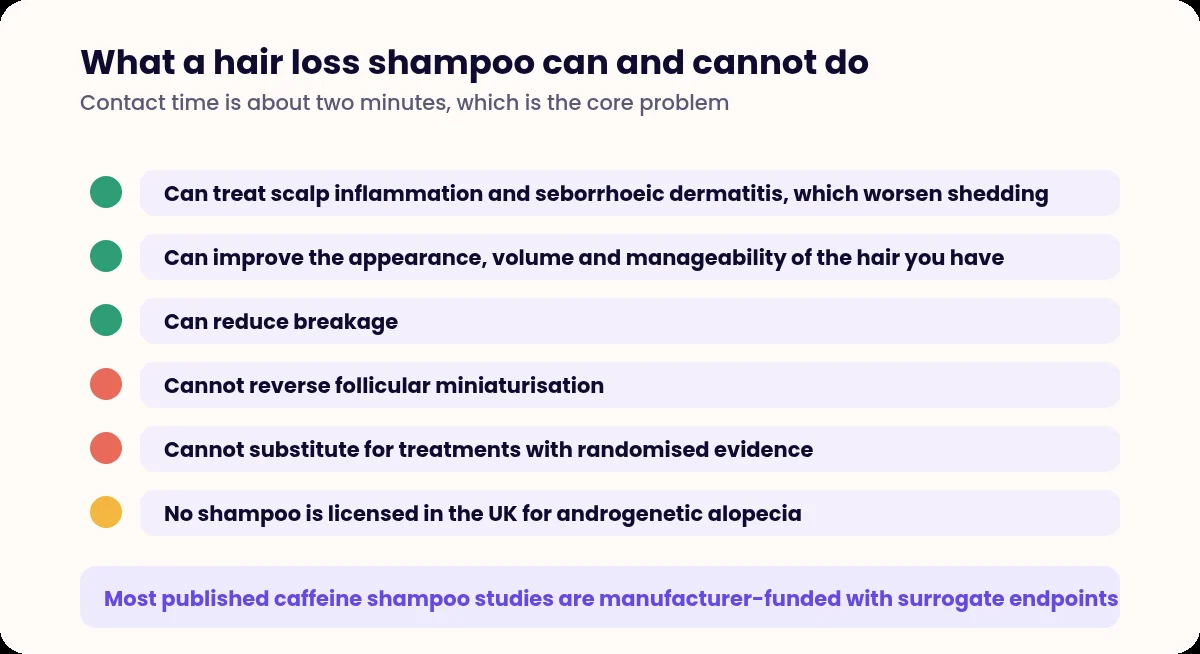
Shampoos can:
- treat scalp inflammation and seborrhoeic dermatitis, which genuinely worsens shedding when it is present
- remove sebum and product build-up that makes hair look flat and lifeless
- improve the cosmetic appearance, volume and manageability of the hair you have
- reduce breakage, which matters because hair that snaps mid-shaft looks exactly like hair that has been lost
Shampoos cannot:
- reverse follicular miniaturisation, which is the process described in male pattern baldness
- meaningfully block DHT at the dermal papilla
- substitute for the treatments with randomised evidence behind them
No shampoo is licensed in the UK as a treatment for androgenetic alopecia. That is the clearest single fact in this section, and it applies to every product on every shelf regardless of what the packaging implies.
How to buy sensibly
If your scalp is itchy, flaky or inflamed, an antifungal or anti-inflammatory shampoo is worth using and may reduce shedding attributable to the inflammation. Treat it as treatment for the scalp, not for the hair loss.
If your scalp is healthy, choose on how the hair looks and feels afterwards, and spend accordingly. There is no reason to pay a premium for an active ingredient whose entire clinical evidence base would fit on one page.
A useful test for any claim on a bottle: ask what was measured, in how many people, over how long, and who paid. In this category the answers are usually a surrogate measure, a few dozen people, a few months, and the manufacturer. Where a product avoids medicinal claims altogether and simply says it cleans and conditions, it is being more honest than most.
And be careful about the substitution effect. The real cost of an expensive shampoo is not usually the money — it is the twelve months spent using it instead of something with evidence, during which miniaturisation carries on. That is the mechanism by which this category does harm, and it is covered further in hair loss myths.
If the flaking is severe, the scalp is painful, or you can see smooth shiny areas where the follicle openings have disappeared, that is not a shampoo problem. Ask for a GP appointment within the week, because scarring alopecia causes permanent loss and is treated by stopping it early.
Frequently asked questions
Does ketoconazole shampoo help hair loss?
The evidence is weak. The foundational study, published in 1998, was small, non-randomised and involved around 39 men over 21 months, and has never been adequately replicated. Ketoconazole 2% is reasonable adjunctive treatment where seborrhoeic dermatitis coexists with pattern hair loss, but it is not a treatment for androgenetic alopecia in its own right and is not licensed for it.
Does caffeine shampoo work?
A 2025 systematic review found only a handful of clinical studies, the great majority manufacturer-funded and many using surrogate endpoints such as follicle organ culture or hair tensile strength rather than hair count. The practical difficulty is contact time: a shampoo sits on the scalp for around two minutes before being rinsed away, which is very different from a leave-on solution.
Can a shampoo block DHT?
Not meaningfully. Blocking DHT at the dermal papilla requires sustained inhibition of 5-alpha reductase in the follicle, and there is no evidence that any rinse-off product achieves that. Shampoos marketed as DHT blockers are food-supplement-style claims applied to a cosmetic, and no such product is licensed in the UK for hair loss.
Are there any shampoos worth buying?
Yes, for what shampoos actually do. An antifungal or anti-inflammatory shampoo genuinely treats a flaky, itchy, inflamed scalp, and that inflammation does worsen shedding. A clarifying shampoo removes build-up. A conditioning one reduces breakage. Those are real benefits, and none of them alters the underlying process in pattern hair loss.
References
- Pierard-Franchimont C et al. Ketoconazole shampoo: effect of long-term use in androgenic alopecia. Dermatology, 1998. pubmed.ncbi.nlm.nih.gov/9669136/
- Gupta AK et al. Ketoconazole in dermatology beyond seborrhoeic dermatitis. JEADV Clinical Practice, 2025. onlinelibrary.wiley.com/doi/full/10.1002/jvc2.70026
- Caffeine as an active ingredient in cosmetic preparations against hair loss: a systematic review, 2025. pubmed.ncbi.nlm.nih.gov/39997270/
- Evron E et al. Natural hair supplement: friend or foe? Saw palmetto, a systematic review. Skin Appendage Disorders, 2020. escholarship.org/uc/item/87w9473t
- DermNet. Male pattern hair loss. dermnetnz.org/topics/male-pattern-hair-loss
- NHS. Hair loss. www.nhs.uk/conditions/hair-loss/
Medical reviewer
Naeem Teni
Clinical Lead at Manova. Registered pharmacist and independent prescriber, GPhC 2215591. Reviews Manova’s clinical content for accuracy and safety.
Written by
Manova Editorial Team
Researched and written to our editorial policy, using NICE, NHS, MHRA and peer-reviewed sources.
This article is for general information and isn’t a substitute for advice from your own clinician. If you feel unwell, contact your GP or NHS 111. In an emergency, call 999.