

Key takeaways
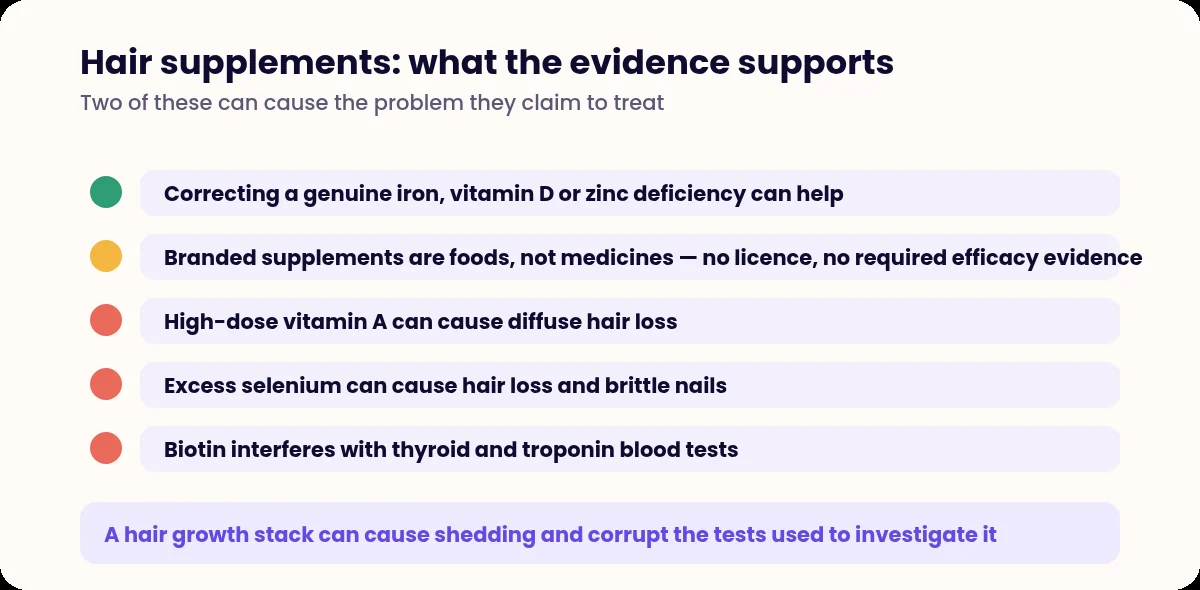
- Supplementation corrects deficiency; it does not treat androgenetic alopecia. In a well-nourished UK population the yield of routine supplementation is very low.
- Excess vitamin A above 10,000 IU a day can itself cause diffuse hair loss — NHS advice caps intake at 1.5mg, about 5,000 IU, a day from food and supplements combined.
- Excess selenium causes hair loss and brittle nails; the UK safe upper level is around 450 micrograms a day, and Brazil nuts plus a supplement can reach toxic levels.
- High-dose biotin interferes with laboratory immunoassays including thyroid function and troponin, so a hair supplement stack can cause shedding and corrupt the tests used to investigate it at the same time.
The question people ask about hair supplements is whether they work. The more useful question is what else they do, because the answer to the first one is fairly settled and fairly dull, and the answer to the second one occasionally matters a great deal.
The settled part: supplementation corrects deficiency. It does not treat androgenetic alopecia. In a well-nourished UK population, the yield from routine supplementation is very low, and the review literature is consistent about this [1, 2].
The part worth your attention: some supplements sold for hair can cause hair loss, and one of them can make the blood tests used to investigate hair loss give the wrong answer.
Supplements that can cause hair loss
This is the genuinely useful angle, and it is almost never covered by the people selling the products.
Vitamin A excess. Intake above 10,000 IU a day risks toxicity, which presents as diffuse non-scarring hair loss and reduced body hair. NHS advice caps intake at 1.5 mg, about 5,000 IU, a day from food and supplements combined — so the threshold for harm is only about twice the recommended ceiling, which is not a wide margin. The usual sources are high-dose retinol products, cod liver oil, and stacked multivitamins where several products each contribute. It is fully reversible on stopping [1].
Selenium excess (selenosis). Causes hair loss and brittle nails, along with garlic breath, nausea and neurological symptoms. The UK safe upper level is around 450 micrograms a day, with toxicity typically above roughly 900 micrograms. Brazil nuts are extraordinarily selenium-dense, and a daily handful plus a supplement can reach that range without anyone intending it. Also reversible on withdrawal [1].
The biotin problem
Biotin deserves a section of its own, not because it works but because of what it does to blood tests.
On efficacy the review literature is blunt: the efficacy of biotin in supplements for hair, skin and nails “is not supported in large-scale studies” [1]. It helps in genuine biotin deficiency, which is rare — biotinidase deficiency, prolonged raw egg white consumption, long-term anticonvulsants, isotretinoin, parenteral nutrition, chronic alcohol use. There is no reason to supplement it in someone eating normally, and no evidence it helps pattern hair loss or telogen effluvium.
The safety story is the real one. Hair, skin and nail supplements typically contain 5,000 to 10,000 micrograms of biotin, up to around 300 times the roughly 30 microgram daily adequate intake. At those doses biotin interferes with any biotin–streptavidin-based immunoassay, which is a very large share of routine laboratory testing [3, 4].
The direction of the error depends on the assay format:
- Competitive assays give falsely high results — including TSH, free T4 and free T3, which can mimic hyperthyroidism.
- Sandwich assays give falsely low results — including troponin, hCG, PTH, ferritin and vitamin D.
The US FDA issued a safety communication specifically about falsely low cardiac troponin results, and reported one death linked to a missed heart attack [3]. Documented real-world consequences also include misdiagnosed hyperthyroidism with unnecessary treatment, false-negative pregnancy tests, and misleading tumour marker results.
Put that next to the vitamin A and selenium point and you get the sharpest message in this whole area: a person taking a “hair growth” stack containing high-dose vitamin A, selenium and biotin may be simultaneously causing hair loss and corrupting the blood tests used to investigate it.
Practical rule
Stop high-dose biotin at least 48 to 72 hours before blood tests — some laboratories advise up to eight days for very high doses — and always tell the clinician or the phlebotomist that you take it [4]. They cannot interpret around an interference they do not know is there. Our guide to blood tests for hair loss covers what those tests are actually for.
The individual nutrients, honestly
Iron and ferritin. This is the one with real substance. Iron deficiency is genuinely and commonly associated with hair loss, particularly telogen effluvium in premenopausal women [1, 6]. Reviews suggest maintaining ferritin above thresholds ranging from 40 to 70 ng/mL for regrowth, but those thresholds are contested and not endorsed by UK haematology guidance, which uses considerably lower levels to define deficiency. The reviews themselves note that debate continues over whether low ferritin causes hair loss or merely correlates with it. Ferritin is also an acute phase reactant, so inflammation can conceal a real deficiency behind a normal-looking number. Do not take iron without testing — iron overload is harmful.
Zinc. Deficiency does cause alopecia and does respond to replacement, but the review position is that insufficient data exists to recommend zinc supplementation in deficient patients with androgenetic alopecia or telogen effluvium, and the evidence in alopecia areata is inconclusive too [1]. Excess zinc causes copper deficiency, which itself causes hair and neurological problems.
Vitamin D. Deficiency correlates with alopecia areata severity and the review recommends measuring it in that condition and replacing where low [1]. Evidence in female pattern hair loss and telogen effluvium is mixed. The vitamin D receptor is required for normal hair cycling, which gives biological plausibility without establishing benefit in people who are already replete. Separately, UK advice to take 10 micrograms (400 IU) daily in autumn and winter applies to everyone regardless of hair.
Marine collagen. The weakest evidence of anything here. No randomised trial demonstrates benefit for androgenetic alopecia or telogen effluvium. Hair is keratin, not collagen, and ingested collagen is digested into amino acids and peptides like any other protein rather than being routed to follicles. The small human studies that exist are manufacturer-funded, use subjective endpoints, and mostly concern skin. There is no credible evidence it grows hair.
What “food supplement” means legally
Branded hair supplements are sold as food supplements, not medicines. The consequences are concrete:
- No MHRA licence, and no assessment of efficacy by any regulator.
- No requirement to hold efficacy evidence at all.
- No lawful basis for medicinal claims — which is why the packaging says things like “supports normal hair” rather than “treats hair loss”.
Where trials exist they are typically small, short, manufacturer-funded, often unblinded, frequently using participants’ self-assessment as the endpoint, and usually conducted in women with self-perceived thinning rather than people with a diagnosis. The marine protein complex products have the most published data, and it remains low quality. Products that are essentially iron plus an amino acid make sense only if you are iron deficient, which is a question answered by a blood test rather than a purchase. Advertising claims in this sector have been challenged by UK regulators more than once.
None of these is a substitute for treatment with randomised evidence, and our guide to hair loss myths covers the rest of what gets overclaimed.
A sensible position
Get tested if the history suggests a deficiency, correct what is actually low, eat enough protein, and take the standard UK vitamin D advice. Beyond that, the money is better spent elsewhere and the stack is a small but real risk to both your hair and your test results.
Frequently asked questions
Does biotin help hair growth?
Only in genuine biotin deficiency, which is rare. The review literature states plainly that the efficacy of biotin supplements for hair, skin and nails is not supported in large-scale studies. There is no evidence it helps androgenetic alopecia or telogen effluvium in someone eating normally, and the doses sold cause laboratory problems.
Can supplements cause hair loss?
Yes. Vitamin A above about 10,000 IU a day can produce diffuse non-scarring hair loss and reduced body hair, and selenium excess causes hair loss and brittle nails alongside garlic breath, nausea and neurological symptoms. Both are reversible on stopping. Stacked multivitamins, cod liver oil and high-dose single-nutrient products are the usual sources.
Should I stop biotin before a blood test?
Yes. Stop high-dose biotin at least 48 to 72 hours before blood tests, and some laboratories advise up to eight days for very high doses. Always tell the clinician or phlebotomist that you take it, because the direction of the error depends on the assay and they cannot correct for what they do not know about.
Are branded hair supplements regulated?
They are sold as food supplements, not medicines. That means no MHRA licence, no requirement to demonstrate efficacy, and no lawful basis for making medicinal claims. The trials that exist are typically small, short, manufacturer-funded, often unblinded and frequently rely on participants rating their own hair.
References
- Almohanna et al. The role of vitamins and minerals in hair loss: a review. Dermatology and Therapy, 2019. link.springer.com/article/10.1007/s13555-018-0278-6
- Wang et al. Micronutrients and androgenetic alopecia: a systematic review. Molecular Nutrition and Food Research, 2024. pubmed.ncbi.nlm.nih.gov/39440586/
- US FDA. Biotin interference with troponin lab tests: assays subject to biotin interference. www.fda.gov/medical-devices/in-vitro-diagnostics/biotin-interference-t
- ADLM (formerly AACC). Academy guidance on biotin interference in laboratory tests. myadlm.org/science-and-research/academy-guidance/biotin-interference-i
- NHS. Hair loss. www.nhs.uk/conditions/hair-loss/
- DermNet. Telogen effluvium. dermnetnz.org/topics/telogen-effluvium
Medical reviewer
Naeem Teni
Clinical Lead at Manova. Registered pharmacist and independent prescriber, GPhC 2215591. Reviews Manova’s clinical content for accuracy and safety.
Written by
Manova Editorial Team
Researched and written to our editorial policy, using NICE, NHS, MHRA and peer-reviewed sources.
This article is for general information and isn’t a substitute for advice from your own clinician. If you feel unwell, contact your GP or NHS 111. In an emergency, call 999.