

Key takeaways
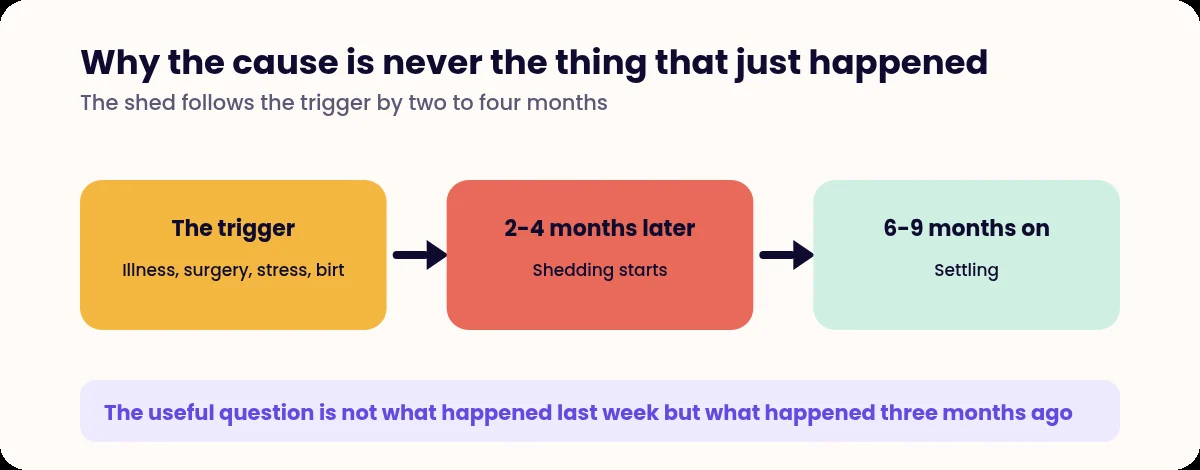
- Shedding begins two to four months after the triggering event, which is why the cause is almost always misidentified — the useful question is what happened three months ago, not what changed last week.
- Around 15% of scalp follicles are normally resting; after a systemic shock as many as 70% of growing hairs can be pushed into the resting phase at once.
- Acute telogen effluvium is self-limiting: shedding peaks after several months and settles over six to nine months, with full cosmetic recovery taking up to 12 to 18 months.
- It frequently unmasks or coexists with androgenetic alopecia, which is the commonest diagnostic trap and the reason recovery sometimes feels incomplete.
Almost everyone with telogen effluvium arrives with the wrong culprit. They blame a new shampoo, a recent stressful week, a change of water, a hair dye. The actual trigger has usually been and gone months earlier, and by the time hair starts coming out it has often been forgotten entirely.
The single most useful thing to understand about this condition is its delay. Once you know about it, the diagnosis frequently makes itself.
The mechanism, and why it lags
Scalp follicles cycle independently: a long growth phase, a brief transition, a resting phase of around three months, then shedding as a new hair pushes the old one out. At any moment roughly 15% of scalp follicles are in the resting phase [1].
A systemic shock disrupts that. Growing follicles are pushed prematurely into resting all at once — after a significant insult, as many as 70% of growing hairs can be precipitated into the telogen phase [1]. Nothing visible happens at that point. The hairs sit there for their three months, and only then are they released as the replacement hair comes through.
That is the delay. Shedding is noticed two to four months after the triggering event [1]. It is why the right question is not “what changed recently?” but “what happened three months ago?”.
What sets it off
The list is long, and several items on it are things people do not think of as illnesses [1]:
- Childbirth — classically around three months after delivery.
- Febrile illness, including COVID-19 and other viral infections.
- Major surgery or general anaesthesia.
- Severe psychological stress — bereavement, a relationship ending, an acute crisis.
- Crash dieting and rapid weight loss, or low protein intake. Our guide to hair loss after weight loss covers this in detail.
- Iron deficiency.
- Thyroid disease, both over- and underactive.
- Starting or stopping the combined oral contraceptive.
- Medicines — retinoids including isotretinoin, beta-blockers, anticoagulants, anticonvulsants, some antidepressants, and high-dose vitamin A.
Work backwards through a calendar rather than a memory. Diaries, photographs and appointment records are more reliable than recall, because the event that mattered often did not feel significant at the time.
Acute and chronic
Acute telogen effluvium follows an identifiable stressor and is self-limiting. Shedding builds, peaks after several months, then settles [1].
Chronic telogen effluvium is different: prolonged, fluctuating shedding lasting months to years, often with no identifiable trigger, typically in middle-aged women. The characteristic history is bitemporal recession with density otherwise preserved [1]. It does not resolve by waiting and warrants proper assessment.
How it is distinguished from other causes
Telogen effluvium produces diffuse thinning across the whole scalp rather than discrete patches or the patterned recession of androgenetic alopecia. A hair pull test is positive, and the hairs come away with small pale club-shaped roots. On a trichogram, more than 25% telogen hairs strongly suggests the diagnosis [1].
Reasonable investigations, guided by the history, include full blood count, ferritin, thyroid function, B12, vitamin D, and coeliac screening where indicated [1]. Our guide to blood tests for hair loss sets out what each of these does and does not tell you.
The trap worth knowing about
Telogen effluvium frequently unmasks or coexists with androgenetic alopecia [1]. This is the commonest diagnostic error in the area, and it has practical consequences.
Someone with early, unnoticed pattern loss has been quietly running on reduced reserve. A shedding episode strips out enough additional hair to make the underlying pattern visible for the first time. When the effluvium resolves, density returns — but only to the pattern-thinned baseline, not to where memory says it was. The person experiences that as incomplete recovery and concludes the shedding never stopped.
The opposite error also happens: patterned loss is attributed entirely to a stressful year, and nothing is done about it. If recovery stalls, or if what is left behind is thinner at the temples and crown specifically, that is worth assessing on its own terms — see male pattern baldness for what patterned loss looks like.
What it feels like day to day
The experience is disproportionate to the eventual outcome, and it is worth saying so. People describe counting hairs, avoiding washing, dreading the shower drain, and checking the scalp in every reflective surface they pass. The shedding is real and often dramatic — far more visible than the gradual thinning of pattern loss — while the end point is usually a return to normal.
Two things help. The first is to stop counting; the count fluctuates day to day with washing frequency and tells you nothing about the trend. The second is standardised photographs at monthly intervals in the same light, which do show the trend and will show recovery before you feel it.
Recovery, and how long it takes
Acute telogen effluvium is described as self-correcting [1]. Shedding peaks after several months and normalises over six to nine months. Full cosmetic recovery can take 12 to 18 months, because regrown hair has to reach the length of the hair around it, and that happens at about a centimetre a month.
Repeated episodes over years may evolve into female pattern hair loss in some women [1, 3].
What actually helps
Not very much, and that is a legitimate answer rather than a shrug [1]:
- Identify and remove the trigger where one is still present — a restrictive diet, a medicine that can be reviewed with your prescriber.
- Correct a genuine deficiency. Iron, thyroid and nutritional problems found on testing should be treated properly. Correction, not speculative supplementation.
- Eat enough protein. Hair is built from it, and very low intake is a recognised trigger.
- Handle hair gently — shedding is happening at the follicle, but traction and breakage add to what you see.
- Reassurance and an explanation of the timeline. This sounds thin written down, and it is genuinely the main intervention. Knowing that the peak has already passed, and that nothing visible will change for several months, prevents the cycle of panic buying that otherwise follows.
Supplements have no proven role in the absence of a deficiency [4], and our guide to the evidence on hair supplements covers where some of them can make things worse.
This clinic does not treat telogen effluvium. If shedding is heavy, prolonged beyond six months, accompanied by other symptoms, or you cannot identify any trigger at all, see your GP for assessment rather than buying a product.
Frequently asked questions
How much shedding is too much?
Everyone sheds hair daily as part of normal cycling. What characterises telogen effluvium is a clear, sustained increase over weeks — visibly more hair in the shower drain, on the pillow and in the brush — usually diffuse across the whole scalp rather than in patches or a pattern. The hairs shed have a small pale club-shaped root.
Will my hair grow back after telogen effluvium?
Acute telogen effluvium is described as self-correcting. Shedding peaks after several months, then normalises over six to nine months, and full cosmetic recovery can take 12 to 18 months. The follicles are not damaged. What delays the sense of recovery is that new hairs grow at roughly a centimetre a month, so the density returns before the length does.
Should I take supplements for shedding?
Supplements correct deficiency; they do not otherwise stop shedding. Iron, thyroid and other tests are worth doing where the history suggests it, and correcting a genuine deficiency helps. Taking a high-dose hair supplement speculatively can cause problems of its own, including interference with the blood tests used to investigate the shedding.
What is chronic telogen effluvium?
A prolonged, fluctuating shedding lasting months to years, often with no identifiable trigger, typically in middle-aged women. The characteristic history is of bitemporal recession with otherwise preserved density. It is distinct from acute telogen effluvium and needs assessment rather than waiting it out.
References
- DermNet. Telogen effluvium. dermnetnz.org/topics/telogen-effluvium
- NHS. Hair loss. www.nhs.uk/conditions/hair-loss/
- DermNet. Female pattern hair loss. dermnetnz.org/topics/female-pattern-hair-loss
- Almohanna et al. The role of vitamins and minerals in hair loss: a review. Dermatology and Therapy, 2019. link.springer.com/article/10.1007/s13555-018-0278-6
- DermNet. Male pattern hair loss. dermnetnz.org/topics/male-pattern-hair-loss
Medical reviewer
Naeem Teni
Clinical Lead at Manova. Registered pharmacist and independent prescriber, GPhC 2215591. Reviews Manova’s clinical content for accuracy and safety.
Written by
Manova Editorial Team
Researched and written to our editorial policy, using NICE, NHS, MHRA and peer-reviewed sources.
This article is for general information and isn’t a substitute for advice from your own clinician. If you feel unwell, contact your GP or NHS 111. In an emergency, call 999.