

Key takeaways
- The usual cause is telogen effluvium: a stress on the body pushes many hairs into the shedding phase at once.
- Shedding typically starts around three months after the trigger, and the range is roughly one to six months.
- It is self-limiting in the large majority of people, with regrowth over six to nine months.
- Very low calorie intake, low protein and low iron make it more likely and more prolonged.
You lose two stone. You feel better than you have in years. And then, three months later, hair starts collecting in the shower drain.
This is common, it is well described, and in the overwhelming majority of people it is temporary.
What is happening
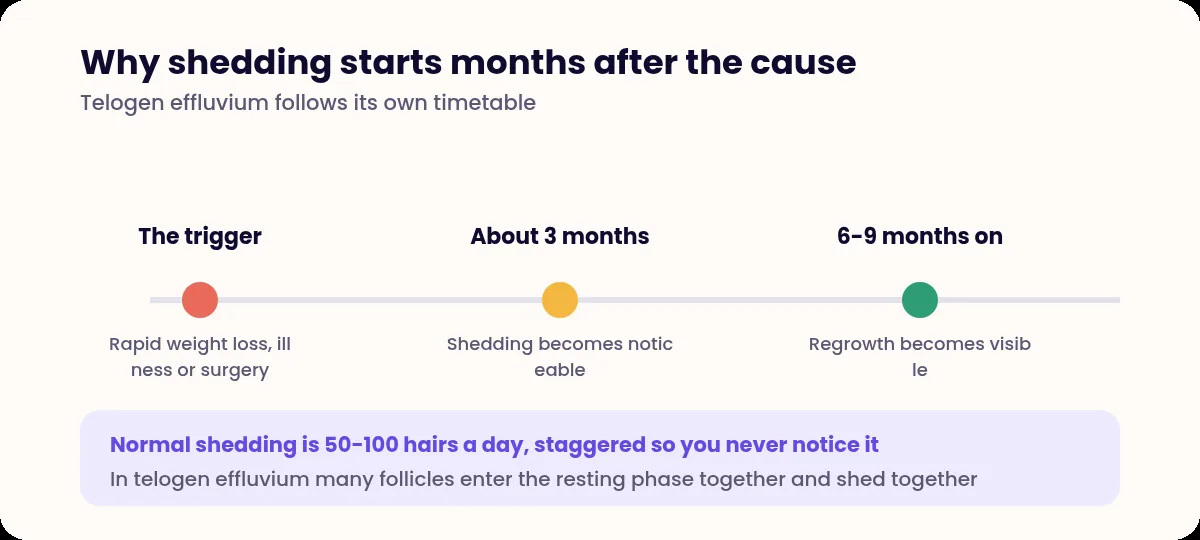
Hair grows in cycles. At any moment, around 85 to 90% of your scalp hairs are in the anagen (growing) phase, and roughly 10 to 15% are in telogen, a resting phase that ends with the hair being shed. Normal shedding is around 50 to 100 hairs a day, invisible because it is staggered.
A significant physiological stress — rapid weight loss, surgery, a severe illness, childbirth, a large calorie restriction — can push an unusually large share of follicles into telogen at the same time. Roughly three months later, those hairs shed together. That is telogen effluvium [1].
The delay is the confusing part. By the time hair is falling, the stressful phase often feels like it is behind you.
Why the timing is what it is
Telogen lasts about three months. So the shedding you see today reflects something that happened to your body around three months ago — the fastest phase of weight loss, a dose escalation, a period of eating very little. Onset is typically at three months, with a reported range of about one to six months [1].
Is it the medication?
Hair loss has been reported by people taking GLP-1 based weight-loss medicines, and it appears in safety data for some of them. The prevailing view is that it reflects the speed and size of the weight loss rather than a direct effect of the drug on follicles. Rapid loss by any route — very low calorie diets, bariatric surgery — produces the same picture.
That distinction is practically useful, because it points at what to do about it.
What actually helps
Do not crash the calories further. Very low intake is the driver. If you are on a weight-loss medicine and appetite has fallen away, it is easy to end up eating far less than you intended.
Protein at every meal. Hair is largely keratin, a protein. Aim for roughly 1.2 to 1.6 g per kg of body weight per day while losing weight.
Check iron and ferritin. Low iron stores are a common contributor, particularly in women who menstruate. This is a blood test worth asking for rather than guessing at.
Consider vitamin D and zinc if intake is low, but only genuine deficiency needs correcting. Taking supplements you do not need does not grow hair, and excess selenium and vitamin A can actually cause shedding [2].
Be gentle with what is there. Avoid tight ponytails, heat and aggressive brushing while shedding is active.
Wait. Unsatisfying, but the follicles are not damaged. Regrowth usually becomes visible as short new hairs around the hairline over six to nine months.
What it should not look like
Telogen effluvium is diffuse: overall thinning, more hairs coming out when you wash. It is not:
- patchy, coin-sized bald areas (suggests alopecia areata)
- a receding hairline or thinning crown in a pattern (suggests androgenetic hair loss, which is separate and may coexist)
- accompanied by a red, scaly, itchy or scarred scalp
- accompanied by eyebrow or body hair loss, marked fatigue and cold intolerance (thyroid disease should be excluded)
When to speak to a clinician
Get it looked at if:
- hair loss is patchy rather than diffuse
- the scalp is sore, red, scaly or scarred
- shedding is still heavy after six months
- you also have fatigue, weight change you cannot explain, or cold intolerance
- you are eating very little, or struggling to eat, on a weight-loss medicine
A clinician can check ferritin, full blood count, thyroid function and vitamin D, and confirm whether anything else is going on.
Frequently asked questions
Why am I losing hair after losing weight?
Rapid weight loss is a physiological stress. It can push a large proportion of hair follicles from the growing phase into the resting phase simultaneously. Those hairs are shed together around three months later, which is why the timing feels disconnected from the cause.
Does Mounjaro or Wegovy cause hair loss?
Hair loss has been reported by people taking weight-loss medicines, and it appears in some trial safety data. The mechanism is generally thought to be the rapid weight loss itself rather than a direct effect of the drug. It is usually temporary.
How long does it last?
Shedding typically continues for about three to six months and then settles. Visible density usually recovers over six to nine months, though it can take longer if weight loss is ongoing or intake remains very low.
Will my hair grow back?
In telogen effluvium, yes, in almost all cases, because the follicles are not destroyed. If hair loss is patchy, is accompanied by scalp scarring or redness, or does not settle after six months, it needs assessment for a different cause.
References
- Hughes EC, Saleh D. Telogen effluvium. StatPearls. 2023. www.ncbi.nlm.nih.gov/books/NBK430848/
- Guo EL, Katta R. Diet and hair loss: effects of nutrient deficiency and supplement use. Dermatology Practical & Conceptual. 2017;7(1):1-10. doi.org/10.5826/dpc.0701a01
- NHS. Hair loss. www.nhs.uk/conditions/hair-loss/
- British Association of Dermatologists. Telogen effluvium patient information leaflet. www.bad.org.uk/pils/telogen-effluvium/
Medical reviewer
Naeem Teni
Clinical Lead at Manova. Registered pharmacist and independent prescriber, GPhC 2215591. Reviews Manova’s clinical content for accuracy and safety.
Written by
Manova Editorial Team
Researched and written to our editorial policy, using NICE, NHS, MHRA and peer-reviewed sources.
This article is for general information and isn’t a substitute for advice from your own clinician. If you feel unwell, contact your GP or NHS 111. In an emergency, call 999.