

Key takeaways
- Partners very commonly conclude that the problem is them — that they are no longer attractive, or that there is someone else — and silence confirms that reading.
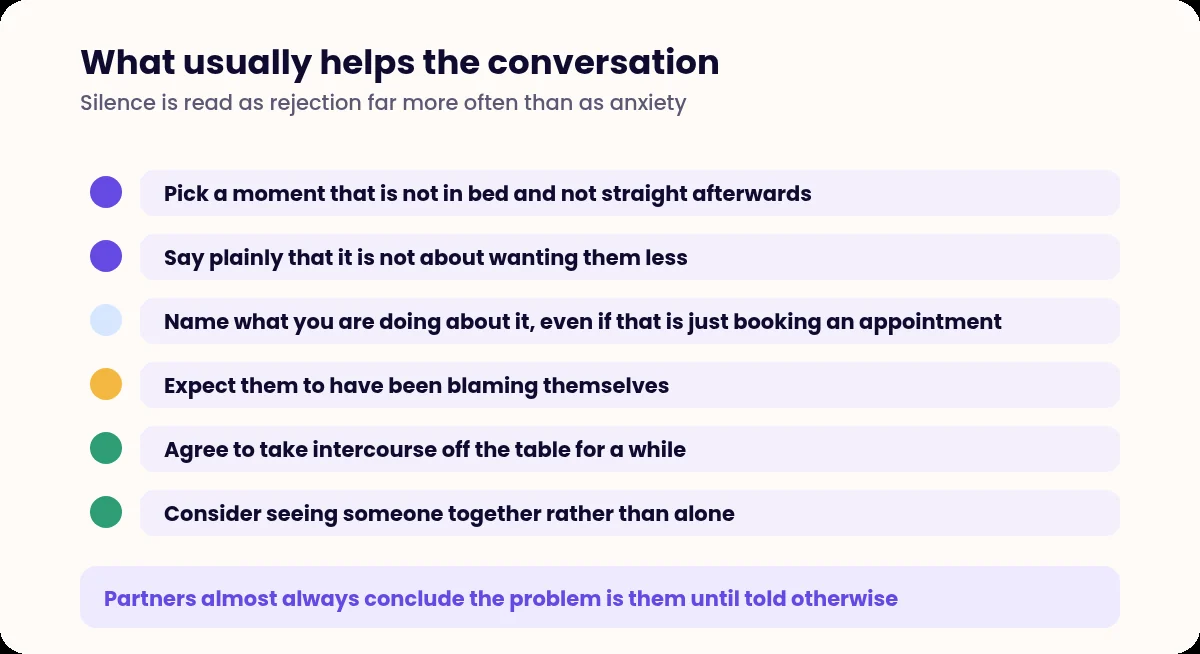
- Have the conversation outside the bedroom and outside the moment, not immediately after a difficult occasion.
- Name the feeling as well as the fact, because 'I couldn't' explains less than 'I was frightened of not being able to.'
- Agreeing to take intercourse off the table for a defined period usually reduces the pressure that is sustaining the problem.
Most of the damage erection problems do to a relationship is done in the gap between the first difficult occasion and the first honest conversation. That gap is routinely months. Sometimes it is years.
What fills it is guesswork, and the guess a partner makes is almost never the right one.
What your partner is probably thinking
This is the single most useful thing to know before you open your mouth.
When sex stops, or becomes unreliable, and nothing is said about why, partners overwhelmingly reach one of three conclusions:
They have stopped being attractive to you. This is the commonest, and it is close to universal. An erection is widely read as an involuntary verdict on desirability, so its absence reads as a verdict too.
There is someone else. The reasoning is simple and, from the outside, not unreasonable: interest has gone somewhere, so it must have gone somewhere else.
You have stopped wanting the relationship. Withdrawal from sex is rarely read as withdrawal from sex alone. It gets read as the first visible sign of a larger exit.
Notice what all three have in common. They locate the problem in the relationship or in your partner, because in the absence of information that is the only available explanation. And notice that avoidance — going to bed later, initiating less, turning away from ordinary affection because it might lead somewhere — is doing far more to confirm those readings than one difficult evening ever did.
Timing, which matters more than wording
Do not have this conversation in bed. Do not have it immediately after a difficult occasion, when both of you are at your least articulate and most exposed.
Have it somewhere neutral, with something else going on. Walking, driving, washing up. The absence of eye contact is a feature rather than a limitation for a lot of people, and having a task in hand takes some of the weight out of it.
Give it a beginning. “There’s something I want to talk about, and I’ve been putting it off” does an enormous amount of work, because it tells your partner that what follows was planned rather than provoked, and it stops them bracing for something worse.
What to actually say
Four things, in roughly this order.
The fact. Plainly, without euphemism or elaborate framing. “I’ve been having trouble getting and keeping an erection.” Medical language is fine if it is easier; so is blunt language. What tends not to work is vagueness, because vagueness leaves the guessing intact.
That it is not about them. Say it explicitly, even if it feels obvious. It is not obvious from where they are standing. If desire is unaffected — and very often it is entirely unaffected — say that too, because the distinction between not wanting and not being able is not visible from the outside.
The feeling, not just the fact. This is the part men most often skip and the part that changes the conversation. “I couldn’t” is information. “I’ve been dreading it, and then avoiding it, and then feeling worse about avoiding it” is an explanation. It also makes sense of behaviour your partner has been interpreting as coldness.
What you want to happen next. Whether that is seeing a clinician, taking the pressure off for a while, or simply having said it out loud and nothing more for now. A conversation without a next step tends to get repeated rather than built on.
What tends to go wrong
Turning it into a medical briefing. Some men manage the discomfort by delivering a lecture on penile blood flow. It is a way of not being present. Your partner does not need the physiology first; they need to know where they stand.
Apologising repeatedly. An apology invites reassurance, reassurance invites another apology, and the conversation loops without moving. Say it once if you want to, then stop.
“It doesn’t matter.” Well meant, and the commonest unhelpful response from the partner’s side. It can close the subject when the subject needs to stay open. Better: acknowledging that it clearly matters to him, and being specific about what you do still want physically.
Making it the only topic. Once it is out, it can colonise everything. Agreeing to revisit it at a set point, rather than every evening, protects the rest of the relationship.
Taking the pressure off, deliberately
The most useful practical agreement a couple can make is to take intercourse off the table for a defined period — a fortnight, a month, whatever you both agree — while keeping everything else.
This is not resignation, and it is not a euphemism for stopping. It is the basic principle behind sensate focus, the structured approach used in psychosexual therapy: remove the performance demand, and a great deal of the anxiety that was sustaining the difficulty has nothing left to attach to. Our guide to performance anxiety and erections explains why that loop is so self-reinforcing.
Two things make it work. It has to be mutual and explicit, rather than one person quietly withdrawing. And “everything else” has to mean everything else — touch, closeness, other kinds of sex — rather than nothing at all, because an agreement that ends all physical contact tends to confirm exactly the fears described above.
If the relationship is newer
A new relationship changes the timing but not much else. There is no obligation to disclose anything on a schedule, and this is not a confession.
A short mention before the situation arises usually works better than an unexplained difficulty in the moment. One sentence, delivered without weight: that this is something that sometimes happens, that it is being looked at, that it is not a reflection on them. How calmly it is said matters considerably more than the words chosen.
Getting outside help
Some conversations do not go well, and some do not happen at all. That is not a failure, and it is a reasonable point to bring someone else in.
Psychosexual therapy is designed for exactly this, and it works with couples as readily as individuals. Therapists can be found through the College of Sexual and Relationship Therapists [2] or through relationship counselling organisations [3], and some areas offer NHS psychosexual services via GP referral, though availability varies considerably. NHS talking therapies are self-referral in England and are appropriate where anxiety or low mood is a significant part of the picture [4].
It is also worth saying that the medical side should not wait for the conversation to go perfectly. Erectile difficulty lasting more than a few weeks warrants assessment in its own right, for reasons that have nothing to do with the relationship — our guide to what causes erectile dysfunction sets out why, and our guide to common myths about erection problems deals with several of the beliefs that keep men from going. The two things run in parallel.
Frequently asked questions
What if I just can't say it out loud?
Write it down. A short message or note is a legitimate opening, and for some people it is easier than speaking. Three or four sentences is enough: that this is happening, that it is not about them, that you find it hard to talk about, and that you would like to talk about it anyway. You can have the rest of the conversation face to face afterwards.
My partner keeps saying it doesn't matter. Does that help?
It is meant kindly and often lands badly, because it can sound like the subject is closed. What usually helps more is acknowledging that it clearly matters to you, asking what you would find useful, and being specific about what they still want from the relationship physically. Reassurance works better when it is detailed.
Should I tell a new partner?
There is no obligation to disclose a health matter on a schedule, but a brief, low-key mention before the situation arises usually goes better than an unexplained difficulty in the moment. A sentence is enough. New partners generally respond to how calmly it is said far more than to what is said.
How do I bring it up if I'm the partner, not the one with the problem?
Lead with the relationship rather than the symptom. Something like: I've noticed we've stopped, I've missed you, and I wondered whether something is going on. Avoid raising it immediately after a difficult occasion, avoid the word 'problem' if you can, and be ready for the first answer to be a deflection. Often the second conversation is the real one.
References
- NHS. Erection problems (erectile dysfunction). www.nhs.uk/conditions/erection-problems-erectile-dysfunction/
- College of Sexual and Relationship Therapists. Find a therapist. www.cosrt.org.uk/information-for-members-of-the-public/
- Relate. Sex therapy. www.relate.org.uk/
- NHS. Talking therapies. www.nhs.uk/mental-health/talking-therapies-medicine-treatments/
- British Society for Sexual Medicine. Guidelines on the management of erectile dysfunction in men. www.bssm.org.uk/guidelines/
Medical reviewer
Naeem Teni
Clinical Lead at Manova. Registered pharmacist and independent prescriber, GPhC 2215591. Reviews Manova’s clinical content for accuracy and safety.
Written by
Manova Editorial Team
Researched and written to our editorial policy, using NICE, NHS, MHRA and peer-reviewed sources.
This article is for general information and isn’t a substitute for advice from your own clinician. If you feel unwell, contact your GP or NHS 111. In an emergency, call 999.