
Key takeaways
- Erections depend on the parasympathetic nervous system; anxiety activates the sympathetic system, which actively opposes them.
- One difficult occasion can create anticipatory worry that makes the next occasion harder — the cycle, not the original cause, is often what maintains the problem.
- Sudden onset, good morning erections and erections during masturbation point towards a psychological contribution rather than a vascular one.
- Psychosexual therapy, including sensate focus, has evidence behind it, and is sometimes combined with medication for a period.
An erection is not something you do. It is something that happens when the nervous system is relaxed enough to let it. That single fact explains most of what follows.
The physiology, briefly
Getting an erection is driven by the parasympathetic nervous system — the branch associated with rest and digestion. It releases nitric oxide, arteries in the penis dilate, blood fills the erectile tissue and the veins that drain it are compressed.
Anxiety activates the sympathetic system — the branch associated with threat. Adrenaline and noradrenaline constrict those same arteries. Sympathetic activity is also what drives detumescence, the loss of an erection after orgasm.
So anxiety does not merely distract from arousal. It triggers the physiological process that ends erections [4]. This is why “just relax” is simultaneously correct and useless advice.
How the cycle builds
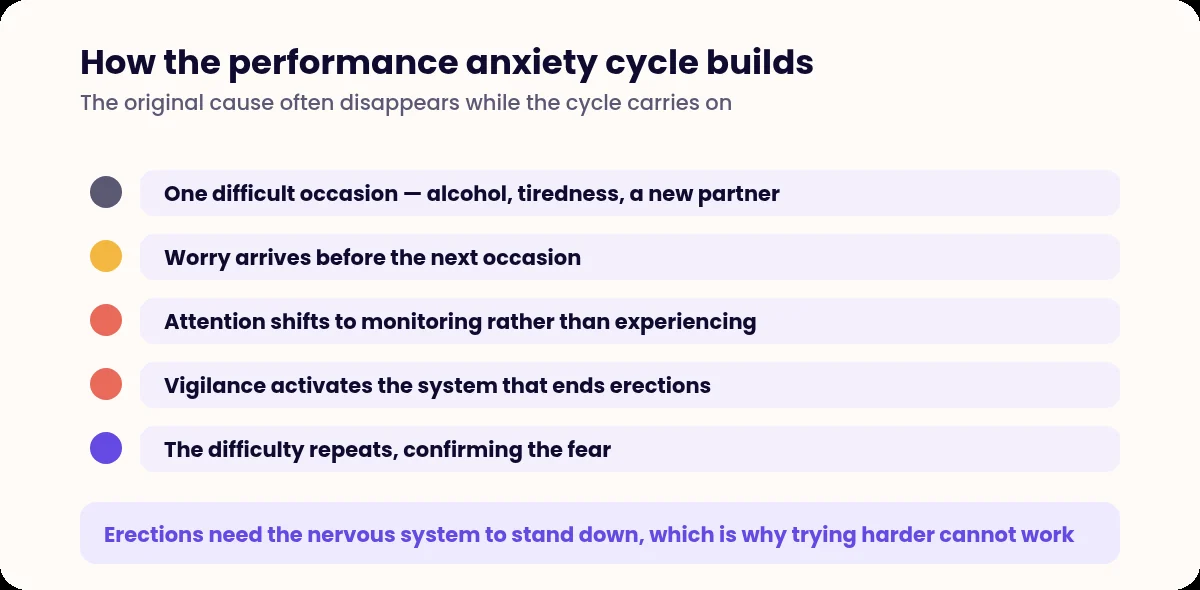
It usually starts with something ordinary. Too much to drink. Exhaustion. A new partner. A stressful week. An erection doesn’t happen, or doesn’t last.
Then the second occasion arrives carrying the memory of the first. Attention shifts from the partner to the penis — what clinicians call spectatoring: monitoring your own response from the outside instead of being in the experience. Monitoring is a vigilance state, and vigilance is sympathetic. The erection is less reliable, which confirms the fear, which raises the vigilance next time.
At that point the original cause — the drink, the tiredness — has gone, and the anxiety about it is doing all the work. This is why the problem often persists long after whatever started it has resolved.
Clues that anxiety is a major part of it
Assessment still matters, because physical and psychological causes frequently coexist and erectile dysfunction can be an early marker of cardiovascular disease (see ED and heart disease). But some patterns point one way [2, 4]:
- Sudden onset, rather than a gradual decline over months or years
- Situational variation — fine alone or with one partner, difficult with another
- Morning erections preserved
- A clear trigger you can date it to
- Age under 40 with no vascular risk factors
Gradual onset over years, absent morning erections, and a background of smoking, diabetes, high blood pressure or high cholesterol point instead towards a vascular contribution.
What actually helps
Take the demand out. The single most effective structural change is removing intercourse as the goal for a defined period. Sensate focus, developed by Masters and Johnson and still central to psychosexual therapy, does this formally: staged touching exercises with a partner in which intercourse is explicitly off-limits at first. Without a test to pass, there is nothing to fail, and arousal tends to return on its own. It is usually done with a therapist guiding the stages [3, 5].
Talk to your partner. Silence is read as rejection or loss of interest far more often than as anxiety. Partners frequently conclude the problem is them. Saying plainly that you are anxious, not uninterested, removes a layer of pressure from both sides — and a partner who understands can stop inadvertently raising the stakes.
Treat the maintaining factors. Alcohol before sex, chronic sleep debt, and the general stress load all lower the threshold. Our guide to lifestyle changes for erections covers the physical side.
Consider therapy properly. Psychosexual therapy has the evidence base here, and works both individually and with couples. COSRT maintains a directory of accredited therapists in the UK; Relate offers sex therapy; some NHS areas have services your GP can point you to [3, 5].
Understand the role medication can play. Clinicians sometimes use a PDE5 inhibitor deliberately for a limited period, not as the treatment but as a way of breaking the cycle: a run of successful occasions rebuilds the expectation of success, after which the medicine can often be reduced. Used that way, with the psychological work happening alongside, it is a tool. Used indefinitely as the only intervention, it tends to become something the anxiety attaches itself to instead. That conversation is worth having explicitly with a prescriber rather than assuming either position.
Watch the comparison problem. Frequent pornography use is often raised in this context. The evidence on whether it causes erectile difficulty is genuinely mixed and hotly argued. What is less controversial is that a large gap between the arousal conditions you have trained yourself on and the conditions of partnered sex can make the latter feel flat — and that reducing the gap is sometimes worth trying.
When to see someone
See a clinician if this has lasted more than a few months, if it started gradually, if morning erections have disappeared, or if you have cardiovascular risk factors. Erectile dysfunction is one of the few symptoms that can precede a cardiac event by years, and that is a reason to be assessed rather than to self-manage.
And if low mood, loss of interest in things generally, or persistent anxiety go beyond the bedroom, say so. Depression and anxiety disorders both affect sexual function, and so do some of the medicines used to treat them — which is a conversation to have openly rather than a reason to stop taking them.
Frequently asked questions
How do I know if my ED is psychological?
Suggestive features include a sudden start, a clear trigger, erections that are fine on waking or alone but not with a partner, and variation between situations. None of these is conclusive — physical and psychological causes often coexist, and an assessment is still worthwhile.
Does taking a tablet make the anxiety worse in the long run?
Not necessarily. Clinicians sometimes use medication deliberately for a limited period to interrupt the cycle and rebuild confidence, alongside psychological work, with a plan to reduce it later. Using it indefinitely without addressing the anxiety is where dependence on it tends to develop.
What is sensate focus?
A structured programme of touch exercises done with a partner in stages, with intercourse off the table initially. It removes the performance demand so that arousal can return without the pressure that is suppressing it. It is usually done with a therapist's guidance.
Can I get psychosexual therapy on the NHS?
Availability varies by area. Your GP can advise on local services. COSRT maintains a directory of accredited therapists for those looking privately.
References
- NHS. Erection problems (erectile dysfunction). www.nhs.uk/conditions/erection-problems-erectile-dysfunction/
- NICE Clinical Knowledge Summaries. Erectile dysfunction. cks.nice.org.uk/topics/erectile-dysfunction/
- College of Sexual and Relationship Therapists. Find a therapist. www.cosrt.org.uk/
- European Association of Urology. Guidelines on Sexual and Reproductive Health. uroweb.org/guidelines/sexual-and-reproductive-health
- Relate. Sex therapy. www.relate.org.uk/
Medical reviewer
Naeem Teni
Clinical Lead at Manova. Registered pharmacist and independent prescriber, GPhC 2215591. Reviews Manova’s clinical content for accuracy and safety.
Written by
Manova Editorial Team
Researched and written to our editorial policy, using NICE, NHS, MHRA and peer-reviewed sources.
This article is for general information and isn’t a substitute for advice from your own clinician. If you feel unwell, contact your GP or NHS 111. In an emergency, call 999.