

Key takeaways
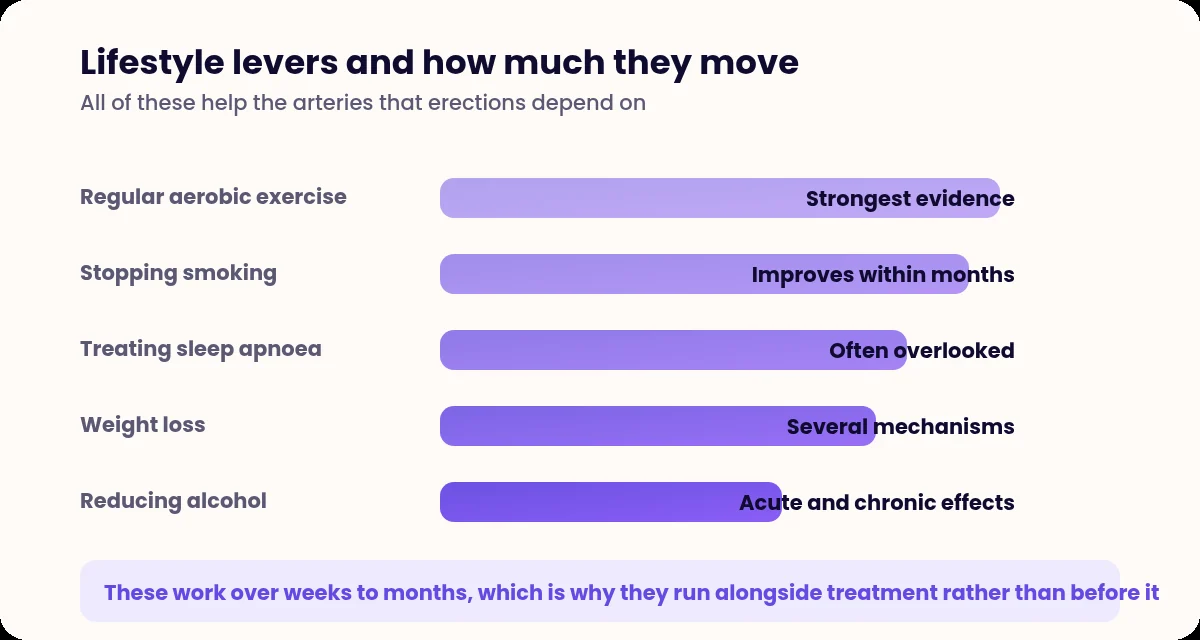
- Erectile tissue depends on small arteries, so the things that protect arteries generally — not smoking, moving, sleeping, managing weight and blood pressure — improve erectile function.
- Randomised trials of aerobic exercise have shown improvements in erectile function scores, with more benefit at higher weekly volumes.
- Stopping smoking improves erectile function, and the benefit appears within months rather than years.
- Changes take weeks to months to show, which is why lifestyle work and medical treatment are often started together rather than one after the other.
The arteries that fill an erection are narrow — around one to two millimetres across, considerably narrower than the coronary arteries. When arterial function starts to decline, they are among the first vessels where it shows [3]. That is the unglamorous reason erectile difficulty can precede heart disease by years, and the reason lifestyle changes work here at all.
None of what follows is a substitute for being assessed. But it is the part you control, it compounds, and its benefits are not confined to the bedroom.
Exercise
This has the best evidence of anything on the list.
Randomised trials of supervised aerobic exercise in men with erectile dysfunction have reported meaningful improvements in erectile function scores, with larger effects at higher weekly training volumes — roughly in the region of 160 minutes a week across several sessions in the studies showing the clearest benefit. Improvement has been seen in men whose erectile dysfunction had a vascular, diabetic or obesity-related basis, and in men on medication for it as well as those not [3].
The mechanism is endothelial: exercise improves the ability of blood vessels to dilate, which is exactly the function erections depend on.
Practically, the UK physical activity guidelines are the sensible target — 150 minutes of moderate activity or 75 of vigorous each week, plus strength work twice a week [2]. Brisk walking counts. If you’re starting from nothing, starting from nothing is fine.
Stopping smoking
Smoking damages endothelial function directly and is consistently associated with erectile dysfunction, with a dose relationship — more cigarettes, higher risk. Studies of men who stop have reported improvement in erectile function within months, and younger men with shorter smoking histories tend to improve most [3].
Vaping is not established as a safe substitute in this context; the evidence is too young. As a route off cigarettes, NHS stop smoking services remain the highest-success option and are free [5].
Weight
Excess weight affects erections through several routes at once: it worsens insulin resistance and vascular function, lowers testosterone, and is strongly associated with obstructive sleep apnoea. Trials of intensive lifestyle programmes producing meaningful weight loss have shown improvements in erectile function scores alongside improvements in blood pressure, lipids and glucose.
Waist circumference is a useful marker here — visceral fat is the metabolically active kind. Our weight loss guides cover that ground in detail.
Sleep, and sleep apnoea in particular
Short sleep lowers testosterone and raises sympathetic activity — both bad for erections. But the specific thing worth ruling out is obstructive sleep apnoea, which is common in men with excess weight, strongly associated with erectile dysfunction, and treatable. Loud snoring, witnessed pauses in breathing, and waking unrefreshed despite adequate hours are the flags. Mention them to your GP.
Alcohol
Acutely, alcohol is one of the commonest causes of a one-off difficulty, and one of the commonest triggers for the anxiety cycle that follows (see performance anxiety and erections). Chronically, heavy drinking affects nerve function, testosterone and the liver.
UK guidance is no more than 14 units a week, spread over three or more days, with drink-free days [4]. If cutting down feels hard, that is itself worth raising with someone.
Diet
There is no erection diet. What the evidence supports is the same pattern that protects arteries generally — a Mediterranean-style approach with vegetables, fruit, wholegrains, pulses, nuts, fish and olive oil, and less ultra-processed food and red and processed meat. Observational studies and some intervention studies have linked this pattern to better erectile function scores, and it is the same pattern recommended for cardiovascular risk, which is convenient.
Blood pressure, cholesterol and glucose
If you have high blood pressure, high cholesterol or type 2 diabetes, treating them well is part of treating erectile dysfunction, because all three damage the vessels involved.
One nuance: some blood pressure medicines — older beta blockers and thiazide diuretics in particular — are associated with erectile dysfunction, while others are not. Do not stop a prescribed medicine on this basis. Raise it with your prescriber; alternatives exist and switching is often straightforward.
Cycling
Long hours on a narrow saddle can compress the pudendal nerve and perineal arteries. Numbness during a ride is the warning sign — it should not be normalised. A wider or cut-out saddle, a small change in saddle angle, a bike fit, and standing out of the saddle regularly address it in most cases. For the overwhelming majority of riders the cardiovascular benefit is the bigger effect.
Pelvic floor exercises
Often assumed to be a women’s intervention, pelvic floor training has been studied in men with erectile dysfunction and has shown benefit in small trials, particularly where there is a venous leak component. A physiotherapist specialising in pelvic health can teach the technique properly, which matters more than doing a lot of it badly.
What to be sceptical of
Supplements and “herbal” products marketed for erections are a poor bet. Regulators including the MHRA have repeatedly found undeclared sildenafil or analogues in such products [6] — which makes them actively dangerous for anyone taking nitrates for angina, a combination that can cause a severe drop in blood pressure. If something bought without a prescription works dramatically, that is a reason for concern rather than reassurance.
Where lifestyle fits alongside treatment
A common misconception is that you should try lifestyle first and medication only if it fails. In practice clinicians often do both: the lifestyle work is doing the long-term repair while treatment restores function in the meantime, and the two are not in competition. Our guide to how ED treatments compare covers the medical options.
Frequently asked questions
How long before lifestyle changes improve erections?
Trials of exercise programmes have typically measured improvement over 8 to 24 weeks. Smoking cessation benefits have been reported within months. This is slower than medication, which is why the two are often used together rather than sequentially.
Does cycling cause erectile dysfunction?
Prolonged cycling on a narrow saddle can compress the perineal nerves and arteries, and numbness during rides is the warning sign. Saddle changes, position adjustment and regular breaks out of the saddle address it. For most riders the cardiovascular benefit outweighs the risk.
Do supplements help erections?
Evidence for supplements is weak, and products marketed for erections have repeatedly been found by regulators to contain undeclared prescription medicines, including sildenafil. That makes them genuinely unsafe for men taking nitrates. Treat them with caution.
Does alcohol affect erections?
Acutely, alcohol impairs erections and is a very common cause of one-off difficulty. Regular heavy drinking has longer-term effects on nerves, hormones and the liver. UK guidance is to keep within 14 units a week spread over several days.
References
- NHS. Erection problems (erectile dysfunction). www.nhs.uk/conditions/erection-problems-erectile-dysfunction/
- UK Chief Medical Officers' physical activity guidelines. www.gov.uk/government/publications/physical-activity-guidelines-uk-chi
- European Association of Urology. Guidelines on Sexual and Reproductive Health. uroweb.org/guidelines/sexual-and-reproductive-health
- Department of Health and Social Care. UK Chief Medical Officers' low risk drinking guidelines. www.gov.uk/government/publications/alcohol-consumption-advice-on-low-r
- NHS. Better Health: quit smoking. www.nhs.uk/better-health/quit-smoking/
- MHRA. Buying medicines online safely. www.gov.uk/guidance/buying-medicines-online-safely
Medical reviewer
Naeem Teni
Clinical Lead at Manova. Registered pharmacist and independent prescriber, GPhC 2215591. Reviews Manova’s clinical content for accuracy and safety.
Written by
Manova Editorial Team
Researched and written to our editorial policy, using NICE, NHS, MHRA and peer-reviewed sources.
This article is for general information and isn’t a substitute for advice from your own clinician. If you feel unwell, contact your GP or NHS 111. In an emergency, call 999.