

Key takeaways
- PDE5 inhibitor tablets are the usual first-line medical treatment in the UK and work for a majority of men who use them correctly.
- A significant proportion of apparent tablet failures are down to dose, timing, arousal or not having tried enough attempts — worth reviewing before moving on.
- Vacuum pumps, urethral and injected alprostadil, and surgical implants are established options when tablets are unsuitable or ineffective.
- Shockwave therapy and platelet-rich plasma injections are not established treatments in the UK and are not recommended outside research settings.
This page is medicine information rather than an advert. Several of the treatments described are prescription only medicines in the UK, and which — if any — is appropriate is a decision for a prescriber after an assessment.
Erectile dysfunction is treated in a rough sequence, though it is less a ladder than a set of options with different trade-offs.
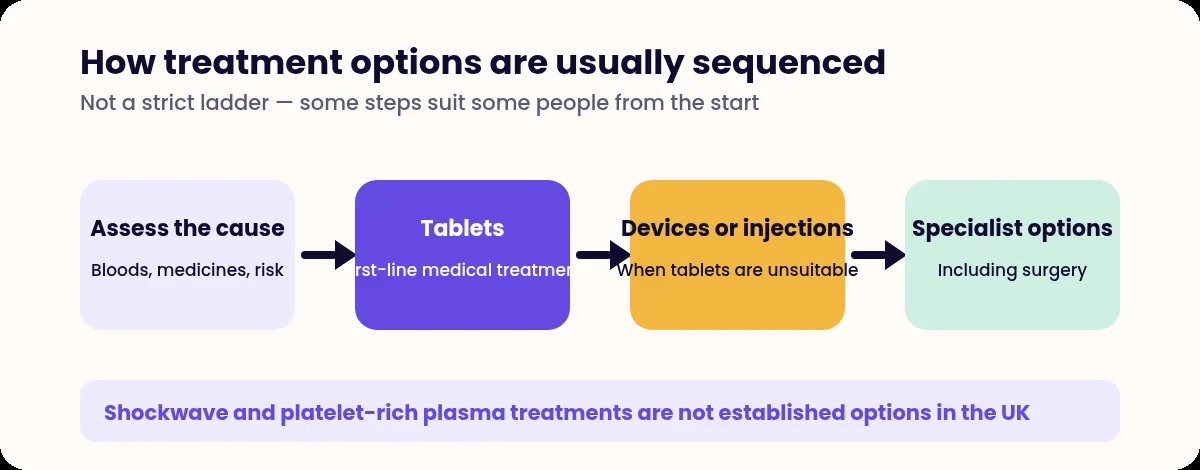
First: the cause
Before any treatment, the underlying picture matters. Erectile dysfunction is frequently the first sign of arterial disease, and an assessment usually includes blood pressure, lipids, HbA1c and sometimes testosterone [1, 2]. It is also commonly medicine-related, and reviewing what you already take can solve it outright.
Our guides to what causes erectile dysfunction and ED and heart disease cover this, and it is not a step to skip in favour of going straight to a treatment.
PDE5 inhibitor tablets
The usual first-line medical treatment in the UK: sildenafil, tadalafil, vardenafil and avanafil [1, 2]. They block the enzyme that breaks down cGMP, so the natural signal that dilates penile arteries is sustained. They do not create arousal — sexual stimulation is still required.
Broadly, they work for a majority of men who use them correctly, with lower response rates in men with long-standing diabetes or after radical prostatectomy.
Before concluding they don’t work, check four things, because a large share of apparent failures are one of them [2]:
- Dose. Have you reached the maximum dose your prescriber considers appropriate?
- Timing. Sildenafil is affected by food and needs time to absorb; tadalafil has a much longer window. Our sildenafil vs tadalafil guide covers the differences.
- Stimulation. Without it, nothing happens. This catches more people than expected.
- Number of attempts. Guidance is to try several separate occasions before judging.
Absolute contraindication: nitrates for angina, and nicorandil. The combination can cause a dangerous fall in blood pressure. Riociguat is also contraindicated. Our guide to PDE5 inhibitors covers the cautions in full.
Vacuum erection devices
A cylinder is placed over the penis and air withdrawn, drawing blood in; a constriction ring at the base then maintains it [2, 4].
Suits: men who cannot take PDE5 inhibitors (including those on nitrates), men after prostate surgery as part of penile rehabilitation, and those who prefer a non-drug approach.
Trade-offs: it takes practice, the erection can feel cooler and hinge at the base, and the ring must not be left on beyond the time stated in the instructions — usually 30 minutes — because of tissue damage risk. Use a device intended for medical use with a pressure-limiting valve, not a novelty product. Caution is needed for anyone on anticoagulants or with a bleeding disorder.
Alprostadil
Alprostadil is a prostaglandin that dilates penile arteries directly, so it does not depend on the nitric oxide pathway and works in many men for whom tablets do not [3].
Urethral routes. A small pellet inserted into the urethra, or a cream applied at the urethral opening. Less invasive than injection; response rates are lower. Local burning or aching is common. There are specific warnings about use with a pregnant partner — a condom is advised.
Intracavernosal injection (Caverject, Viridal). A fine needle used to inject into the side of the shaft. Highly effective, including in men with diabetes or after prostate surgery. The first dose is always given under supervision so the response can be titrated, and men are taught the technique properly [3].
The critical warning is priapism — an erection lasting more than four hours. This is a medical emergency requiring immediate attendance at A&E, because prolonged erection damages the tissue permanently. Anyone using injections must know this before they start. Scarring at injection sites can develop over time and is a reason for periodic review.
Penile implants
Surgically placed devices, either malleable rods or an inflatable system with a pump in the scrotum. Offered through specialist urology services when other options have failed or are unsuitable [2].
Satisfaction rates among men who have them are high. But it is surgery, with infection and mechanical failure risks, and it permanently alters the erectile tissue — other treatments will not work afterwards. It is a considered decision, not a quick one.
Psychosexual therapy
Not an alternative to medical treatment so much as a parallel track, and the right first move where anxiety is driving or maintaining the problem. It is also worth combining with medication where both physical and psychological factors are present, which is most of the time. See performance anxiety and erections.
Lifestyle
Exercise, stopping smoking, weight, sleep and alcohol all measurably affect erectile function and carry benefits far beyond it. See lifestyle changes for erections. These work slowly, which is why they run alongside treatment rather than instead of it.
Treatments with limited or no evidence
Low-intensity shockwave therapy. Studied for over a decade with mixed results and considerable variation in protocols. Not recommended as established treatment in current UK and European guidance outside research settings [2], despite being sold privately, often at several thousand pounds. If a provider offers it, ask which trials they are relying on and what happens if it doesn’t work.
Platelet-rich plasma (“P-shot”). No adequate evidence base. Not recommended.
Stem cell therapy. Experimental. Should only be received within a properly regulated trial.
Herbal and over-the-counter “male enhancement” products. Repeatedly found by regulators to contain undeclared sildenafil or analogues — which is specifically dangerous for anyone on nitrates, since they would be taking the one combination that must be avoided without knowing it.
Where to start
With an assessment. Erectile dysfunction is treatable in the great majority of men, but which treatment suits depends on the cause, your other medicines and what you are willing to use. A UK-registered pharmacy or your GP can make that assessment; anywhere that supplies a prescription medicine without asking about your health and current medicines is not doing so safely [5].
Frequently asked questions
What if tablets don't work?
Review before concluding they have failed: the maximum tolerated dose, correct timing relative to food and sex, adequate sexual stimulation, and several separate attempts all matter. If they genuinely don't work, vacuum devices, alprostadil and referral to a specialist service are the next steps.
Are vacuum pumps available on the NHS?
They can be prescribed in some circumstances, and are available to buy. Devices intended for medical use have a pressure-limiting mechanism; novelty devices do not and can cause injury.
Does shockwave therapy work for ED?
Low-intensity shockwave therapy has been studied and results are mixed. UK and European guidance does not recommend it as an established treatment outside research, and it is widely sold privately at high cost. Ask what trial evidence a provider is relying on.
Is an implant a last resort?
It is generally offered when other treatments have failed or are unsuitable, usually via a specialist urology service. Satisfaction rates in men who have one are high, but it is surgery and it permanently alters the erectile tissue.
References
- NICE Clinical Knowledge Summaries. Erectile dysfunction. cks.nice.org.uk/topics/erectile-dysfunction/
- European Association of Urology. Guidelines on Sexual and Reproductive Health. uroweb.org/guidelines/sexual-and-reproductive-health
- British National Formulary. Alprostadil. bnf.nice.org.uk/drugs/alprostadil/
- NHS. Erection problems (erectile dysfunction). www.nhs.uk/conditions/erection-problems-erectile-dysfunction/
- The Human Medicines Regulations 2012, regulation 284. www.legislation.gov.uk/uksi/2012/1916/regulation/284
Medical reviewer
Naeem Teni
Clinical Lead at Manova. Registered pharmacist and independent prescriber, GPhC 2215591. Reviews Manova’s clinical content for accuracy and safety.
Written by
Manova Editorial Team
Researched and written to our editorial policy, using NICE, NHS, MHRA and peer-reviewed sources.
This article is for general information and isn’t a substitute for advice from your own clinician. If you feel unwell, contact your GP or NHS 111. In an emergency, call 999.