

Key takeaways
- Erectile difficulty is almost never purely psychological or purely physical — most men have some of each, and the split matters less than getting both looked at.
- Erections do change with age, but ageing alone is a poor explanation and a worse reason to accept the problem untreated.
- Erectile dysfunction can precede a cardiac event by several years, which makes it a reason to have your heart and metabolic risk checked rather than a purely sexual complaint.
- Herbal and 'natural' erection products bought online are repeatedly found by regulators to contain undeclared prescription medicines, which is specifically dangerous for anyone taking nitrates.
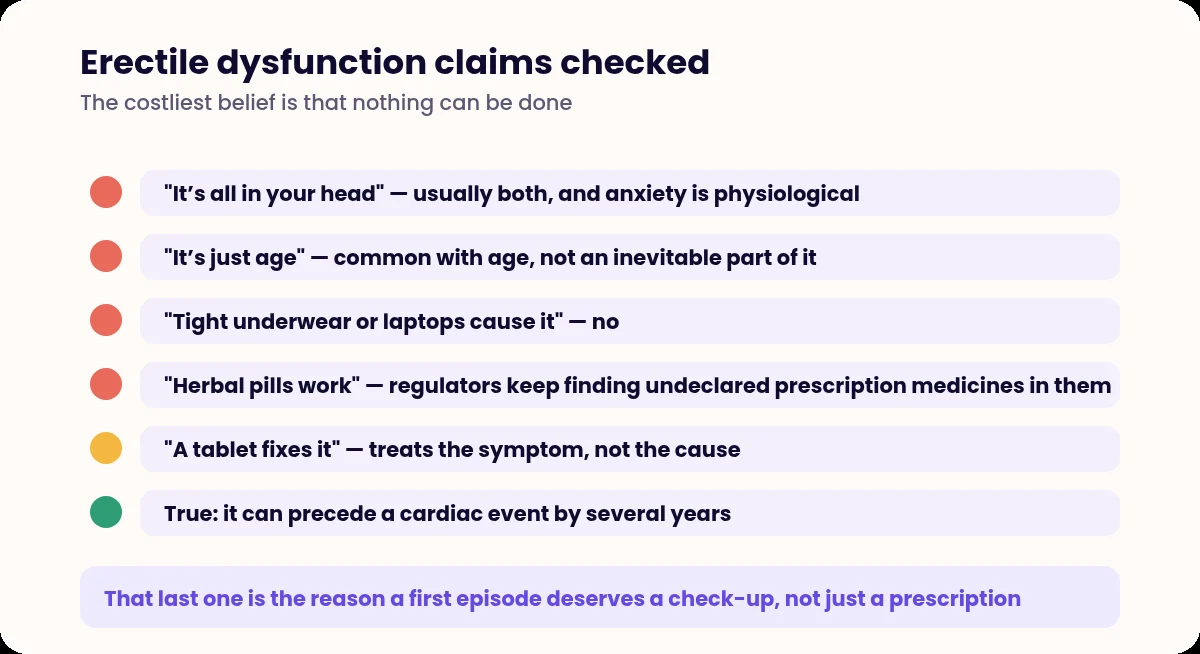
Erectile dysfunction is one of the few common medical problems where most men’s information comes from other men who are equally unsure, plus whatever an advert told them. The result is a stock of beliefs that are confidently held and frequently wrong, and several of them actively delay assessment.
Here are the ones worth dismantling, and one genuinely counterintuitive thing that is true.
“It’s all in your head”
This is the most persistent and the least useful. The honest position is that erections are a neurovascular event with a heavy psychological overlay, and almost nobody sits cleanly at one end of that spectrum.
A man with mild arterial disease who then has one bad night develops anxiety about the next one, and the anxiety produces a sympathetic nervous system state that directly opposes erection. By the time he seeks help, both are real and both need addressing. Telling him it is psychological is not reassurance, it is a dead end — and it implies the fix is willpower, which it is not. Our guide to performance anxiety and erections covers what actually helps when the anxiety loop is the dominant part.
“If you can do it alone, it isn’t physical”
A close relative of the first myth, and clinically the more damaging one because it sounds like reasoning.
Solo erections happen without a partner watching, usually with familiar stimulation, often at a time of day when testosterone is higher. Removing the performance demand changes the outcome even when there is a measurable vascular contribution. The same applies to morning erections: their presence points towards a psychogenic or situational component, but it does not rule out organic disease. And their absence is not diagnostic either, because morning erections are reduced by poor sleep, depression, sleep apnoea, alcohol and some medicines, and most men simply do not wake at the right moment to notice. We go through this properly in our guide to morning erections.
“It’s just ageing, and nothing can be done”
Erectile function does decline with age. But age travels with type 2 diabetes, hypertension, raised cholesterol, medication burden, sleep apnoea and reduced physical activity, and those are the things doing the damage. Age is a marker, not a mechanism.
The practical consequence of believing the myth is that a 62-year-old with new erectile difficulty puts it down to birthdays and never has his HbA1c or blood pressure checked. Among men with diabetes, erectile dysfunction is far more common than in men without — by a wide margin — and it is frequently the symptom that surfaces first [2, 3].
“Only older men get it”
The mirror image, and it makes younger men less likely to speak up rather than more. Reviews of erectile dysfunction in men under 40 report prevalence considerably higher than most men would guess, and conclude that it is under-recognised rather than uncommon. We cover the specifics in ED in younger men.
“Tight underwear, cycling shorts or a laptop caused it”
Underwear and laptops are not a recognised cause of erectile dysfunction. Scrotal temperature has been studied in relation to fertility, which is a separate question with a separate answer.
Cycling is more nuanced but still widely misreported. Large surveys of cyclists have generally not found worse erectile function than in other athletes or the general population; the risk appears concentrated in high-volume riders on traditional nosed saddles, and the warning sign is genital numbness rather than soreness. Our article on cycling and erectile dysfunction sets out the mitigation, which is worth doing whether or not you have symptoms.
“Herbal and ‘natural’ erection pills work”
They do not, and the interesting question is why some men insist they do.
Regulators including the MHRA repeatedly find so-called herbal or “natural” sexual performance products sold online to contain undeclared prescription pharmaceutical ingredients, sometimes at unpredictable doses [5]. That is the usual explanation for a product that appears to work. It also makes these products specifically dangerous, because a man who takes nitrates for angina and believes he is taking a herb has no reason to avoid the interaction — and that combination can cause a dangerous fall in blood pressure. The dose is unknown, the contents are unlabelled, and nothing on the packet warns him.
If you are buying anything online for erections, our guide to buying ED medicines safely explains how to check a UK supplier is legitimate.
“A tablet is a permanent fix”
PDE5 inhibitor tablets are effective for many men, but they treat the symptom while it is in the bloodstream. They do not repair endothelial function, reverse diabetes or resolve anxiety. Used as the sole intervention indefinitely, they leave the underlying cause running.
The more useful framing is that a tablet buys a window — during which weight, activity, alcohol, smoking, sleep and blood pressure are worth actually addressing, because those change the trajectory. Our guide to lifestyle changes for erections covers what has evidence behind it.
“It means you don’t fancy your partner”
Very common, rarely said aloud, and corrosive. Silence around erectile difficulty is far more often read as rejection than as anxiety, which is exactly why it escalates. Talking to your partner about ED is not a soft add-on to treatment; in couples it is frequently the intervention that unlocks the rest.
The counterintuitive thing that is true
Erectile dysfunction can be an early warning of cardiovascular disease, appearing years before a cardiac event.
The mechanism is straightforward once stated. The same endothelial dysfunction and atherosclerosis that narrow coronary arteries also affect the penile arteries, and the penile arteries are narrower — so they show trouble first. Consensus cardiology guidance now treats erectile dysfunction as a risk-enhancing factor for atherosclerotic cardiovascular disease in men aged 40 to 79, with cohort data associating it with a meaningfully raised rate of cardiovascular events, and a commonly cited lead time of roughly three to five years [6].
That is the single most valuable thing in this article. New erectile difficulty is a reasonable prompt to have blood pressure, HbA1c or fasting glucose, lipids and cardiovascular risk assessed [2, 3]. Our guide to ED and heart disease explains what that assessment involves.
When to get seen rather than read
Book a GP or clinic appointment if erectile difficulty has persisted beyond a few weeks, if it is causing distress, or if it arrived alongside chest tightness or breathlessness on exertion. See a clinician promptly for any new penile curvature, lump or pain on erection. And an erection lasting more than four hours is a medical emergency — go to A&E, do not wait it out.
Frequently asked questions
If I can get an erection on my own, does that prove it's psychological?
No. It shifts the odds, but it does not prove anything. Solo erections happen without performance demand, often with different stimulation and often at a different time of day. Plenty of men with early arterial or metabolic disease can still manage an erection alone while struggling with a partner. It is a useful clue, not a diagnosis.
Does tight underwear or a laptop on your lap cause erectile dysfunction?
There is no good evidence that either causes erectile dysfunction. Prolonged scrotal heating has been studied in relation to sperm quality, which is a different question entirely. If you have erection problems, underwear is not the place to look.
Is erectile dysfunction just part of getting older?
It becomes more common with age, but so do diabetes, high blood pressure and vascular disease, and those are doing much of the work. Age is a risk marker, not a mechanism. Treating ageing as the whole explanation is how a treatable cause gets missed.
Do herbal erection supplements work?
There is no reliable evidence that any herbal product improves erectile function. Regulators in the UK and elsewhere repeatedly find such products adulterated with undeclared prescription ingredients. If one appears to work, that is the most likely reason, and it is dangerous for anyone taking nitrates for angina.
References
- NHS. Erection problems (erectile dysfunction). www.nhs.uk/conditions/erection-problems-erectile-dysfunction/
- NICE Clinical Knowledge Summaries. Erectile dysfunction. cks.nice.org.uk/topics/erectile-dysfunction/
- British Society for Sexual Medicine. Guidelines on the management of erectile dysfunction in men. www.bssm.org.uk/guidelines/
- European Association of Urology. Guidelines on Sexual and Reproductive Health. uroweb.org/guidelines/sexual-and-reproductive-health
- Medicines and Healthcare products Regulatory Agency. Buying medicines online and the risks of falsified products. www.gov.uk/government/organisations/medicines-and-healthcare-products-
- Princeton IV Consensus. Sexual activity and cardiovascular risk in men with erectile dysfunction. pubmed.ncbi.nlm.nih.gov/
Medical reviewer
Naeem Teni
Clinical Lead at Manova. Registered pharmacist and independent prescriber, GPhC 2215591. Reviews Manova’s clinical content for accuracy and safety.
Written by
Manova Editorial Team
Researched and written to our editorial policy, using NICE, NHS, MHRA and peer-reviewed sources.
This article is for general information and isn’t a substitute for advice from your own clinician. If you feel unwell, contact your GP or NHS 111. In an emergency, call 999.