

Key takeaways
- Nocturnal erections happen mainly during REM sleep, typically three to five times a night, and become shorter and less frequent with age.
- Their presence is reassuring about the plumbing and the nerves, and points towards a psychological or situational contribution when partnered erections are poor.
- Their absence is not diagnostic of anything on its own — depression, poor sleep, sleep apnoea, alcohol, shift work and some medicines all suppress them.
- Most men do not wake during or straight after an episode, so noticing none is weak evidence that none occurred.
Men are told, usually by the internet, that morning erections are the test that sorts physical erectile dysfunction from psychological. Get them, and the problem is in your head. Lose them, and something is wrong with your body.
That framing is tidy, memorable and wrong in one direction. The presence of morning erections carries real information. Their absence carries much less. Getting this the wrong way round sends anxious men to needless investigation and, worse, reassures men who should be seen.
What is actually happening overnight
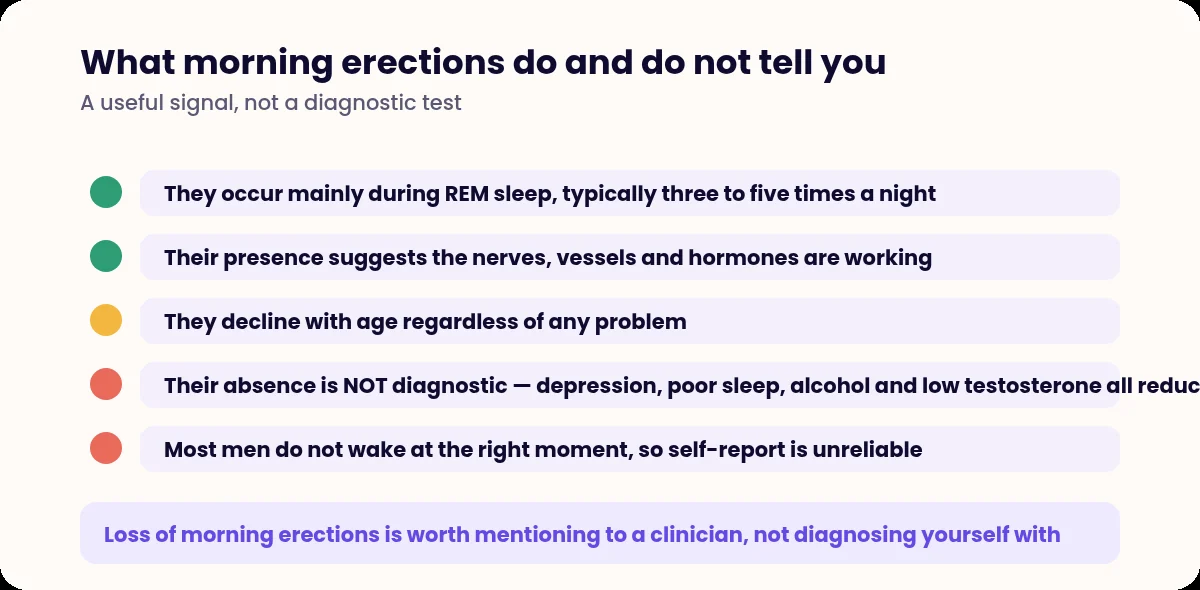
Erections during sleep are called nocturnal penile tumescence. They occur predominantly during REM sleep, and a typical night contains three to five episodes of varying duration. The “morning” erection is usually just the last one of the night, still present when you happen to surface from the final REM period.
The mechanism is essentially a rehearsal of the daytime one without the psychological input. During REM, the sympathetic outflow that normally opposes erection is reduced, nitric oxide signalling proceeds, and the erectile tissue fills. It is testosterone-dependent, nerve-dependent and blood-supply-dependent.
That is why the presence of these erections is genuinely informative. If they are happening, the nerves, the arteries, the venous sealing mechanism and the hormonal environment are all doing enough of their jobs. Where a man has firm nocturnal erections and poor partnered ones, the gap between the two is where the explanation lies — anxiety, relationship context, or a specific situation. Our guide to performance anxiety and erections covers what that gap usually looks like.
Frequency and duration decline progressively with age, and this happens independently of changes in sleep architecture. A man of 55 is not abnormal for having fewer and briefer episodes than he had at 25.
Why absence proves very little
Here is the part most articles get wrong.
Nocturnal erections are suppressed by a long list of things that are not vascular disease. They are androgen-dependent, so low testosterone reduces them. They are reduced by depression. They are reduced by poor or fragmented sleep, by obstructive sleep apnoea, by shift work, by alcohol in the evening, and by several medicines including SSRIs [3, 4].
Every one of those is common. Several of them are reversible. None of them means your arteries are failing.
And you probably cannot tell whether they are happening. This is the underrated point. Most nocturnal episodes occur and resolve entirely during sleep. Whether you wake with one depends largely on when in the REM cycle you happen to wake, which is why men who set an alarm mid-cycle report more of them than men who wake naturally. Not noticing any is weak evidence that none occurred. Self-report is, frankly, a poor instrument.
There is also a reporting problem in the other direction. Men who become worried about erections start monitoring, and monitoring changes what you notice. A man who never paid attention now notices every morning he wakes without one, and concludes that something has changed, when what has changed is the attention.
The formal test, and why you will probably not have it
Nocturnal penile tumescence and rigidity can be measured objectively. The standard device, RigiScan, uses two loops around the penis to record circumference and rigidity continuously over two or three nights at home.
Three things are worth knowing about it.
It is rarely used in routine UK practice. It survives mainly in specialist andrology units and medico-legal work, and NHS access is limited. Most UK assessment of erectile dysfunction proceeds on history, examination and blood tests, without any nocturnal recording at all [1, 2, 4].
It has documented false positives and false negatives. A man can produce a normal tracing and still have significant organic erectile dysfunction; a man with anxiety, poor sleep in an unfamiliar monitoring setup, or depression can produce an abnormal one without vascular disease. It measures what happened on two or three particular nights, which is not always representative.
And it rarely changes management. If the history and bloods point somewhere, the tracing usually confirms what was already suspected. If they do not, the tracing tends to add ambiguity rather than resolve it.
What to do with the information
Treat loss of morning erections as a prompt, not a verdict. It is a reasonable thing to mention to a clinician, and a reasonable trigger for the standard work-up: blood pressure, HbA1c or fasting glucose, lipids, a morning fasting testosterone, and a proper conversation about sleep, mood, alcohol and medicines [2, 3].
The checks that follow are the point. If the reason is undiagnosed type 2 diabetes, that is worth finding. If it is untreated sleep apnoea, that is worth finding — snoring, witnessed pauses in breathing and daytime sleepiness are the things to mention [5]. If it is testosterone deficiency, our guide to low testosterone symptoms explains how that is properly tested, which requires a morning fasting sample and a second confirmatory one. If it is low mood, that is worth treating regardless of what it is doing to erections.
What you should not do is either of the two things men commonly do. Do not conclude, because you still get morning erections, that there is nothing physical worth checking — erectile dysfunction is an established early marker of arterial disease and the checks are worth having either way, as our guide to erectile dysfunction in younger men sets out. And do not conclude, because you have not noticed one for a fortnight, that you have vascular disease.
One more thing worth unlearning
There is a persistent idea that morning erections are caused by a full bladder. They are not. The timing overlap is coincidental: the last REM period of the night tends to fall close to the point at which the bladder is fullest, which is why the two so often arrive together. The erection is a product of sleep stage, not of pressure from below, and the belief matters only because it leads men to attribute a change to their fluid intake rather than to anything worth checking.
When to see someone
See a clinician if erectile difficulty has persisted for more than a few weeks, if it is causing distress, or if the loss of morning erections came alongside other symptoms — fatigue, loss of libido, mood change, weight gain, or new snoring and daytime sleepiness. Take it as one line in a longer history rather than the headline, and our guide to what causes erectile dysfunction covers what that assessment should include.
Sudden loss of erections after pelvic or perineal trauma, or alongside new numbness in the saddle area or bladder or bowel changes, is different and needs urgent assessment rather than a routine appointment.
Frequently asked questions
I've stopped getting morning erections. Does that mean I have a physical problem?
Not on its own. It is a soft signal worth mentioning to a clinician, because it prompts sensible checks of testosterone, glucose, cholesterol, blood pressure, sleep and mood. But low mood, broken sleep, heavy drinking, shift work and several common medicines all reduce them without any vascular disease being present.
How many should I be getting?
Three to five episodes across a night is typical, lasting varying lengths of time, and almost all occur during REM sleep. Frequency and duration decline gradually with age independently of any disease. Because most of them happen while you are asleep and you wake after the last one has faded, counting them is not something you can do from experience.
I still get them but sex is a problem. What does that suggest?
Preserved nocturnal erections with poor partnered ones point towards a psychological or situational contribution — anxiety, relationship factors, or a specific context. It does not rule out a physical contributor entirely, but it shifts the emphasis, and it is one of the more useful things you can tell a clinician.
Is there a test that measures this properly?
Yes, called RigiScan, which records rigidity and circumference over two or three nights. It is rarely used in routine UK practice, is largely confined to specialist andrology and medico-legal settings, and has documented false positives and false negatives. It is not something to ask for as a first step.
References
- NHS. Erection problems (erectile dysfunction). www.nhs.uk/conditions/erection-problems-erectile-dysfunction/
- NICE Clinical Knowledge Summaries. Erectile dysfunction. cks.nice.org.uk/topics/erectile-dysfunction/
- European Association of Urology. Guidelines on Sexual and Reproductive Health. uroweb.org/guidelines/sexual-and-reproductive-health
- British Society for Sexual Medicine. Guidelines on the management of erectile dysfunction in men. www.bssm.org.uk/guidelines/
- NHS. Obstructive sleep apnoea. www.nhs.uk/conditions/obstructive-sleep-apnoea/
Medical reviewer
Naeem Teni
Clinical Lead at Manova. Registered pharmacist and independent prescriber, GPhC 2215591. Reviews Manova’s clinical content for accuracy and safety.
Written by
Manova Editorial Team
Researched and written to our editorial policy, using NICE, NHS, MHRA and peer-reviewed sources.
This article is for general information and isn’t a substitute for advice from your own clinician. If you feel unwell, contact your GP or NHS 111. In an emergency, call 999.