
Key takeaways
- Large surveys of cyclists have generally not found worse erectile function than in other athletes or the general population, including one cross-sectional study of around 5,000 cyclists.
- Risk appears concentrated in high-volume riders using traditional nosed saddles, where body weight loads the perineum rather than the sit bones.
- Genital numbness — not soreness — is the warning sign, because it indicates the pudendal nerve is being compressed.
- Saddle design, saddle angle, saddle height and riding posture measurably reduce perineal pressure, and are worth getting right whether or not you have symptoms.
Every few years a headline announces that cycling causes erectile dysfunction, and every few years a lot of people who should be doing cardiovascular exercise think about not doing it. The evidence does not support the headline. It does support something narrower and more actionable, which is worth understanding properly if you ride.
The short version: for most cyclists, riding is not associated with worse erectile function, and the exercise itself is protective of the vascular system that erections depend on. The risk is concentrated in high-volume riders on traditional nosed saddles, the warning sign is numbness rather than pain, and the mitigation is mostly a matter of equipment and setup.
What the surveys found
Large cross-sectional studies of cyclists have generally not found cyclists to have worse erectile function than other athletes or the general population. One large study of roughly 5,000 cyclists found no association with erectile dysfunction — although it did find that genital numbness and saddle sores were commonly reported [3].
That combination is the key to the whole topic. The pressure effect is real and riders feel it. What has not been demonstrated is that it translates, for the average rider, into erectile dysfunction. Those are different claims and the distance between them is where most of the misreporting happens.
The mechanism, which is real
A conventional nosed saddle is designed so that your weight sits on the ischial tuberosities — the sit bones. In practice, particularly on a road bike with a forward-rotated pelvis and a low handlebar, a substantial share of that weight moves onto the perineum: the soft tissue between the sit bones.
The pudendal artery and the pudendal nerve run through that area. Loading it compresses them between the saddle nose and the pubic bone. Reduced perineal blood flow and nerve compression are measurable, and measurement studies show that noseless saddles substantially reduce perineal pressure and improve penile oxygenation [2].
So the physiology is not in dispute. What is in dispute is the dose at which it becomes clinically meaningful, and the survey data suggest that for recreational riders it usually does not.
Numbness is the warning sign, not pain
This is the most useful single point in the article, and it is the one riders most often get backwards.
Saddle soreness is a skin and soft-tissue complaint. It is unpleasant, it can cause infected follicles and saddle sores, and it needs managing — but it is not the signal we are talking about here.
Numbness is the nerve telling you it is being compressed. Tingling, a dead feeling in the perineum, or loss of sensation in the penis during or after a ride all indicate that pressure is falling where it should not. If you get numb on the bike, that is a setup problem to fix now rather than something to build tolerance to.
Numbness that lingers after you get off the bike, or that is accompanied by new erectile difficulty, is worth a clinician’s opinion. So is any new penile pain, curvature or lump, which is a separate issue entirely.
How to set a bike up so this doesn’t happen
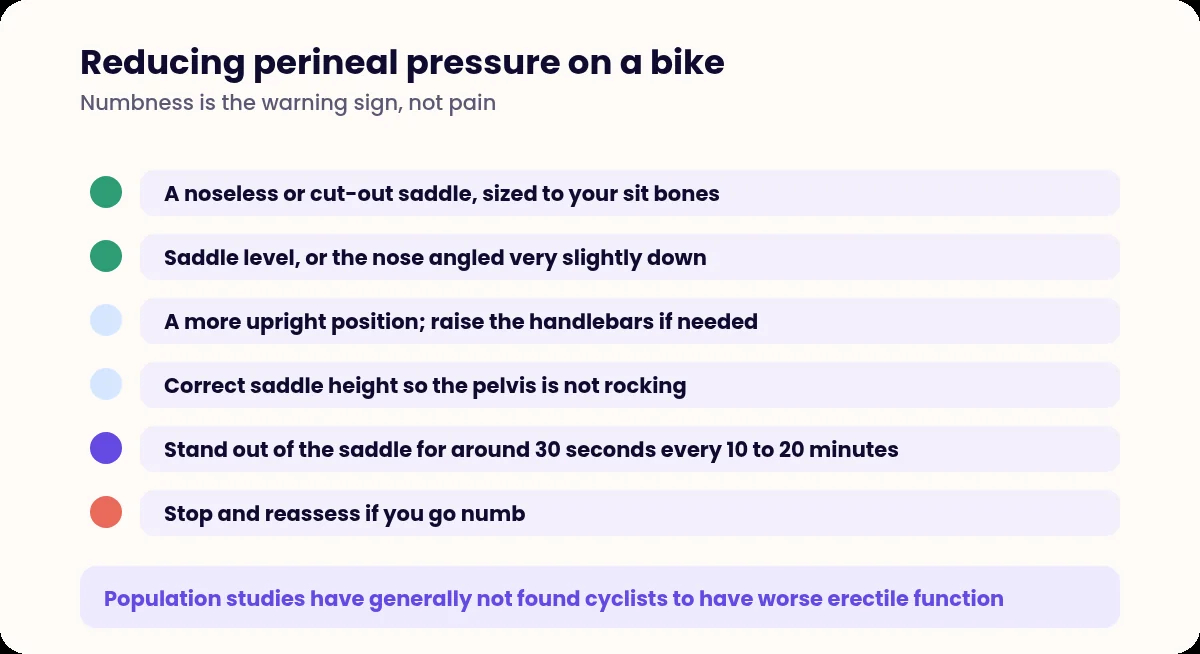
The 2020 systematic review and meta-analysis found that saddle design, saddle position and riding posture all measurably reduce perineal pressure [2]. This is the practical part.
Get the saddle width right first. A saddle only supports you on the sit bones if it is wide enough for your sit bones. Most decent bike shops will measure sit-bone width, often on a simple gel pad, and it takes two minutes. A too-narrow saddle pushes load forward onto the perineum no matter what else you do.
Choose a cut-out or noseless design. A central cut-out or channel relieves the pressure over the perineum directly. Fully noseless saddles reduce perineal pressure the most, with the trade-off that many riders steer partly through thigh and saddle contact, so handling takes some adjustment. For most people a well-sized cut-out saddle is the pragmatic choice.
Set the saddle level, or with the nose very slightly down. Nose-up tilts load straight onto the perineum. A small nose-down angle reduces perineal pressure, though too much tips you forward onto your hands and wrists.
Get the saddle height right. Too high and your pelvis rocks side to side to reach the pedals, grinding the perineum with every stroke.
Sit more upright. More upright postures reduce perineal pressure. On a road bike that may mean raising the bars or shortening the reach rather than abandoning the position entirely.
Wear proper padded shorts, with nothing underneath. Padded shorts spread load and reduce friction. Underwear beneath them creates seams and moisture, which is how saddle sores start.
Stand up out of the saddle for about 30 seconds every 10 to 20 minutes. This is the single easiest habit to adopt and it restores perfusion. On a long ride it matters more than anything else on this list.
Should you cycle less?
The NHS advises against cycling for more than three hours a week if you already have erection problems [1]. That is a sensible precaution in a specific group, not a general population limit, and it is often quoted out of that context.
For most men the calculation runs the other way. Regular aerobic exercise improves endothelial function, blood pressure, weight and insulin sensitivity, and those are the things that determine erectile function over a lifetime — as our guide to lifestyle changes for erections sets out. Giving up cycling to protect your erections, when cycling is your only exercise, is very likely a net loss.
If you have erectile difficulty and you are a high-volume rider on a nosed saddle, a reasonable experiment is to fix the setup, cut volume temporarily, and swap some of it for a non-saddle activity for six to eight weeks. If nothing changes, cycling was not the cause, and the question moves on to the wider list in our guide to erectile dysfunction causes.
When it isn’t the bike
It is easy to blame the most visible thing. Before settling on the saddle, consider what else changed around the same time: alcohol intake, sleep, a new medicine, weight, mood, or a new relationship context. In younger men in particular, psychological and situational factors are the most common drivers, which our article on ED in younger men covers.
See a clinician if erectile difficulty has lasted more than a few weeks, if numbness persists off the bike, or if there is any perineal pain that does not settle within a day or two of riding.
Frequently asked questions
Does cycling cause erectile dysfunction?
For most riders, the evidence does not support that. Large cross-sectional studies of cyclists, including one of around 5,000 riders, have generally found no association with erectile dysfunction, although genital numbness and saddle sores were commonly reported. The concern is concentrated in high-volume riders on traditional nosed saddles.
How much cycling is too much?
There is no firm threshold in the evidence. The NHS advises against cycling for more than three hours a week if you already have erection problems, which is a sensible precaution rather than a demonstrated cut-off. For most riders without symptoms, saddle setup matters more than weekly hours.
What does numbness while cycling mean?
It means the pudendal nerve is being compressed between the saddle nose and your pubic bone, and that the same pressure is likely affecting the pudendal artery. Treat it as a setup problem to fix immediately rather than something to ride through. Numbness that persists after you get off the bike warrants a clinician's opinion.
Are noseless saddles better?
For perineal pressure, yes — noseless and cut-out designs substantially reduce it and improve penile oxygenation in measurement studies. Noseless saddles take some getting used to for bike handling, since many riders steer partly through saddle contact. A well-fitted cut-out saddle of the right width is a reasonable middle ground.
References
- NHS. Erection problems (erectile dysfunction). www.nhs.uk/conditions/erection-problems-erectile-dysfunction/
- Systematic review and meta-analysis of saddle design, position and posture on perineal pressure in cyclists. Sports Medicine, 2020. pubmed.ncbi.nlm.nih.gov/
- Large cross-sectional study of cyclists, erectile function, genital numbness and saddle sores. pubmed.ncbi.nlm.nih.gov/
- NICE Clinical Knowledge Summaries. Erectile dysfunction. cks.nice.org.uk/topics/erectile-dysfunction/
- British Society for Sexual Medicine. Guidelines on the management of erectile dysfunction in men. www.bssm.org.uk/guidelines/
- NHS. Physical activity guidelines for adults aged 19 to 64. www.nhs.uk/live-well/exercise/physical-activity-guidelines-19-64-year-
Medical reviewer
Naeem Teni
Clinical Lead at Manova. Registered pharmacist and independent prescriber, GPhC 2215591. Reviews Manova’s clinical content for accuracy and safety.
Written by
Manova Editorial Team
Researched and written to our editorial policy, using NICE, NHS, MHRA and peer-reviewed sources.
This article is for general information and isn’t a substitute for advice from your own clinician. If you feel unwell, contact your GP or NHS 111. In an emergency, call 999.