

Key takeaways
- Erectile recovery after radical prostatectomy continues for up to 24 to 36 months, so function at three or six months is not the final answer.
- Published potency rates vary enormously depending on how potency was defined and which men were studied, which is why no single percentage is meaningful.
- Nerve-sparing matters: bilateral nerve-sparing gives the best outcomes, unilateral less, and non-nerve-sparing surgery least.
- Penile rehabilitation is widely offered but has not been shown definitively to improve long-term unassisted erectile function.
Most men leave the pre-operative appointment with a number in their head. A percentage, quoted quickly, about how many men get their erections back after a radical prostatectomy.
That number is close to meaningless, and it is worth explaining why before anything else. Published potency rates after prostate surgery vary enormously depending on how the researchers defined potency — erections firm enough for penetration, erections without medication, a score above a threshold on a questionnaire — and on which men were included. A series of young men with excellent baseline function and bilateral nerve-sparing surgery produces a figure that bears no relation to a series of older men with pre-existing erectile difficulty. Both get published. Neither tells you what will happen to you.
What is much more useful is understanding the shape of the recovery.
The timeline is years, not months
The cavernous nerves run in bundles immediately alongside the prostate. Even when a surgeon preserves them completely, the handling, stretching and thermal exposure involved in dissecting them free causes neuropraxia — a temporary loss of function in a structurally intact nerve.
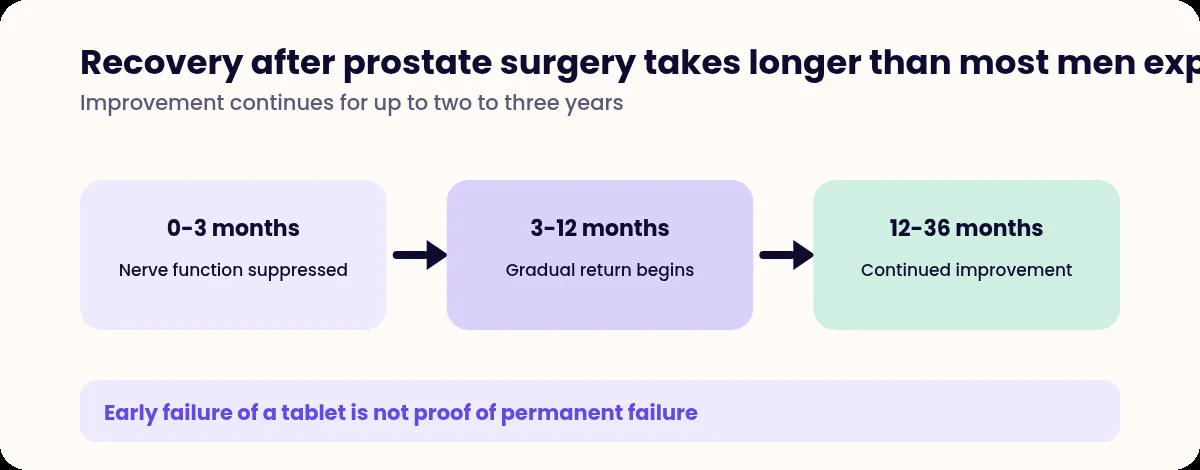
Nerve recovery is slow. Erectile function after radical prostatectomy continues to improve for up to 24 to 36 months [1]. Most of the gain happens in the first year to eighteen months, but improvement genuinely does continue beyond that.
This has one very practical consequence: early failure is not proof of permanent failure. A man who cannot achieve an erection at three months, and concludes it is over, is making a judgement at the wrong point on the curve. It is the single most common misunderstanding in this area.
Nerve-sparing is the main determinant
There is a clear gradient in outcomes, consistent across studies:
- Bilateral nerve-sparing — best outcomes, earliest recovery.
- Unilateral nerve-sparing — intermediate.
- Non-nerve-sparing — poorest spontaneous recovery.
Whether nerve-sparing is possible is a cancer decision, not a sexual one. Where the tumour is close to or through the capsule, sparing the nerves would mean leaving cancer behind, and no reasonable surgeon will trade that. If you do not know which was performed in your case, ask — it changes what to expect and it changes the conversation about treatment.
Other factors that consistently predict recovery: age, erectile function before surgery, and vascular health. A man who already had significant erectile difficulty before the operation is not going to have better function afterwards, which is why an honest baseline conversation before surgery matters. If diabetes or vascular disease is part of the background, our article on what causes erectile dysfunction covers how those contributions stack up.
Why tablets often fail early
PDE5 inhibitors do not create an erection. They prevent the breakdown of a messenger molecule downstream of nitric oxide released by the cavernous nerves. If those nerves are in neuropraxia, there is very little nitric oxide being released, so there is very little for the drug to work on [1].
That explains the pattern men describe: nothing at all at two months, partial response at eight months, better response at eighteen. The drug did not change. The nerve did. Our explainer on how PDE5 inhibitors work sets out the mechanism.
All of these medicines are prescription only in the UK and require assessment before use, particularly if you take nitrates or alpha blockers for prostate symptoms.
Penile rehabilitation: what the evidence supports
“Penile rehabilitation” is the practice of starting treatment early after surgery — usually a daily or on-demand PDE5 inhibitor, sometimes a vacuum device or injections — with the aim of preserving the tissue while the nerves recover. The theory is reasonable: without regular oxygenated blood flow, cavernosal smooth muscle undergoes fibrosis and loses elasticity, and that change may be permanent.
The evidence is less tidy than the theory. The REACTT trial compared daily and on-demand PDE5 inhibitor treatment with placebo after bilateral nerve-sparing surgery [3]. A 2021 systematic review and network meta-analysis in the Journal of Urology pulled the field together [4]. The bottom line from that body of work is consistent and worth stating plainly: there is no consensus on the optimal timing, agent or protocol, and rehabilitation has not been shown definitively to improve long-term unassisted erectile function.
That is not a reason to refuse it. Early treatment helps many men resume sexual activity sooner, which matters in itself, and the potential tissue benefit is biologically plausible even if unproven. It is a reason to be sceptical of anyone selling a rehabilitation protocol as established fact.
What is actually available
European guidance for 2025 recommends PDE5 inhibitors, vacuum erection devices and intracavernosal injections for erectile dysfunction after radical prostatectomy [1].
Vacuum devices work mechanically and do not depend on nerve function at all, which makes them useful early. Some rehabilitation protocols use them daily for tissue oxygenation rather than for sex.
Intracavernosal injections act directly on cavernosal smooth muscle, bypassing the nerve signal entirely. This is why they often work when tablets do not, and why they are the usual next step. They need proper teaching and a supervised first dose.
Penile prosthesis surgery is considered where function has not recovered after a reasonable period — usually at least two years — and other options have failed. Satisfaction rates are high.
Our comparison of ED treatments covers how these options differ in practice.
The parts nobody warns you about
Orgasm changes. It becomes dry, because the prostate and seminal vesicles have been removed. Some men find the sensation altered or shorter. Climacturia — leaking urine at orgasm — is common early on and usually improves with pelvic floor work.
Penile shortening is reported by a proportion of men, and is one of the reasons early rehabilitation is offered.
And the psychological load is substantial: cancer, continence, and sexual function all at once, usually while everyone around you is relieved the operation went well. That is worth naming to the specialist nurse rather than absorbing.
When to ask for more
Ask for a referral to a specialist in sexual function if you are more than six months out and have had no discussion of options beyond a repeat prescription, if tablets have been tried properly and not worked, or if the psychological impact is not improving. Prostate cancer specialist nurses can usually route this quickly [6].
Frequently asked questions
How long does it take for erections to come back after a prostatectomy?
Longer than most men expect. Recovery of the cavernous nerves is slow and improvement continues for up to 24 to 36 months after surgery. Judging the outcome at three or six months is premature. Men who have had bilateral nerve-sparing surgery tend to recover earlier and more completely than those who have not.
Why do erection tablets not work straight after surgery?
PDE5 inhibitors amplify a nerve-derived nitric oxide signal rather than generating one. While the cavernous nerves are still in neuropraxia after being stretched or handled during surgery, there is little signal to amplify. That is why early non-response is common and is not proof that the tablets will never work.
Does penile rehabilitation work?
The honest answer is that it is not settled. Trials including the REACTT study and later systematic reviews have not established an optimal agent, dose or timing, and rehabilitation has not been shown definitively to improve long-term unassisted erectile function. Many surgeons still offer it, reasonably, on a theoretical basis and because it helps men resume sexual activity sooner.
Will I still have orgasms?
Usually yes, though they change. The prostate and seminal vesicles are removed, so ejaculation no longer happens and orgasm is dry. Some men notice altered intensity, a shorter sensation, or leakage of urine at climax. These are common, rarely discussed in advance, and worth raising with the specialist nurse.
References
- European Association of Urology. Guidelines on Sexual and Reproductive Health. uroweb.org/guidelines/sexual-and-reproductive-health
- NICE. Prostate cancer: diagnosis and management. NG131. www.nice.org.uk/guidance/ng131
- Montorsi F et al. REACTT: effects of daily and on-demand PDE5 inhibitor treatment after bilateral nerve-sparing radical prostatectomy. European Urology. www.europeanurology.com/
- Systematic review and network meta-analysis of penile rehabilitation after radical prostatectomy. Journal of Urology, 2021. www.auajournals.org/guides/juro
- NHS. Prostate cancer treatment. www.nhs.uk/conditions/prostate-cancer/treatment/
- Prostate Cancer UK. Sex and prostate cancer. prostatecanceruk.org/
Medical reviewer
Naeem Teni
Clinical Lead at Manova. Registered pharmacist and independent prescriber, GPhC 2215591. Reviews Manova’s clinical content for accuracy and safety.
Written by
Manova Editorial Team
Researched and written to our editorial policy, using NICE, NHS, MHRA and peer-reviewed sources.
This article is for general information and isn’t a substitute for advice from your own clinician. If you feel unwell, contact your GP or NHS 111. In an emergency, call 999.