

Key takeaways
- When you lose weight through diet alone, a meaningful share of what you lose can be lean tissue, including muscle.
- Strength training two or more days a week is the most effective way to protect muscle while you lose fat.
- Higher protein intakes (around 1.2 to 1.6 g per kg of body weight a day) help preserve muscle during a calorie deficit, unless a clinician has advised otherwise.
- Losing weight gradually, sleeping well and eating enough overall all help protect muscle.
Most people want to lose fat. But the scales can’t tell the difference between fat, water and muscle. Lose weight quickly through diet alone, and a noticeable part of what comes off can be lean tissue [1].
That matters. Muscle keeps you strong and mobile, helps control blood sugar and makes everyday life easier as you age. Keeping it also makes it easier to keep the weight off. The good news: protecting muscle comes down to a few simple, well-proven habits.
Why you lose muscle when you lose weight
When you eat less energy than you use, your body draws on its stores. Most of that comes from fat, but some comes from lean tissue, especially if:
- your calorie deficit is very large
- you eat relatively little protein
- you don’t give your muscles a reason to stay (no resistance exercise)
- you’re older, as muscle is harder to maintain with age
A review of weight-loss studies found that without exercise, a substantial fraction of the weight lost is lean mass. Combining diet with exercise, particularly resistance training, reduces that loss considerably [1].
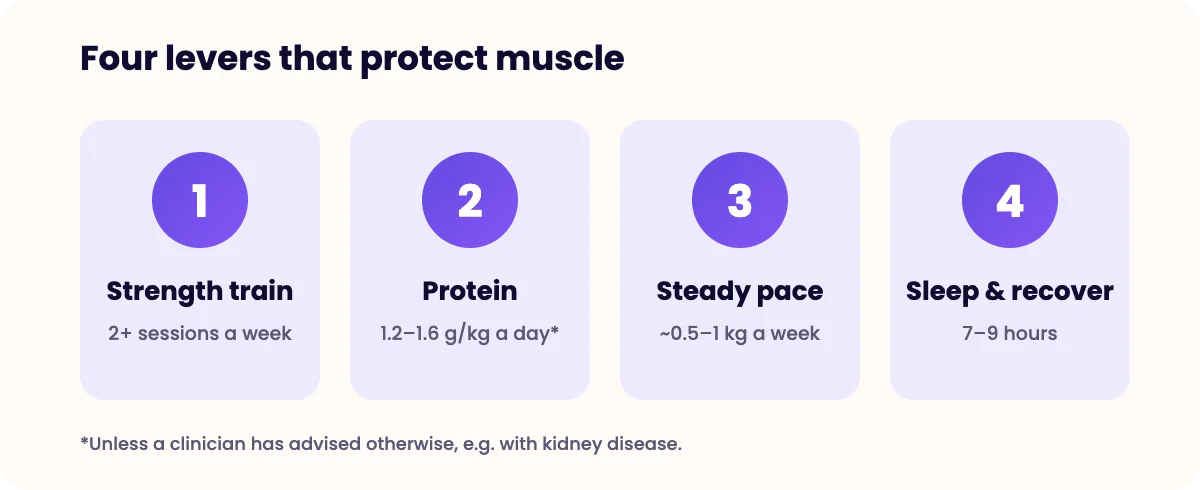
1. Strength train at least twice a week
Resistance training is the single biggest lever. It signals to your body that muscle is needed, so it’s preserved while fat is used for energy.
A trial in older adults with obesity who were dieting compared aerobic training, resistance training and both combined. The combined group improved physical function most, and adding resistance exercise reduced the loss of lean mass and bone density that dieting alone can cause [4].
The UK Chief Medical Officers recommend muscle-strengthening activity on at least two days a week for all adults [7]. That could be:
- gym sessions with weights or machines
- bodyweight exercises at home (squats, lunges, push-ups, rows with a resistance band)
- classes such as circuits or Pilates with resistance
A simple starting routine (30 minutes, twice a week): squats, push-ups (against a wall or bench if needed), bent-over rows with dumbbells or a band, glute bridges, and a plank. Do 2–3 sets of 8–12 repetitions. Increase the weight or difficulty gradually as it gets easier. This “progressive overload” is what drives results.
2. Eat enough protein, spread through the day
Protein provides the building blocks for muscle and is also the most filling nutrient.
- The UK reference intake for adults is 0.75 g per kg of body weight a day [6]. That’s designed to prevent deficiency, not to optimise muscle during weight loss.
- A large meta-analysis of resistance-training studies found benefits for muscle up to around 1.6 g per kg a day, with little extra gain beyond that [3].
- In a controlled trial during an aggressive calorie deficit plus intense training, a very high protein intake (2.4 g per kg) led to lean mass gain and more fat loss than a lower intake (1.2 g per kg) [2].
For most adults losing weight, 1.2 to 1.6 g per kg a day is a sensible target. For someone who weighs 90 kg, that’s about 110–145 g a day.
Spread it out. Muscle-building responds best to protein distributed across meals, roughly 0.4 g per kg per meal over three or four meals, rather than one large dose at dinner [5].
| Food | Approx. protein |
|---|---|
| 150 g chicken breast (cooked) | 45 g |
| 200 g 0% Greek yoghurt | 20 g |
| 3 medium eggs | 19 g |
| 1 can (145 g drained) tuna | 36 g |
| 200 g cooked lentils | 18 g |
| 150 g firm tofu | 20 g |
Values are typical; check product labels.
A note on kidneys: higher protein intakes are safe for most healthy adults, but if you have chronic kidney disease, speak to your clinician first.
3. Lose weight steadily, not drastically
Very aggressive diets make muscle loss more likely and are harder to stick to. The NHS recommends aiming for around 0.5 to 1 kg a week [8]. A moderate deficit you can keep up beats a crash diet you abandon.
4. Keep moving between workouts
Daily steps, taking stairs and active commuting all add up. Aerobic activity improves heart health and helps reduce visceral fat, and it works well alongside strength training.
5. Sleep and recover
Muscle repairs while you rest. Consistently short sleep increases appetite and makes training feel harder. Aim for 7–9 hours.
How to tell if it’s working
Don’t rely on the scales alone. Track:
- Waist measurement every two weeks
- Strength: are the weights or reps going up?
- How clothes fit and how you feel day to day
- Progress photos, if you find them helpful
If your weight is falling but you’re getting noticeably weaker, it’s a sign to increase protein, reduce the size of your deficit or prioritise strength training. It also helps to understand why weight loss can stall as your body adapts.
When to speak to a clinician
Check with a clinician before starting a new exercise programme if you have heart disease, chest pain on exertion, uncontrolled blood pressure, or joint problems. Speak to your GP if you notice unexplained muscle weakness or wasting.
Frequently asked questions
How much protein do I need to lose weight without losing muscle?
The UK reference intake for adults is 0.75 g of protein per kg of body weight a day, but research on weight loss and training suggests benefits up to around 1.6 g per kg. For a 90 kg adult that's roughly 110 to 145 g a day, spread across meals. If you have kidney disease, check with your clinician before increasing protein.
Can you build muscle while losing fat?
Yes, particularly if you're new to strength training or returning after a break. Combining a moderate calorie deficit with resistance training and higher protein has been shown to increase lean mass while reducing fat mass in controlled studies.
Is cardio bad for muscle when losing weight?
No. Aerobic exercise is excellent for heart health and visceral fat. The key is to add strength training alongside it, not replace one with the other. Doing both gives the best results for body composition.
How do I know if I'm losing muscle or fat?
Signs you may be losing muscle include getting weaker in everyday tasks or at the gym, and your weight falling while your waist barely changes. Tracking your waist measurement and strength (for example, how many push-ups or how heavy a lift) gives a better picture than the scales alone.
References
- Cava E, Yeat NC, Mittendorfer B. Preserving healthy muscle during weight loss. Advances in Nutrition. 2017;8(3):511-519. doi.org/10.3945/an.116.014506
- Longland TM, Oikawa SY, Mitchell CJ, Devries MC, Phillips SM. Higher compared with lower dietary protein during an energy deficit combined with intense exercise promotes greater lean mass gain and fat mass loss: a randomized trial. The American Journal of Clinical Nutrition. 2016;103(3):738-746. doi.org/10.3945/ajcn.115.119339
- Morton RW, Murphy KT, McKellar SR, et al. A systematic review, meta-analysis and meta-regression of the effect of protein supplementation on resistance training-induced gains in muscle mass and strength in healthy adults. British Journal of Sports Medicine. 2018;52(6):376-384. doi.org/10.1136/bjsports-2017-097608
- Villareal DT, Aguirre L, Gurney AB, et al. Aerobic or resistance exercise, or both, in dieting obese older adults. New England Journal of Medicine. 2017;376(20):1943-1955. doi.org/10.1056/NEJMoa1616338
- Schoenfeld BJ, Aragon AA. How much protein can the body use in a single meal for muscle-building? Implications for daily protein distribution. Journal of the International Society of Sports Nutrition. 2018;15:10. doi.org/10.1186/s12970-018-0215-1
- British Nutrition Foundation. Protein. www.nutrition.org.uk/nutritional-information/protein/
- Department of Health and Social Care. UK Chief Medical Officers' physical activity guidelines. Updated 10 July 2026. www.gov.uk/government/collections/physical-activity-guidelines
- NHS inform. Tips for losing weight safely. www.nhsinform.scot/healthy-living/weight-loss/tips-for-losing-weight-s
Medical reviewer
Naeem Teni
Clinical Lead at Manova. Registered pharmacist and independent prescriber, GPhC 2215591. Reviews Manova’s clinical content for accuracy and safety.
Written by
Manova Editorial Team
Researched and written to our editorial policy, using NICE, NHS, MHRA and peer-reviewed sources.
This article is for general information and isn’t a substitute for advice from your own clinician. If you feel unwell, contact your GP or NHS 111. In an emergency, call 999.