
Key takeaways
- Weight loss naturally slows over time because a smaller body uses less energy, and your body also adapts by increasing appetite.
- Short-term 'stalls' of a week or two are often water, not fat. Look at the trend over 3–4 weeks.
- Common fixes: re-check portions honestly, raise protein, add strength training, increase daily steps and improve sleep.
- A long plateau can also be your body's new maintenance point. Holding a lower weight is itself a success.
You were doing everything right and the scales were moving. Then, for weeks, nothing. It’s one of the most frustrating parts of losing weight, and one of the most common reasons people give up.
A plateau doesn’t mean your plan has failed. It means your body has changed. Here’s why it happens and what you can do about it.
Is it a plateau or just a stall?
Body weight naturally swings by 1–2 kg from day to day because of water, salt, carbohydrate stores, bowel contents and, for women, the menstrual cycle. So a week without progress isn’t necessarily a plateau.
Look at the trend. Weigh yourself at the same time (for example, first thing in the morning after the toilet) and compare weekly averages over 3–4 weeks. If the average hasn’t moved in a month, you’ve hit a genuine plateau.
Why weight loss slows down
1. A smaller body needs less energy
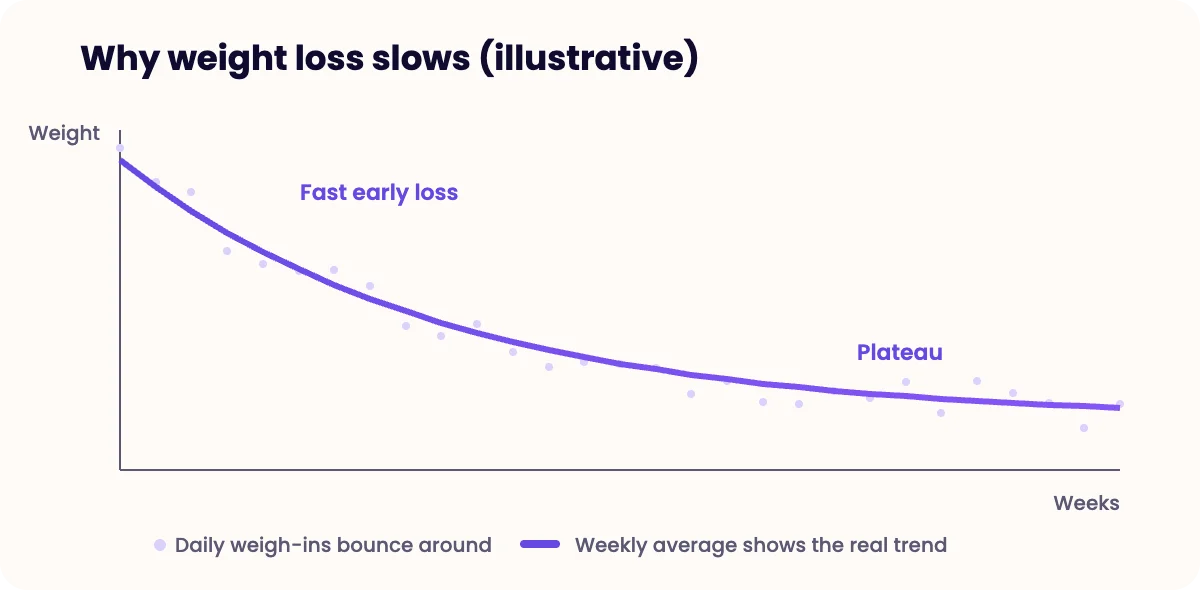
Every kilo you lose reduces the energy your body needs to function and move. So the same diet that created a deficit at 100 kg creates a much smaller one at 90 kg. Mathematical modelling of real-world weight change shows that weight loss naturally follows a curve: fast at first, then slowing until it levels off, even if you change nothing [1].
2. Your metabolism adapts
Beyond the drop you’d expect from being smaller, your body becomes more energy-efficient during weight loss. This is called adaptive thermogenesis [2]. Your muscles do the same work with less fuel, and you may unconsciously move less (fidgeting, pacing, taking the stairs).
3. Hunger hormones push back
After weight loss, levels of hunger-related hormones change in ways that increase appetite. In one study these changes were still present a year later [3]. You may notice you’re hungrier or think about food more, which makes “calorie creep” more likely.
4. Calorie creep
Portions grow, weekend meals get bigger, a daily coffee becomes a latte and a pastry. Most people underestimate what they eat. In a classic study, people who described themselves as “diet resistant” under-reported their food intake by around half and over-reported their activity [4]. That isn’t dishonesty. It’s simply very hard to track food by memory.
5. Muscle loss
If you’ve lost weight without strength training or enough protein, some of it may be muscle, which lowers your energy needs further. See our guide to losing weight without losing muscle.
7 ways to break a weight loss plateau
- Audit a typical week honestly. Track everything for 7 days, including drinks, cooking oils, sauces and weekend meals. Most people find 200–400 “hidden” calories a day.
- Prioritise protein and fibre. Build meals around a palm-sized (or larger) portion of protein and half a plate of vegetables. Both are filling for relatively few calories.
- Cut liquid calories. Alcohol, sugary drinks, juices and large milky coffees add up quickly and don’t fill you up.
- Add strength training. Two sessions a week helps protect muscle, which supports your energy needs over time [7].
- Increase daily movement. Everyday activity falls during weight loss without you noticing. Setting a step target (and increasing it by 1,000–2,000 a day) counters this.
- Fix your sleep. Short sleep increases appetite and cravings. Our guide to sleep and weight loss explains the evidence.
- Consider a planned maintenance break. In the MATADOR trial, men who alternated two weeks of dieting with two weeks at maintenance lost more fat and kept more of it off than those who dieted continuously [5]. A deliberate pause can help you reset and keep going.
When a plateau is your new normal
Sometimes a plateau means you’ve reached the weight your current lifestyle supports. That isn’t failure. Keeping weight off is harder than losing it, and holding a lower weight for months is a real achievement for your health.
If you still have health reasons to lose more weight, the choice is whether to change your habits further, or seek structured support. For most people, slow and steady (around 0.5–1 kg a week while losing) is the most sustainable pace [6].
When to speak to a clinician
See your GP if your weight is stuck despite consistent changes and you also feel unusually tired, cold, low in mood, constipated, or notice changes to your periods, hair or skin. Conditions such as an underactive thyroid, and some medicines (including certain antidepressants, steroids and diabetes treatments), can affect weight. Don’t stop any prescribed medicine without advice.
Frequently asked questions
How long does a weight loss plateau last?
It varies. Short stalls caused by water retention often resolve within one to two weeks. A true plateau, where your energy intake now matches your lower energy needs, lasts until something changes: your food intake, activity or both. If your weight hasn't moved for over a month despite consistent habits, it's time to review your plan.
Is it starvation mode?
Not in the way it's often described. Your metabolism does slow somewhat when you lose weight (known as adaptive thermogenesis), and appetite hormones shift to make you hungrier, but your body doesn't stop losing fat while in a genuine calorie deficit. Plateaus usually reflect a smaller deficit than you think.
Should I eat less to break a plateau?
Cutting calories sharply often backfires by increasing hunger and muscle loss. Small, sustainable changes, such as more protein and vegetables, fewer liquid calories, and extra daily steps, are usually more effective. Some people also benefit from a planned week or two at maintenance before resuming weight loss.
Why do I weigh more after a workout?
Hard or new exercise causes temporary inflammation and fluid retention in muscles as they repair, which can add weight on the scales for several days. It's not fat gain and usually settles as your body adapts.
References
- Hall KD, Sacks G, Chandramohan D, et al. Quantification of the effect of energy imbalance on bodyweight. The Lancet. 2011;378(9793):826-837. doi.org/10.1016/S0140-6736(11)60812-X
- Rosenbaum M, Leibel RL. Adaptive thermogenesis in humans. International Journal of Obesity. 2010;34(Suppl 1):S47-S55. doi.org/10.1038/ijo.2010.184
- Sumithran P, Prendergast LA, Delbridge E, et al. Long-term persistence of hormonal adaptations to weight loss. New England Journal of Medicine. 2011;365(17):1597-1604. doi.org/10.1056/NEJMoa1105816
- Lichtman SW, Pisarska K, Berman ER, et al. Discrepancy between self-reported and actual caloric intake and exercise in obese subjects. New England Journal of Medicine. 1992;327(27):1893-1898. doi.org/10.1056/NEJM199212313272701
- Byrne NM, Sainsbury A, King NA, Hills AP, Wood RE. Intermittent energy restriction improves weight loss efficiency in obese men: the MATADOR study. International Journal of Obesity. 2018;42(2):129-138. doi.org/10.1038/ijo.2017.206
- NHS inform. Tips for losing weight safely. www.nhsinform.scot/healthy-living/weight-loss/tips-for-losing-weight-s
- Department of Health and Social Care. UK Chief Medical Officers' physical activity guidelines. Updated 10 July 2026. www.gov.uk/government/collections/physical-activity-guidelines
Medical reviewer
Naeem Teni
Clinical Lead at Manova. Registered pharmacist and independent prescriber, GPhC 2215591. Reviews Manova’s clinical content for accuracy and safety.
Written by
Manova Editorial Team
Researched and written to our editorial policy, using NICE, NHS, MHRA and peer-reviewed sources.
This article is for general information and isn’t a substitute for advice from your own clinician. If you feel unwell, contact your GP or NHS 111. In an emergency, call 999.