

Key takeaways
- Visceral fat is stored deep inside the abdomen around organs such as the liver and intestines. It's more strongly linked to type 2 diabetes and heart disease than fat under the skin.
- You can't see or pinch visceral fat, but a waist-to-height ratio of 0.5 or more is a good sign you're carrying too much.
- Sit-ups won't target it: spot reduction doesn't work. Regular aerobic exercise reduces visceral fat even when the scales barely move.
- Overall weight loss, cutting back on alcohol, better sleep and managing stress all help.
“Belly fat” gets talked about as one thing. In fact your abdomen stores fat in two quite different places, and one of them matters far more for your long-term health.
This guide explains what visceral fat is, how to tell whether you carry too much, and what the evidence says actually reduces it. It’s not endless crunches.
Visceral fat vs subcutaneous fat
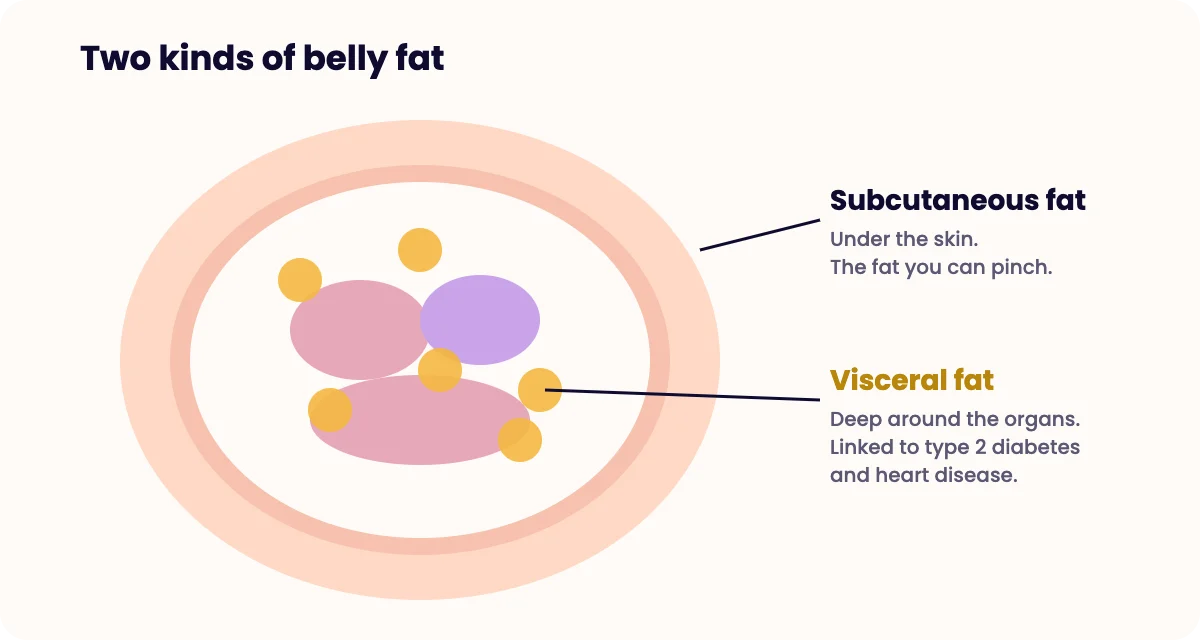
- Subcutaneous fat sits just under the skin. It’s the soft fat you can pinch on your stomach, hips and thighs.
- Visceral fat is stored deeper, inside the abdominal cavity, wrapped around organs such as the liver, pancreas and intestines. You can’t pinch it. A firm, rounded stomach, rather than a soft one, is often a sign of more visceral fat.
Everyone needs some of both. Problems start when visceral fat builds up.
Why visceral fat is harmful
Visceral fat isn’t just stored energy. It’s metabolically active tissue that releases fatty acids and inflammatory chemicals straight into the blood supply to the liver. An international position statement concluded that excess visceral and “ectopic” fat (fat stored in and around organs) is a key driver of [1]:
- insulin resistance and type 2 diabetes
- raised blood pressure and unhealthy cholesterol
- fatty liver disease
- heart attack and stroke
This is why two people with the same BMI can have very different health risks. The one carrying more weight around the middle is usually at greater risk.
How to tell if you have too much visceral fat
You don’t need a scan. The most practical check is your waist-to-height ratio, which NICE recommends alongside BMI [2]:
- Measure your waist halfway between your lowest rib and the top of your hip bone, breathing out normally.
- Divide by your height (same units).
| Result | What it suggests |
|---|---|
| Below 0.5 | Healthy level of central fat |
| 0.5 to 0.59 | Increased central fat and health risk |
| 0.6 or more | High central fat and health risk |
For example, if you’re 175 cm tall, a waist above 87.5 cm means it’s time to take action. Our guide to healthy BMI in the UK explains how the two measures work together.
What causes visceral fat to build up?
- Genetics and sex. Men and women after the menopause tend to store more fat centrally.
- Age. Visceral fat tends to increase as we get older, even if weight stays similar.
- Calorie surplus. Taking in more energy than you use over months and years.
- Inactivity. Long periods sitting, and little aerobic exercise.
- Alcohol. Alcohol is energy-dense and easy to overconsume.
- Poor sleep and chronic stress. Both disrupt appetite and hormones, and stress hormone (cortisol) responses have been linked to central fat [7].
How to lose visceral fat: what the evidence supports
1. Forget spot reduction
You can’t burn fat from one area by working the muscles underneath it. In a controlled trial, adults who did seven abdominal exercises five days a week for six weeks lost no more belly fat than those who didn’t [4]. Core work is still good for strength and posture. It just won’t shrink your waist on its own.
2. Move more, especially aerobic exercise
Exercise is particularly good at shifting visceral fat. A meta-analysis of 117 studies found that while dieting produced more weight loss on the scales, exercise tended to reduce visceral fat more and cut it by around 6% even in studies where body weight didn’t change [3].
The UK Chief Medical Officers recommend at least 150 minutes of moderate activity a week (brisk walking, cycling, swimming), or 75 minutes of vigorous activity, plus strength training on two days [5]. If you’re starting from zero, a daily 20–30 minute brisk walk is a genuinely effective beginning.
3. Create a steady calorie deficit
Visceral fat usually responds early to overall weight loss. You don’t need extreme diets. Focus on:
- protein at each meal (it keeps you fuller and protects muscle)
- vegetables, pulses and whole grains for fibre
- fewer ultra-processed snacks and sugary drinks
- portions that leave you comfortably satisfied, not stuffed
4. Cut back on alcohol
The UK low-risk guideline is no more than 14 units a week, spread over three or more days [6]. That’s about six pints of average-strength beer or six medium glasses of wine. Beyond the health risks, alcohol adds calories and tends to increase snacking.
5. Protect your sleep
Short sleep increases appetite. In a randomised trial, adults with overweight who extended their sleep by about 1.2 hours a night ate around 270 fewer calories a day without being told to diet [8]. Aim for 7–9 hours. Our guide to sleep and weight loss explains why.
6. Manage stress
Walking outdoors, exercise, social time and good sleep all help keep stress in check. If stress is leading to comfort eating, it’s worth tackling directly, with support if you need it.
When to speak to a clinician
Speak to your GP or a registered clinician if your waist-to-height ratio is 0.6 or more, or 0.5 or more with a family history of type 2 diabetes or heart disease. They can check your blood pressure, blood sugar (HbA1c) and cholesterol. Get medical advice promptly if your abdomen is swelling rapidly, or if you have unexplained weight loss, persistent pain or yellowing of the skin or eyes.
Frequently asked questions
What's the fastest way to lose visceral fat?
There's no shortcut, but visceral fat tends to respond earlier than other fat stores. A combination of a modest calorie deficit, around 150 minutes a week of moderate aerobic activity plus strength training, less alcohol and good sleep is the best-supported approach. Many people see their waist measurement fall within weeks.
Can you have visceral fat if you're slim?
Yes. Some people with a healthy BMI still store excess fat around their organs, sometimes called 'normal weight central obesity'. That's why checking your waist-to-height ratio is useful whatever your weight.
Do crunches or sit-ups burn belly fat?
No. Abdominal exercises strengthen the muscles underneath but don't selectively burn the fat on top or inside. In one controlled trial, six weeks of daily abdominal exercises didn't reduce belly fat compared with no exercise. Whole-body activity and overall fat loss are what shrink the waist.
How can I measure visceral fat accurately?
Scans such as MRI, CT or DEXA measure it directly, but they're rarely needed. For most people, waist-to-height ratio is a practical and well-validated guide. Home 'visceral fat' scales give an estimate based on electrical impedance and can be inconsistent, so look at trends rather than single readings.
References
- Neeland IJ, Ross R, Després JP, et al. Visceral and ectopic fat, atherosclerosis, and cardiometabolic disease: a position statement. The Lancet Diabetes & Endocrinology. 2019;7(9):715-725. doi.org/10.1016/S2213-8587(19)30084-1
- National Institute for Health and Care Excellence. Overweight and obesity management (NG246), section 1.9. Published 14 January 2025. www.nice.org.uk/guidance/ng246/chapter/Identifying-and-assessing-overw
- Verheggen RJHM, Maessen MFH, Green DJ, et al. A systematic review and meta-analysis on the effects of exercise training versus hypocaloric diet: distinct effects on body weight and visceral adipose tissue. Obesity Reviews. 2016;17(8):664-690. doi.org/10.1111/obr.12406
- Vispute SS, Smith JD, LeCheminant JD, Hurley KS. The effect of abdominal exercise on abdominal fat. Journal of Strength and Conditioning Research. 2011;25(9):2559-2564. doi.org/10.1519/JSC.0b013e3181fb4a46
- Department of Health and Social Care. UK Chief Medical Officers' physical activity guidelines. Updated 10 July 2026. www.gov.uk/government/collections/physical-activity-guidelines
- Department of Health and Social Care. UK Chief Medical Officers' low risk drinking guidelines. www.gov.uk/government/publications/alcohol-consumption-advice-on-low-r
- Epel ES, McEwen B, Seeman T, et al. Stress and body shape: stress-induced cortisol secretion is consistently greater among women with central fat. Psychosomatic Medicine. 2000;62(5):623-632. doi.org/10.1097/00006842-200009000-00005
- Tasali E, Wroblewski K, Kahn E, Kilkus J, Schoeller DA. Effect of sleep extension on objectively assessed energy intake among adults with overweight in real-life settings: a randomized clinical trial. JAMA Internal Medicine. 2022;182(4):365-374. doi.org/10.1001/jamainternmed.2021.8098
Medical reviewer
Naeem Teni
Clinical Lead at Manova. Registered pharmacist and independent prescriber, GPhC 2215591. Reviews Manova’s clinical content for accuracy and safety.
Written by
Manova Editorial Team
Researched and written to our editorial policy, using NICE, NHS, MHRA and peer-reviewed sources.
This article is for general information and isn’t a substitute for advice from your own clinician. If you feel unwell, contact your GP or NHS 111. In an emergency, call 999.