
Key takeaways
- In the UK, a healthy BMI is 18.5 to 24.9. Overweight is 25 to 29.9 and obesity starts at 30.
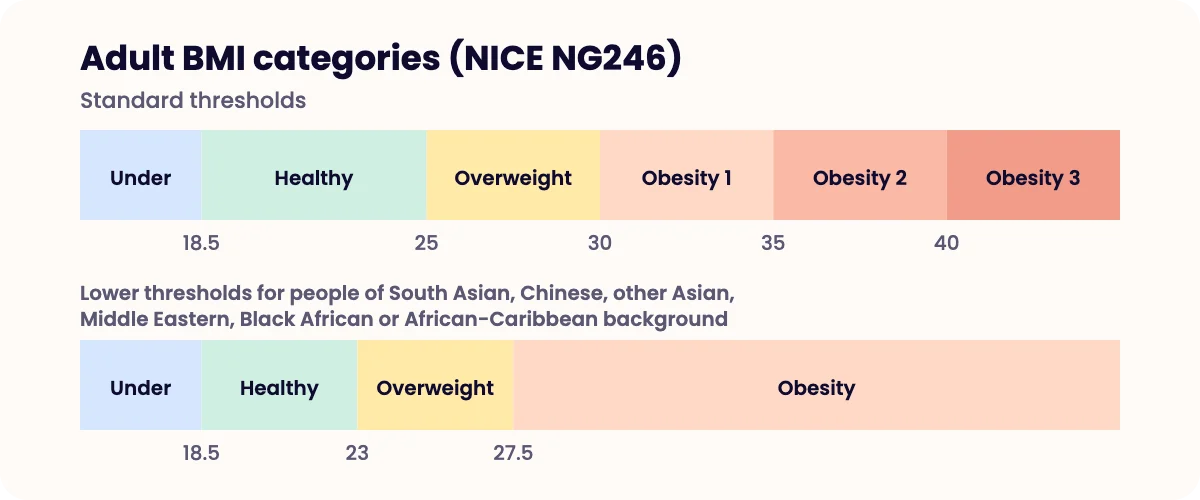
- NICE recommends lower thresholds for people with a South Asian, Chinese, other Asian, Middle Eastern, Black African or African-Caribbean background: overweight from 23 and obesity from 27.5.
- BMI can't tell fat from muscle or show where fat is stored. NICE advises measuring waist-to-height ratio too.
- A healthy waist-to-height ratio is below 0.5. In other words, keep your waist to less than half your height.
If you’ve ever put your height and weight into a calculator and wondered what the number actually means, you’re not alone. Body mass index (BMI) is the first thing most clinicians check when talking about weight. It’s quick, free and genuinely useful. But it has blind spots, and the “healthy” range isn’t the same for everyone.
Here’s what the UK ranges are, who should use different thresholds, and the simple extra measurement that tells you far more about your health.
What is BMI?
BMI is your weight in kilograms divided by your height in metres squared. For example, someone who weighs 85 kg and is 1.78 m tall has a BMI of 85 ÷ (1.78 × 1.78) = 26.8.
It was designed to describe populations, not individuals. It’s still used because, across large groups of people, a higher BMI tracks closely with a higher risk of type 2 diabetes, high blood pressure, heart disease and some cancers [6].
What is a healthy BMI in the UK?
NICE (the National Institute for Health and Care Excellence) uses these adult categories [1]:
| BMI | Category |
|---|---|
| Below 18.5 | Underweight |
| 18.5 to 24.9 | Healthy weight |
| 25 to 29.9 | Overweight |
| 30 to 34.9 | Obesity class 1 |
| 35 to 39.9 | Obesity class 2 |
| 40 or above | Obesity class 3 |
These are the same bands the NHS BMI calculator uses [2]. In England, most adults are now above the healthy range: the Health Survey for England found around two in three adults were overweight or living with obesity in 2022 [5].
Do BMI ranges differ by ethnicity?
Yes. This is one of the most important and least-known parts of UK guidance.
People from some ethnic backgrounds develop conditions such as type 2 diabetes at a lower BMI. So NICE recommends lower thresholds for adults with a South Asian, Chinese, other Asian, Middle Eastern, Black African or African-Caribbean family background [1]:
- Overweight: BMI 23 to 27.4
- Obesity: BMI 27.5 or above
So a British South Asian man with a BMI of 28 is classed as living with obesity. On the standard chart he’d look “only overweight”. Clinical services should apply these thresholds when assessing risk and eligibility for support, and it’s worth asking about them if they haven’t been mentioned.
What BMI doesn’t tell you
BMI is a starting point, not a diagnosis. Its main limits:
- It can’t tell fat from muscle. A rugby player and a sedentary office worker can have the same BMI with very different body fat. NICE advises interpreting BMI with caution in adults with high muscle mass [1].
- It ignores where fat is stored. Fat around the organs (visceral fat) carries more health risk than fat under the skin of the hips and thighs. Two people with identical BMIs can have very different risk depending on their waistline.
- It’s less reliable in older adults. NICE advises caution in people aged 65 and over, where a slightly higher BMI may even be protective [1].
- It doesn’t measure health. In 2025 an international Lancet commission argued that BMI alone shouldn’t be used to diagnose obesity. It should be confirmed with another body measurement, such as waist size, or a direct measure of fat, and clinicians should assess whether excess fat is actually affecting how the body works [4].
The better check: waist-to-height ratio
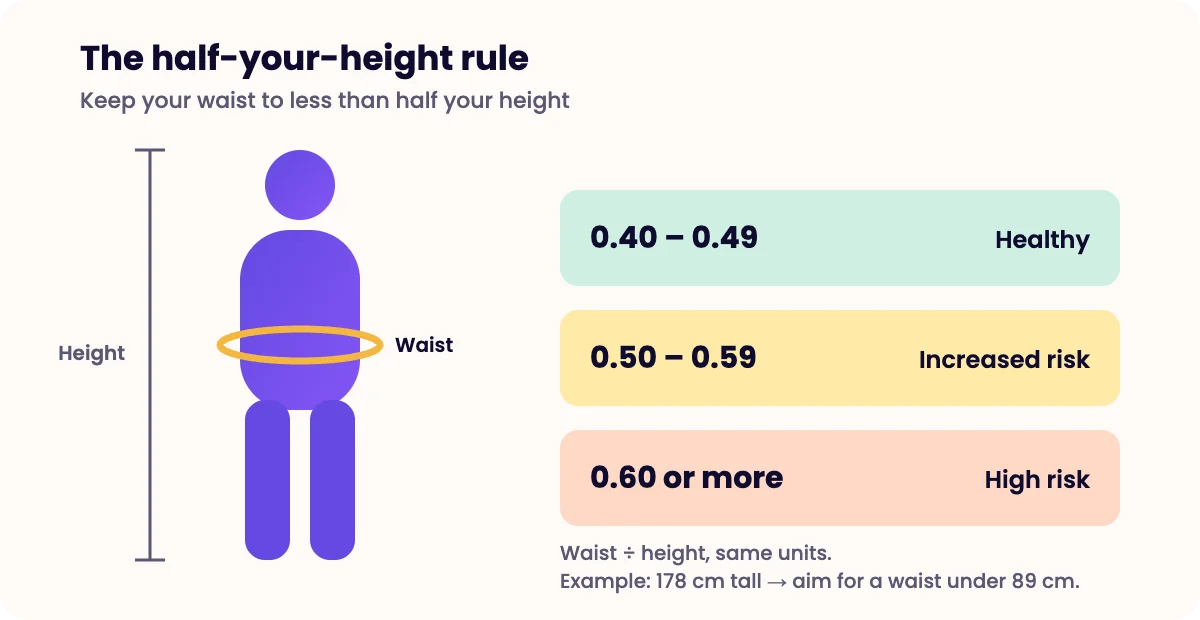
Since 2022, NICE has recommended that adults with a BMI below 35 also measure their waist-to-height ratio [1]. It’s simple: your waist should be less than half your height.
How to measure it
- Find the midpoint between the bottom of your lowest rib and the top of your hip bone.
- Wrap a tape measure around at that level, snug but not tight, and breathe out normally.
- Divide your waist measurement by your height, using the same units (both in cm, or both in inches).
What the result means [1]
| Waist-to-height ratio | Central fat |
|---|---|
| 0.4 to 0.49 | Healthy |
| 0.5 to 0.59 | Increased: higher health risk |
| 0.6 or more | High: further increased health risk |
For example, someone 178 cm tall should aim for a waist under 89 cm. A meta-analysis of more than 300,000 adults found waist-to-height ratio was a better screening tool for heart and metabolic risk than either BMI or waist circumference alone [3]. It also uses the same cut-off for men and women and across ethnic groups.
What to do with your numbers
- BMI and waist-to-height ratio both in the healthy range: great. Keep the habits that got you here: regular activity, strength training, good sleep and a mostly whole-food diet.
- BMI is high but your waist is healthy and you’re muscular: your risk may be lower than the BMI suggests. Waist size and blood tests (such as blood pressure, blood sugar and cholesterol) give a fuller picture.
- Waist-to-height ratio 0.5 or more, whatever your BMI: this is worth acting on. Losing even a few centimetres from your waist improves blood pressure, blood sugar and cholesterol for most people. Read our guide to visceral fat and how to reduce it.
- BMI 30 or more (27.5 or more with the lower thresholds): you may benefit from structured, clinician-led support rather than going it alone.
When to speak to a clinician
Speak to your GP or a registered clinician if you have a high BMI or waist-to-height ratio and also:
- have a family history of type 2 diabetes or heart disease
- are often very thirsty, need to pass urine often or feel unusually tired
- snore heavily or stop breathing during sleep
- have lost weight without trying
If you have chest pain, sudden breathlessness or symptoms of a stroke, call 999.
Frequently asked questions
What BMI is classed as obese in the UK?
A BMI of 30 or above is classed as obesity for most adults. It's split into class 1 (30 to 34.9), class 2 (35 to 39.9) and class 3 (40 or above). If you have a South Asian, Chinese, other Asian, Middle Eastern, Black African or African-Caribbean background, NICE classes obesity from a BMI of 27.5.
Is BMI accurate if I'm muscular?
Not always. BMI only uses height and weight, so people with a lot of muscle can be labelled overweight when their body fat is healthy. NICE advises interpreting BMI with caution in adults with high muscle mass, and using waist-to-height ratio alongside it.
How do I measure my waist-to-height ratio?
Measure your waist midway between the bottom of your ribs and the top of your hips, breathing out normally. Divide that number by your height in the same units. A result of 0.4 to 0.49 is healthy; 0.5 to 0.59 means increased central fat; 0.6 or more is high.
Is a healthy BMI different for older people?
NICE advises interpreting BMI with caution in people aged 65 and over, taking into account other health conditions, physical function and the possible protective effect of a slightly higher BMI in later life. A clinician can help put your number in context.
References
- National Institute for Health and Care Excellence. Overweight and obesity management (NG246), section 1.9: Identifying and assessing overweight, obesity and central adiposity. Published 14 January 2025. www.nice.org.uk/guidance/ng246/chapter/Identifying-and-assessing-overw
- NHS. Calculate your body mass index (BMI) for adults. www.nhs.uk/health-assessment-tools/calculate-your-body-mass-index/calc
- Ashwell M, Gunn P, Gibson S. Waist-to-height ratio is a better screening tool than waist circumference and BMI for adult cardiometabolic risk factors: systematic review and meta-analysis. Obesity Reviews. 2012;13(3):275-286. doi.org/10.1111/j.1467-789X.2011.00952.x
- Rubino F, Cummings DE, Eckel RH, et al. Definition and diagnostic criteria of clinical obesity. The Lancet Diabetes & Endocrinology. 2025;13(3):221-262. doi.org/10.1016/S2213-8587(24)00316-4
- NHS England. Health Survey for England, 2022 Part 2: Adult overweight and obesity. digital.nhs.uk/data-and-information/publications/statistical/health-su
- NHS. Overweight and obesity in adults. www.nhs.uk/conditions/overweight-and-obesity/
Medical reviewer
Naeem Teni
Clinical Lead at Manova. Registered pharmacist and independent prescriber, GPhC 2215591. Reviews Manova’s clinical content for accuracy and safety.
Written by
Manova Editorial Team
Researched and written to our editorial policy, using NICE, NHS, MHRA and peer-reviewed sources.
This article is for general information and isn’t a substitute for advice from your own clinician. If you feel unwell, contact your GP or NHS 111. In an emergency, call 999.