
Key takeaways
- Large studies of energy expenditure show metabolic rate is essentially stable from age 20 to 60, then declines slowly.
- The usual drivers of midlife weight gain are lost muscle, less incidental movement, worse sleep and more alcohol.
- Around menopause, fat tends to redistribute towards the abdomen even when total weight is unchanged.
- The fixes are unglamorous: resistance training twice a week, protein at each meal, and protecting sleep.
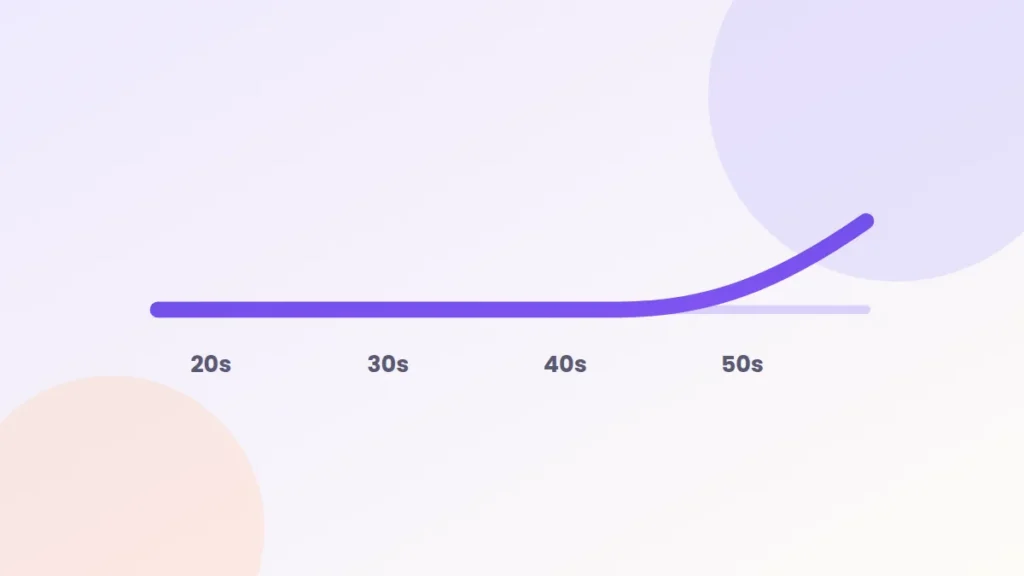
There is a story almost everyone has been told: after 40, your metabolism slows down and weight gain becomes inevitable. It is a comforting explanation. It is also, by the best available evidence, wrong.
What the data actually shows
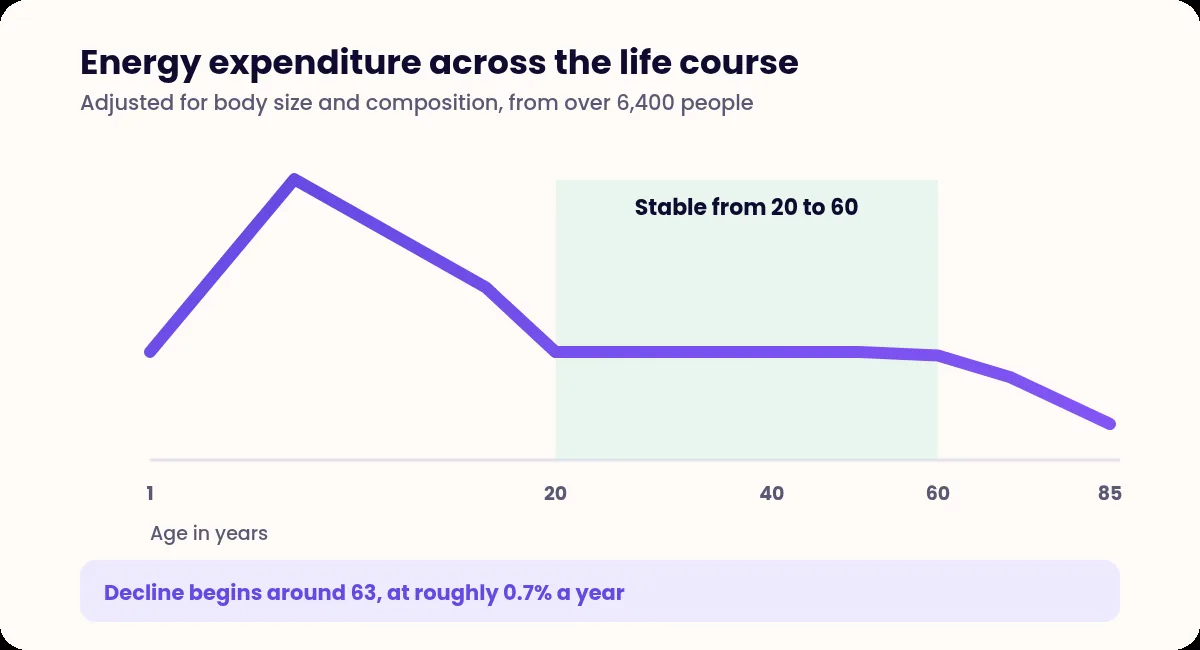
In 2021, researchers pooled doubly labelled water measurements — the gold standard for measuring real-world energy expenditure — from more than 6,400 people aged 8 days to 95 years across 29 countries. The pattern surprised almost everyone.
Energy expenditure, once adjusted for body size and composition, is essentially flat from around age 20 to age 60. Only after about 63 does it begin to decline, and then at roughly 0.7% a year [1].
So if metabolism is not the culprit, what is?
The four things that really change
1. You have less muscle than you did
From around 30, adults lose roughly 3 to 8% of muscle mass per decade unless they train [3]. Less muscle means a slightly lower resting burn, but more importantly it means a body that stores glucose less efficiently and looks softer at the same weight. This is the single most modifiable item on the list — see strength training over 40.
2. You move less without noticing
Not exercise: incidental movement. Promotions replace site work with desk work. Children stop needing carrying. Cars get used for journeys that used to be walked. None of it registers as a decision, and together it can account for hundreds of calories a day.
3. Sleep gets worse
Midlife brings broken sleep from hot flushes, caring responsibilities, work stress and, increasingly, sleep apnoea. Short sleep reliably raises appetite and shifts food choices towards calorie-dense options.
4. Alcohol quietly accumulates
The forties and fifties are, for many people, the decades of most social drinking. Two glasses of wine four nights a week is roughly 1,500 calories that leave you no fuller.
What changes at menopause
Menopause has a specific and separate effect. Longitudinal data from the SWAN study shows that fat mass rises and lean mass falls most sharply in the year or so either side of the final period, and that fat redistributes towards the abdomen [2]. Many women find their waist measurement increases even when their weight does not.
That abdominal shift matters because visceral fat is the type most linked to blood pressure, cholesterol and type 2 diabetes risk. It also means the scales alone are a poor way to track progress in this period — take a waist measurement as well.
What actually works in midlife
Resistance training twice a week. The highest-value change on the list, because it acts on the muscle loss that everything else compounds.
Protein at every meal. Roughly 25 to 30 g per meal supports muscle retention far better than one large protein-heavy dinner.
Protect sleep deliberately. A consistent wake time and a genuine wind-down hour are not luxuries here.
Audit the drinking, honestly. Count a normal week, not a good one.
Measure your waist, not just your weight. Halfway between the lowest rib and the top of the hip bone, after breathing out.
When to speak to a clinician
Make an appointment if you have:
- weight gain that is rapid or unexplained
- increasing thirst, tiredness or needing to pass urine at night
- menopausal symptoms that are affecting your sleep or daily life
- a waist measurement over 94 cm (men) or 80 cm (women), which raises cardiometabolic risk
- weight gain that started shortly after a new medication
A clinician can check thyroid function, HbA1c, blood pressure and lipids, and discuss whether treatment is appropriate.
Frequently asked questions
Does your metabolism slow down after 40?
Not as much as people assume. A large international study of over 6,000 people found that energy expenditure adjusted for body composition is stable from roughly age 20 to 60, and only then starts to fall by about 0.7% a year.
Why do I gain weight around my middle in midlife?
Falling oestrogen around menopause shifts where fat is stored, from hips and thighs towards the abdomen. In men, gradual declines in testosterone and activity have a similar effect. Waist measurement often rises even when the scales do not.
Is it harder to lose weight at 50?
The biology is not dramatically different, but the circumstances often are: less time, more sitting, poorer sleep, more social drinking and less muscle. Addressing those usually matters more than the number on your birth certificate.
How much weight do people typically gain in midlife?
Cohort studies commonly find around half a kilogram a year through the forties and fifties. It is slow enough to go unnoticed year to year and adds up to a stone or more across a decade.
References
- Pontzer H, Yamada Y, Sagayama H, et al. Daily energy expenditure through the human life course. Science. 2021;373(6556):808-812. doi.org/10.1126/science.abe5017
- Greendale GA, Sternfeld B, Huang M, et al. Changes in body composition and weight during the menopause transition. JCI Insight. 2019;4(5):e124865. doi.org/10.1172/jci.insight.124865
- Volpi E, Nazemi R, Fujita S. Muscle tissue changes with aging. Current Opinion in Clinical Nutrition and Metabolic Care. 2004;7(4):405-410. doi.org/10.1097/01.mco.0000134362.76653.b2
- NHS. Menopause. www.nhs.uk/conditions/menopause/
- NICE. Obesity: identification, assessment and management. CG189. www.nice.org.uk/guidance/cg189
Medical reviewer
Naeem Teni
Clinical Lead at Manova. Registered pharmacist and independent prescriber, GPhC 2215591. Reviews Manova’s clinical content for accuracy and safety.
Written by
Manova Editorial Team
Researched and written to our editorial policy, using NICE, NHS, MHRA and peer-reviewed sources.
This article is for general information and isn’t a substitute for advice from your own clinician. If you feel unwell, contact your GP or NHS 111. In an emergency, call 999.