

Key takeaways
- Androgenetic alopecia roughly follows the rule that the percentage of men affected matches their age in decades, so around 20% of men in their 20s, and around 16% of men aged 18 to 29 show moderate to extensive loss in population surveys.
- The psychological impact is inversely related to age of onset and correlates poorly with objective severity — mild loss in a 22-year-old can be more distressing than extensive loss at 55.
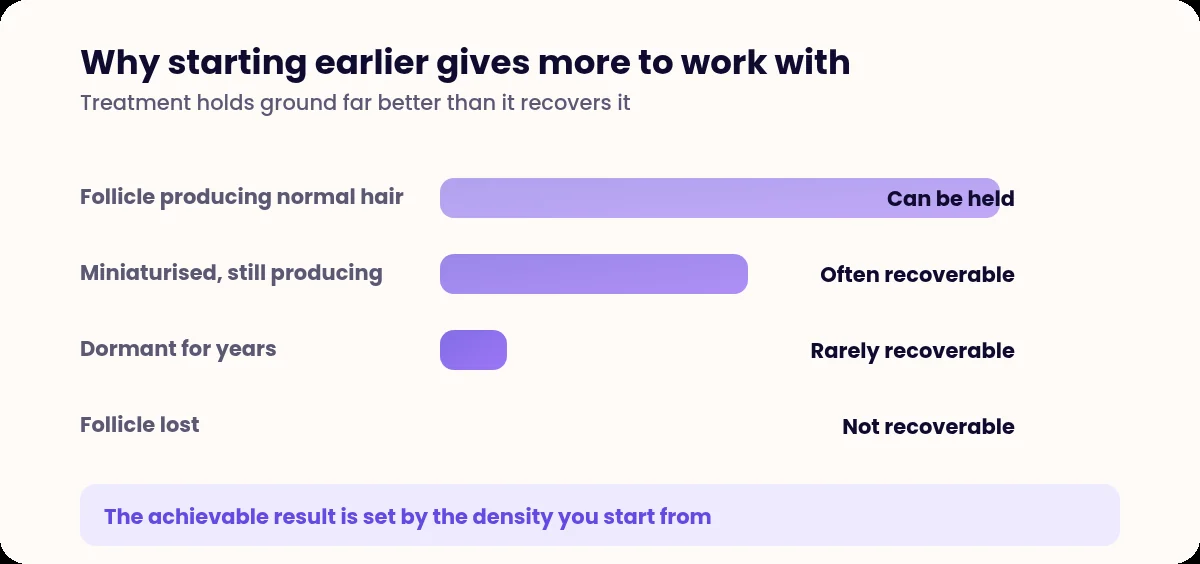
- Once a follicle is lost, no medical therapy recovers it, so the density at which treatment starts largely defines the achievable outcome.
- The main treatments are suppressive, not curative: benefit is lost within roughly six to twelve months of stopping, which makes starting young a long-term commitment decision rather than a course of treatment.
Two things are true about hair loss in your twenties and they pull in opposite directions. It is common enough to be unremarkable statistically, and it is, on the available evidence, harder to live with the younger it starts. Most writing on the subject picks one of those and ignores the other.
How common it is
The standard reference figure is Norwood’s observation that the proportion of men with androgenetic alopecia roughly matches their age in decades: around 20% in their 20s, 30% in their 30s, and so on. Population surveys put around 16% of men aged 18 to 29 in the moderate-to-extensive range. Onset can begin any time after puberty [1].
For context, up to 50% of white men have some degree of loss by 50 and possibly 80% by 70, with rates substantially lower in Japanese and Chinese populations [1]. The figures are approximate and drawn largely from white European populations, so treat them as orientation rather than precision.
The part that is not vanity
The psychological evidence here is better than the evidence behind most products sold into this market, and it is the strongest single justification for taking young men’s hair loss seriously.
Studies consistently report reduced self-esteem, body image dissatisfaction, social anxiety, elevated depression and anxiety scores, and avoidance behaviours in men with androgenetic alopecia compared with controls [2, 3]. Two findings are particularly relevant if you are in your twenties:
- The impact is inversely related to age of onset. The younger it starts, the greater the psychological burden.
- It correlates poorly with objective severity. Mild loss in a 22-year-old can be more distressing than extensive loss in a 55-year-old, and clinicians who assess distress by looking at the scalp get it wrong routinely.
A 2025 study also documents the role of social media in driving treatment decisions in this group [2] — which is a polite way of describing a market in which the loudest voices are selling something. If you have spent evenings on hair loss forums and come away certain about a protocol, it is worth asking where that certainty came from.
Distress is a legitimate reason to seek treatment. It is also a reason to be careful about what you buy and what you are told, because people in distress are easy to sell to.
Why timing has a mechanism behind it
Androgenetic alopecia is progressive follicular miniaturisation: each cycle produces a finer, shorter, less pigmented hair, until the follicle drops out and the area fibroses. The key fact is that once a follicle is lost, no medical therapy recovers it. The available treatments are substantially better at preventing further loss and maintaining existing hair than at regrowing hair from a bald scalp.
The consequence follows directly: the density at which you start defines the best outcome available to you. This is not a marketing line, it is what the mechanism implies, and it is why “wait and see how bad it gets” is a weaker strategy than it sounds. In the five-year trials of the standard tablet treatment, around 90% of men treated showed no further visible loss, against roughly 75% of men on placebo showing visible progression.
Our guides to male pattern baldness and receding or maturing hairline cover how the diagnosis is actually confirmed — which matters, because the first step is establishing that this is what you have rather than something else.
The argument on the other side
Here is what an honest account has to include, and what most of the internet will not tell a 22-year-old.
Both main treatments are suppressive, not curative. Benefit is lost within roughly six to twelve months of stopping, and the hair reverts to approximately where it would have been without treatment. Starting at 22 is therefore not a course of treatment; it is a decision about the next several decades, including years in which your circumstances, your priorities and your access to prescribing may all change.
That is a genuine trade-off and it deserves weighing rather than dismissing. Some men decide the commitment is worth it and are glad they started early. Some decide it is not, keep their hair short, and are entirely content. Some start, stop, and find the loss that follows harder than not having started. All three are real outcomes and none is a failure of nerve.
The treatments have side effect profiles that have to be discussed before you start, not after. The prescription tablet used for pattern hair loss carries documented associations with sexual dysfunction and with depression and suicidal ideation, and UK product information now states that these may persist after treatment is stopped [4]. The topical treatment has its own tolerability issues. None of this makes treatment unreasonable; it makes an unconsidered start unreasonable.
What UK prescribing now requires
This has changed, and it changes what a proper consultation looks like.
Following MHRA action in April 2024 and a further Drug Safety Update on 11 May 2026, UK prescribers are expected to ask about and document a history of depression or suicidal ideation before prescribing, to document a discussion of sexual and psychiatric risks including possible persistence after stopping, to supply the patient alert card included in packs, and to have a follow-up plan [4, 5]. Anyone prescribing for hair loss without asking about your mental health is not meeting the current standard.
There is an uncomfortable intersection here that is worth naming. The group most distressed by hair loss — young men with early onset — is the same group in whom the psychiatric safety signal matters most. That is not an argument against treating them. It is an argument for treating them properly: a real assessment, a documented conversation, a named prescriber and a review, rather than a form and a delivery.
A reasonable order of operations
- Establish the diagnosis. Patchy, painful, scaly or suddenly diffuse loss is not pattern hair loss and needs a different route.
- Take standardised baseline photographs. Six and twelve months from now they are the only reliable record of whether anything changed.
- Decide how much this actually bothers you, honestly, before anyone offers you a product.
- Have the consultation properly, including the mental health history and the long-term commitment question.
- Ignore the protocols you read at 1am. Our guide to hair loss myths covers what the market reliably overclaims.
Frequently asked questions
Is it normal to lose hair at 22?
It is common. Androgenetic alopecia can begin any time after puberty, and around a fifth of men show some degree of it in their twenties. Being young does not make the diagnosis less likely, and it does not mean something else must be going on — though a clinician should still rule out other causes rather than assume.
Should I start treatment now or wait?
The mechanistic argument is that treatment preserves existing hair far better than it regrows lost hair, so waiting reduces what there is to preserve. The counterargument is that treatment is long-term and has real trade-offs, and starting at 22 means deciding about the next several decades. Both arguments are legitimate, which is why this is a conversation with a prescriber and not a rule.
Why does losing hair young feel so much worse?
Because it is out of step with your peers, because it changes a face you have not finished getting used to, and because it arrives at an age when appearance carries a lot of social weight. Research consistently finds the impact is greater the younger the onset, and that it tracks poorly with how much hair has actually gone.
Do I need to tell a prescriber about my mental health?
Yes, and you will be asked. UK prescribers are now expected to document a history of depression or suicidal ideation before prescribing for hair loss and to discuss psychiatric and sexual risks explicitly. That is not a hurdle placed in your way; it exists because these things intersect in exactly this age group.
References
- DermNet. Male pattern hair loss. dermnetnz.org/topics/male-pattern-hair-loss
- Ferhatosmanoglu et al. Comprehensive evaluation of androgenetic alopecia: demographic characteristics, psychosocial impact, and the role of social media in treatment choices. Journal of Cosmetic Dermatology, 2025. pmc.ncbi.nlm.nih.gov/articles/PMC12023709/
- The psychosocial impact of alopecia in men: a mixed-methods survey study, 2024. pmc.ncbi.nlm.nih.gov/articles/PMC11442044/
- MHRA. Finasteride and dutasteride: updated safety warnings for psychiatric side effects and sexual dysfunction. Drug Safety Update, 11 May 2026. www.gov.uk/drug-safety-update/finasteride-and-dutasteride-updated-safe
- MHRA. Drug Safety Update, April 2024, volume 17 issue 9. assets.publishing.service.gov.uk/media/6630a6d03579e7a8f398a9a6/April_
- NHS. Hair loss. www.nhs.uk/conditions/hair-loss/
Medical reviewer
Naeem Teni
Clinical Lead at Manova. Registered pharmacist and independent prescriber, GPhC 2215591. Reviews Manova’s clinical content for accuracy and safety.
Written by
Manova Editorial Team
Researched and written to our editorial policy, using NICE, NHS, MHRA and peer-reviewed sources.
This article is for general information and isn’t a substitute for advice from your own clinician. If you feel unwell, contact your GP or NHS 111. In an emergency, call 999.