
Key takeaways
- The 'mature hairline' is a useful descriptive idea, not a formal diagnostic entity — it originates in Norwood's description of the adolescent-to-adult transition and was popularised by hair transplant clinics.
- Most men's hairline recedes slightly and symmetrically in the late teens to mid-twenties, typically to about 1 to 2 cm above the highest forehead crease. That is not androgenetic alopecia.
- The decisive tool is trichoscopy showing hair diameter diversity above roughly 20% in the frontal zone compared against the occipital scalp — miniaturisation, not hairline shape, is what distinguishes the two.
- For a worried person in their early twenties the honest answer is serial standardised photography at baseline, six and twelve months rather than a definitive verdict on day one.
Before anything else, one piece of framing that changes how the rest reads: “mature hairline” is not a formal diagnostic entity. You will not find it in NICE guidance, in British Association of Dermatologists material, or in the dermatological literature as a defined condition. It originates in Norwood’s description of the adolescent-to-adult hairline transition and was popularised largely by hair transplant clinics, for whom “yours is just maturing” and “yours needs treating” are both commercially useful answers depending on the day.
That does not make it a useless idea. The underlying phenomenon is real and common. It just means the term is descriptive rather than diagnostic, and that no one can settle your case by matching your photograph against a chart.
The real phenomenon underneath it
The adolescent hairline sits low and straight across the forehead. In the majority of men it moves back slightly and symmetrically somewhere between the late teens and the mid-twenties, settling into the adult hairline — typically around 1 to 2 cm above the highest forehead crease, with mild rounding at the temples.
This happens in a substantial majority of men and is not androgenetic alopecia. It is a one-off shift to a new position, and then it stops.
What points towards maturation
Features consistent with a benign maturing hairline:
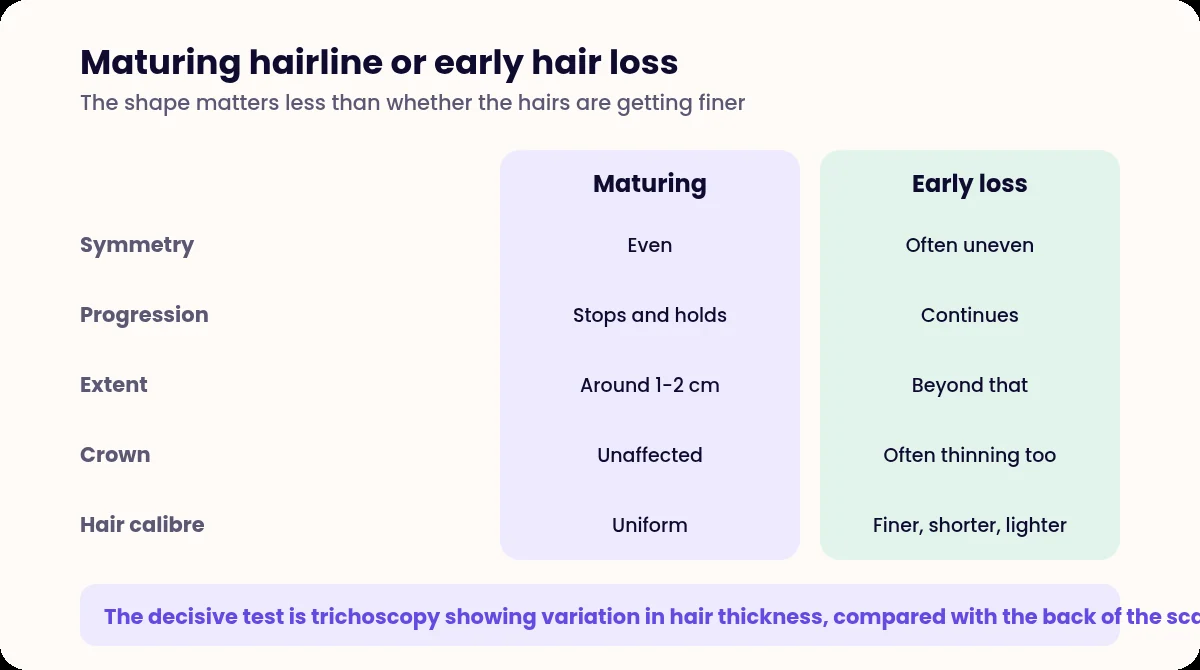
- Symmetry. Both temples have moved back by a similar amount.
- Stability. It changed, then stopped, and has looked the same in photographs for a couple of years.
- Magnitude. Recession of roughly 2 cm or less from the teenage hairline.
- Shallow, even temporal recession rather than deep points.
- Uniform hair calibre across the frontal zone — the hairs at the new hairline are as thick as the hairs behind them.
- No vertex involvement and no increase in shedding.
What points towards early androgenetic alopecia
- Ongoing progression documented over 6 to 12 months.
- Recession beyond 2 cm from the juvenile line.
- Asymmetry — one side clearly further back than the other.
- Deep, pointed temporal recession producing a pronounced “M”.
- Concurrent thinning at the vertex or mid-scalp, which maturation does not cause.
- Finer, shorter, lighter hairs at the front and temples — miniaturisation.
- A positive family history and increased shedding.
Note that only some of these are about the hairline at all. Crown involvement and miniaturisation are the ones that carry real diagnostic weight, and the Norwood scale describes the pattern without answering the question of whether you are on it.
How clinicians actually decide
Here is the part that most online discussion misses. The decisive tool is not the shape of the hairline. It is trichoscopy — dermoscopic examination of the scalp at magnification — looking for evidence of miniaturisation.
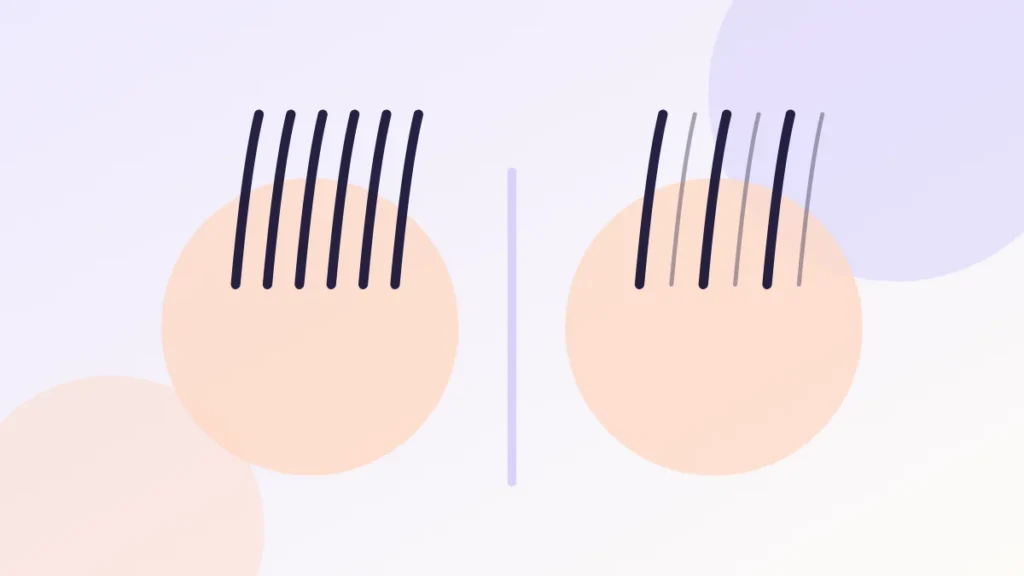
The accepted trichoscopic marker of androgenetic alopecia is hair diameter diversity, or anisotrichosis, affecting more than about 20% of hairs in the affected area. In plain terms: hairs of visibly different thicknesses growing side by side, because sensitive follicles are producing progressively finer shafts each cycle while their neighbours are not.
Other trichoscopic signs of androgenetic alopecia include peripilar signs (a brown halo around the follicle), yellow dots, an increased proportion of single-hair follicular units where the normal scalp has two to four hairs per unit, and an excess of short vellus hairs [1].
Crucially, this is a comparison, not an absolute measurement. Androgenetic alopecia spares the occipital scalp, so the examination compares the frontal and temporal zones against the back of the head as an internal reference. A uniform occiput and a diverse frontal zone is the finding that makes the diagnosis. Uniform calibre in both places suggests recession without miniaturisation — which is what hairline maturation is.
This is also why a phone photograph posted online cannot answer the question, and why an opinion given without a magnified look at your scalp is a guess dressed up as an assessment.
The honest answer for a worried 22-year-old
Even with trichoscopy, early disease is genuinely hard to call. Miniaturisation in its first stages is subtle, and inter-observer agreement on early change is only moderate.
The practical answer is to answer a different question. Rather than “is this androgenetic alopecia?”, which may not be answerable today, ask “is this progressing?”, which is answerable — just not immediately.
Serial standardised photography at baseline, six months and twelve months is the method. Fixed lighting, fixed camera position and distance, dry hair combed identically, eyebrows raised so the highest forehead crease gives a fixed anatomical reference, and the same set of angles every time — front, both three-quarters, and top-down for the crown.
A hairline that is in the same place at twelve months has matured. A hairline that has moved has told you what you needed to know, and you have lost very little time finding out, because pattern hair loss over twelve months in your early twenties is not usually the difference between a good and a bad outcome.
What that approach also does is stop the daily mirror check, which is the single most corrosive habit in this whole area. Memory is not a measuring instrument and light is not constant. People routinely convince themselves of change in both directions within a week.
Why the label matters less than you think
There is a version of this question that is really about reassurance, and a version that is about what to do next. They deserve different answers.
If what you want is to know whether you are normal, the answer is that a hairline sitting a centimetre or two higher than it did at sixteen is the usual outcome for men, and says nothing about what the next twenty years hold. If what you want is a decision, then the label matters only insofar as it changes that decision — and in practice the trigger for acting is documented progression plus a level of bother that makes long-term treatment worth it to you, not the name given to your hairline shape at a single appointment.
That is why an assessment that ends with “let us photograph it and look again in six months” is a better assessment than one that hands you a confident verdict on day one. The confident verdict is usually the less honest of the two.
When to stop watching and get an opinion
Some findings should not go into a twelve-month photo series [1, 3]:
- hair coming out in discrete round patches — see alopecia areata
- itch, burning or pain, scale, redness, or skin that looks smooth and shiny where hair used to be — this raises the possibility of a scarring process, which is urgent
- sudden diffuse shedding across the whole scalp, particularly a few months after illness, surgery, weight loss or major stress
- other symptoms — fatigue, weight change, nail changes
And if the answer does turn out to be early pattern loss, the decision that follows is a bigger one than it looks at 22, because the treatments involved are long-term commitments. Our guide to hair loss in your 20s covers that properly.
Frequently asked questions
Is my hairline receding or maturing?
If the recession is symmetrical, has stayed put for a couple of years, is within about 2 cm of your teenage hairline, and the hairs in the frontal zone are all the same thickness, maturation is likely. Ongoing progression, asymmetry, deep pointed temples, crown thinning or visibly finer hairs at the front point the other way. Neither answer can be settled from a single photograph.
What is hair diameter diversity?
It means hairs of noticeably different thicknesses growing side by side in the same area — a mixture of normal terminal hairs and thinner miniaturised ones. Above roughly 20% of hairs, it is the accepted trichoscopic marker of androgenetic alopecia. Hairline maturation produces recession without it, which is the whole basis of the distinction.
At what age does the hairline stop maturing?
The transition typically happens between the late teens and the mid-twenties and then stops. That is the key feature: maturation is a one-off shift to a new stable position, not an ongoing process. A hairline still moving at 28, three years after it first changed, is behaving like androgenetic alopecia rather than maturation.
How do I photograph my hairline properly?
Same room, same time of day, same overhead light, hair dry and combed the same way, camera at the same distance and height, eyebrows raised so the highest forehead crease is visible as a fixed reference. Take front, both three-quarter angles and a top-down shot. Repeat at exactly six and twelve months. Inconsistent photographs are worse than none, because they invite false conclusions.
References
- DermNet. Male pattern hair loss. dermnetnz.org/topics/male-pattern-hair-loss
- NICE Clinical Knowledge Summaries. Alopecia, androgenetic – male. cks.nice.org.uk/topics/alopecia-androgenetic-male/
- NHS. Hair loss. www.nhs.uk/conditions/hair-loss/
- DermNet. Female pattern hair loss. dermnetnz.org/topics/female-pattern-hair-loss
Medical reviewer
Naeem Teni
Clinical Lead at Manova. Registered pharmacist and independent prescriber, GPhC 2215591. Reviews Manova’s clinical content for accuracy and safety.
Written by
Manova Editorial Team
Researched and written to our editorial policy, using NICE, NHS, MHRA and peer-reviewed sources.
This article is for general information and isn’t a substitute for advice from your own clinician. If you feel unwell, contact your GP or NHS 111. In an emergency, call 999.