

Key takeaways
- The most common side effects of semaglutide (Wegovy) and tirzepatide (Mounjaro) are nausea, diarrhoea, constipation, vomiting and stomach discomfort.
- They're usually mild to moderate and most likely in the weeks after starting or increasing the dose.
- Seek urgent help for severe, persistent stomach pain that may spread to the back (possible pancreatitis), sudden changes in eyesight, or signs of a severe allergic reaction.
- Tell anyone treating you, including anaesthetists before surgery, that you take one of these medicines.
Semaglutide (Wegovy) and tirzepatide (Mounjaro) belong to a group of medicines that act on gut hormone receptors. Like all medicines, they can cause side effects. Most are predictable and manageable. A small number are rare but need urgent attention.
This guide explains what’s common, practical ways people manage it, and the warning signs everyone taking these medicines should know. It doesn’t replace the Patient Information Leaflet that comes with your medicine, or advice from your prescriber.
Why side effects happen
These medicines slow the rate at which your stomach empties and act on appetite centres in the brain [1, 2]. That’s part of how they reduce hunger. It’s also why most side effects involve the digestive system, and why doses are increased gradually over weeks.
Common side effects
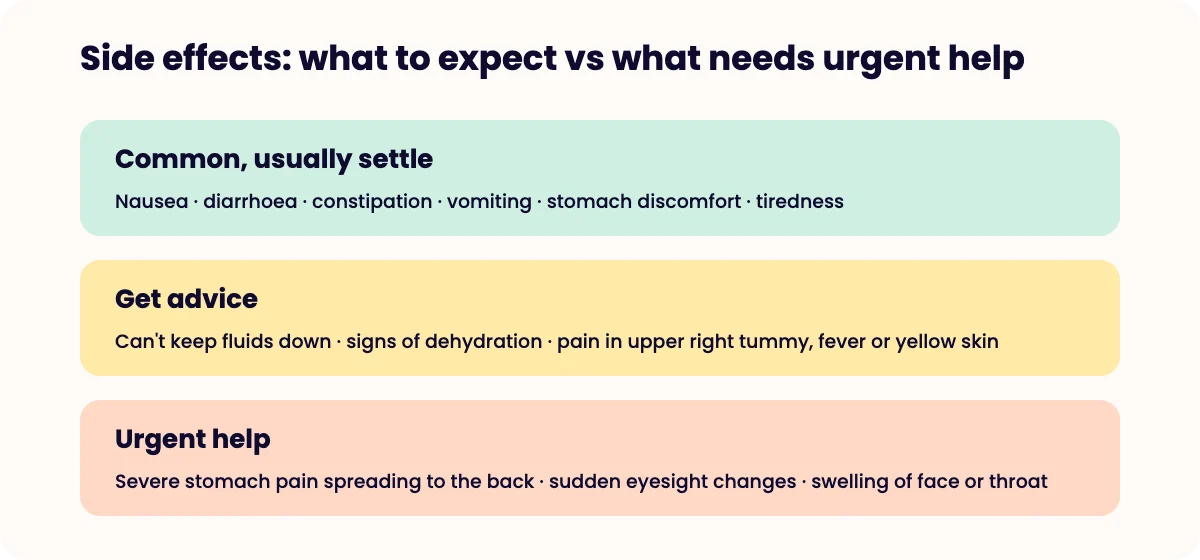
Listed as very common (may affect more than 1 in 10 people) in the UK product information [1, 2]:
- nausea
- diarrhoea
- vomiting
- constipation
- stomach (abdominal) pain
- tiredness
- headache (semaglutide)
Listed as common (up to 1 in 10) include indigestion, reflux or heartburn, burping, wind, bloating, dizziness, altered taste, injection site reactions and, for semaglutide, hair loss [1, 2].
In the main clinical trials, digestive side effects were the most frequently reported. They were mostly mild to moderate and happened mainly during the dose-escalation period [3, 4]. A minority of participants stopped treatment because of them.
Practical tips people find helpful
These are general tips. If symptoms are troublesome, speak to your prescriber or pharmacy team rather than struggling on.
Nausea
- Eat smaller meals and stop when you first feel full.
- Choose plain, lower-fat foods; greasy or very rich meals often make it worse.
- Eat slowly and don’t lie down straight after eating.
- Sip fluids steadily through the day.
Constipation
- Drink plenty of fluids.
- Increase fibre gradually (vegetables, fruit, oats, pulses, wholegrains).
- Keep active; walking helps.
- Ask a pharmacist before using laxatives.
Diarrhoea and vomiting
- Replace fluids little and often; oral rehydration sachets can help.
- Seek advice if you can’t keep fluids down, or if you notice signs of dehydration (dark urine, passing little urine, dizziness). Dehydration can affect the kidneys.
Tiredness
- Make sure you’re eating enough, including protein, and drinking enough.
- Keep a regular sleep routine.
Less common but serious: know the warning signs
Pancreatitis
Inflammation of the pancreas is uncommon but can be serious. In January 2026 the MHRA strengthened warnings for all medicines in this group, noting reports of necrotising and fatal cases [5].
Seek urgent medical attention if you have severe, persistent pain in the upper stomach that may spread to your back, with or without nausea and vomiting [5]. Don’t take further doses unless a clinician confirms it’s safe.
Gallbladder problems
Gallstones and gallbladder inflammation can occur, and are more likely with rapid weight loss [1, 2]. Get medical advice for pain in the upper right side of your tummy, fever, or yellowing of the skin or eyes.
Sudden changes in eyesight
The MHRA has concluded that a type of sudden sight loss called NAION is a very rare side effect of semaglutide, affecting up to 1 in 10,000 people. If you notice sudden loss of vision or rapidly worsening eyesight in one or both eyes, go to eye casualty or A&E urgently [6].
Before surgery or sedation
Because these medicines slow stomach emptying, there’s a potential risk of inhaling stomach contents during a general anaesthetic or deep sedation. The MHRA advises telling your healthcare team and anaesthetist as early as possible before any procedure, including if your medicine was prescribed privately [7].
Allergic reactions
Rarely, serious allergic reactions can occur. Call 999 for swelling of the face, lips, tongue or throat, difficulty breathing, or a widespread rash with feeling faint.
Low blood sugar
Hypoglycaemia is uncommon in people without diabetes. The risk is higher if you also take insulin or a sulfonylurea for diabetes, when those doses may need adjusting [1, 2].
Pregnancy and contraception
These medicines shouldn’t be used during pregnancy. Breastfeeding advice now differs between them: the semaglutide product information advises against use, while the tirzepatide product information says it could be considered — check the leaflet for your own medicine. On pregnancy, the MHRA advises [8]:
- using effective contraception during treatment
- stopping semaglutide at least 2 months, and tirzepatide at least 1 month, before trying to conceive
- for tirzepatide, using a non-oral method (such as condoms or a coil) or adding a barrier method for 4 weeks after starting and 4 weeks after each dose increase, because it can reduce the effectiveness of the pill
Buying safely
Only use weight loss medicines prescribed for you after a proper assessment, and supplied by a UK-registered pharmacy. Products sold on social media, beauty salons or websites without a prescription may be fake, contaminated or the wrong strength.
Reporting side effects
You can report any suspected side effect to the MHRA through the Yellow Card scheme [9]. Reports help identify new safety issues, and patients can report directly.
For more on how the two main medicines compare, see Mounjaro vs Wegovy.
Frequently asked questions
How long do side effects last on Mounjaro or Wegovy?
For most people, digestive side effects are worst in the first few days after starting or increasing a dose and ease over the following weeks as the body adjusts. If side effects are severe, persistent or stopping you eating and drinking, contact your prescriber or pharmacy team. Your dose schedule may need to be reviewed.
What are the signs of pancreatitis?
The main sign is severe, persistent pain in the upper stomach that may spread to your back, often with nausea and vomiting. The MHRA advises seeking urgent medical attention if this happens. Stop taking the medicine and don't restart it unless a clinician confirms it's safe.
Do weight loss medicines cause hair loss?
Hair loss is listed as a common side effect of semaglutide. Hair shedding can also happen with any significant weight loss, particularly if it's rapid or protein intake is low. It's usually temporary. Eating enough protein and a balanced diet may help.
Can I drink alcohol while taking weight loss medication?
There's no absolute ban, but alcohol can worsen nausea and dehydration, adds calories, and in people with diabetes taking other glucose-lowering medicines it can increase the risk of low blood sugar. Keep within UK low-risk guidelines and discuss it with your prescriber.
References
- Novo Nordisk Limited. Wegovy 2.4 mg FlexTouch: Summary of Product Characteristics. Electronic Medicines Compendium. www.medicines.org.uk/emc/product/13803/smpc
- Eli Lilly and Company Limited. Mounjaro KwikPen: Summary of Product Characteristics. Electronic Medicines Compendium. www.medicines.org.uk/emc/product/15481/smpc
- Wilding JPH, Batterham RL, Calanna S, et al. Once-weekly semaglutide in adults with overweight or obesity. New England Journal of Medicine. 2021;384(11):989-1002. doi.org/10.1056/NEJMoa2032183
- Jastreboff AM, Aronne LJ, Ahmad NN, et al. Tirzepatide once weekly for the treatment of obesity. New England Journal of Medicine. 2022;387(3):205-216. doi.org/10.1056/NEJMoa2206038
- MHRA. GLP-1 receptor agonists and dual GLP-1/GIP receptor agonists: strengthened warnings on acute pancreatitis, including necrotising and fatal cases. Drug Safety Update, 29 January 2026. www.gov.uk/drug-safety-update/glp-1-receptor-agonists-and-dual-glp-1-s
- MHRA. Semaglutide (Wegovy, Ozempic and Rybelsus): risk of non-arteritic anterior ischemic optic neuropathy (NAION). Drug Safety Update, 5 February 2026. assets.publishing.service.gov.uk/media/69847cb7468d351e1406b4d2/DSU_-_
- The Pharmaceutical Journal. MHRA warns of pulmonary aspiration risk for GLP-1 receptor agonists during general anaesthesia or deep sedation. 31 January 2025. pharmaceutical-journal.com/article/news/mhra-warns-of-pulmonary-aspira
- The Pharmaceutical Journal. MHRA urges women taking weight-loss drugs to use effective contraception. 5 June 2025. pharmaceutical-journal.com/article/news/mhra-urges-women-taking-weight
- MHRA. Yellow Card: report a suspected side effect. yellowcard.mhra.gov.uk/
- Department of Health and Social Care. UK Chief Medical Officers' low risk drinking guidelines. www.gov.uk/government/publications/alcohol-consumption-advice-on-low-r
Medical reviewer
Naeem Teni
Clinical Lead at Manova. Registered pharmacist and independent prescriber, GPhC 2215591. Reviews Manova’s clinical content for accuracy and safety.
Written by
Manova Editorial Team
Researched and written to our editorial policy, using NICE, NHS, MHRA and peer-reviewed sources.
This article is for general information and isn’t a substitute for advice from your own clinician. If you feel unwell, contact your GP or NHS 111. In an emergency, call 999.