

Key takeaways
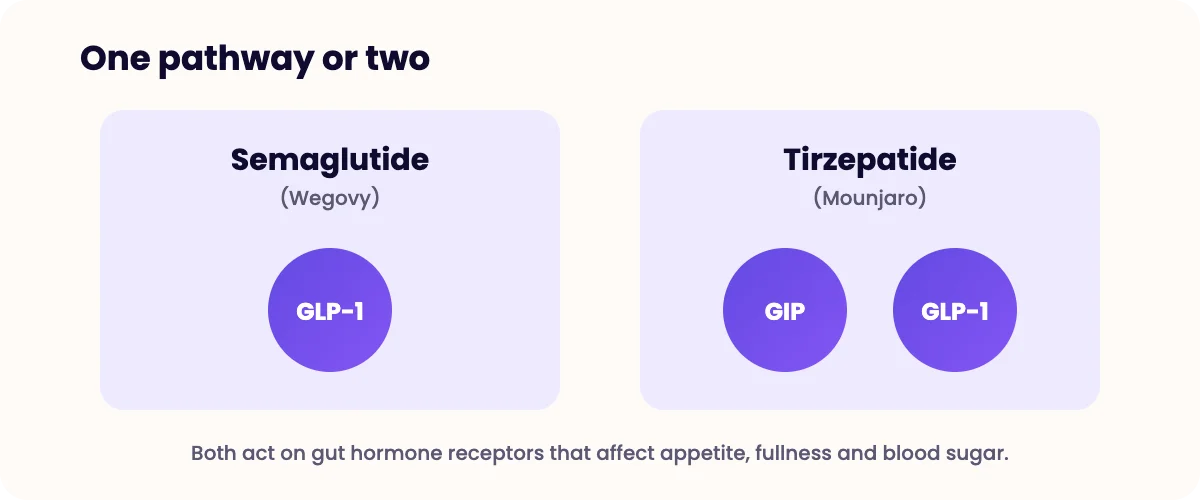
- Wegovy contains semaglutide, which acts on one gut hormone receptor (GLP-1). Mounjaro contains tirzepatide, which acts on two (GIP and GLP-1).
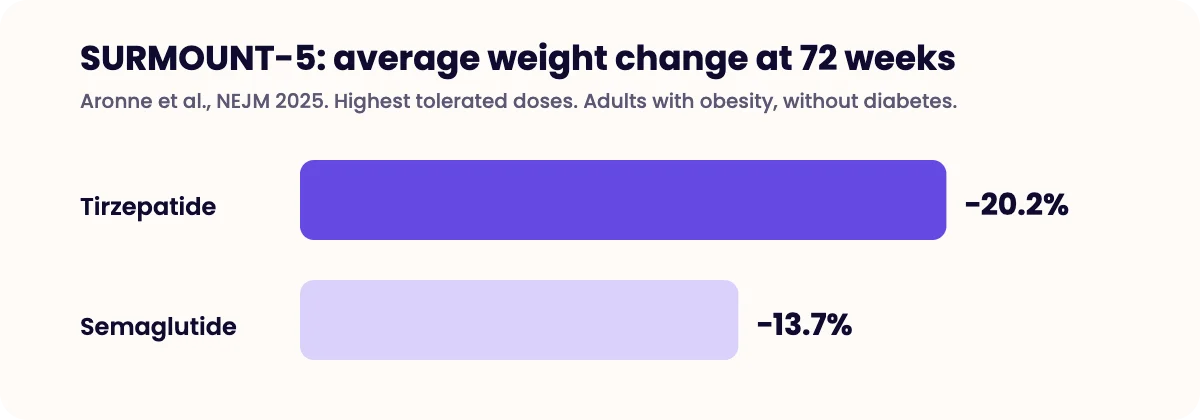
- In the first head-to-head trial, people on tirzepatide lost an average of 20.2% of body weight at 72 weeks, compared with 13.7% on semaglutide.
- Side effects are similar and mostly digestive, especially while the dose is being increased.
- Semaglutide has proven cardiovascular benefit in people with heart disease. Which medicine is suitable depends on your health, history and preferences, and is a decision for you and a prescriber.
Mounjaro and Wegovy are the two most talked-about prescription medicines for weight management in the UK. They’re often mentioned in the same breath, but they aren’t the same medicine.
This article sets out the facts: what each contains, how they work, what the clinical trials found, and how their side effects compare. It’s general information, not a recommendation. Whether any medicine is right for someone can only be decided with a prescriber, after a proper assessment.
At a glance
| Wegovy | Mounjaro | |
|---|---|---|
| Active ingredient | Semaglutide | Tirzepatide |
| How it works | Mimics GLP-1, one gut hormone | Mimics GIP and GLP-1, two gut hormones |
| How it’s taken | Injection once a week (a daily semaglutide tablet was also authorised in June 2026 [11]) | Injection once a week |
| Starting dose | 0.25 mg weekly | 2.5 mg weekly |
| Usual maintenance dose | 2.4 mg weekly (7.2 mg optional for obesity) | 5, 10 or 15 mg weekly |
| Dose increases | Every 4 weeks | At least every 4 weeks, in 2.5 mg steps |
| UK licence for weight management | Adults with BMI ≥30, or ≥27 with a weight-related condition | Adults with BMI ≥30, or ≥27 with a weight-related condition |
| Heart outcomes trial | Yes: reduced major cardiovascular events in people with heart disease (SELECT) | Trial ongoing |
Sources: UK Summaries of Product Characteristics [5, 6]; SELECT [4].
How do they work?
After you eat, your gut releases hormones called incretins. Two important ones are GLP-1 (glucagon-like peptide-1) and GIP (glucose-dependent insulinotropic polypeptide). Among other effects, they help regulate blood sugar, slow the rate at which the stomach empties and act on appetite centres in the brain, helping people feel fuller sooner and for longer.
- Semaglutide (Wegovy) is a long-acting version of GLP-1.
- Tirzepatide (Mounjaro) activates both GIP and GLP-1 receptors. The combined action is thought to explain its larger average effect on weight in trials.
Neither medicine is designed to be used on its own. Both are licensed alongside a reduced-calorie diet and increased physical activity [5, 6].
What did the clinical trials find?
Separate trials against placebo
- STEP 1 (semaglutide 2.4 mg): adults with overweight or obesity lost an average of 14.9% of body weight over 68 weeks, compared with 2.4% with placebo [2].
- SURMOUNT-1 (tirzepatide): average weight loss over 72 weeks was 15.0% (5 mg), 19.5% (10 mg) and 20.9% (15 mg), compared with 3.1% with placebo [3].
These trials can’t be compared directly, because they involved different people and designs. That’s why a head-to-head trial matters.
The head-to-head trial: SURMOUNT-5
SURMOUNT-5 randomly assigned 751 adults with obesity (without diabetes) to the highest tolerated dose of tirzepatide or semaglutide for 72 weeks [1]:
| Result at 72 weeks | Tirzepatide | Semaglutide |
|---|---|---|
| Average body weight change | −20.2% | −13.7% |
| Average waist change | −18.4 cm | −13.0 cm |
People on tirzepatide were also more likely to reach 10%, 15%, 20% and 25% weight loss. The trial was funded by the manufacturer of tirzepatide [1].
Two important caveats:
- Averages hide wide individual variation. Some people lose much more or much less on either medicine.
- The trial compared semaglutide at 2.4 mg. A higher 7.2 mg maintenance dose was authorised in the UK in January 2026 [5] and wasn’t part of SURMOUNT-5.
Heart health
The SELECT trial studied semaglutide 2.4 mg in over 17,000 adults with overweight or obesity and established cardiovascular disease, but without diabetes. It found a 20% lower risk of major cardiovascular events (heart attack, stroke or cardiovascular death) compared with placebo [4]. A similar outcomes trial for tirzepatide in people with obesity hasn’t yet reported.
How do the side effects compare?
The side-effect profiles are very similar [5, 6]:
- Very common: nausea, diarrhoea, vomiting, constipation, stomach pain and tiredness. Semaglutide’s product information also lists headache.
- These are mostly mild to moderate and most frequent in the weeks after starting or increasing the dose, which is why doses go up gradually [1].
- Less common but important: gallstones and gallbladder inflammation, and acute pancreatitis. In January 2026, the MHRA strengthened warnings about pancreatitis for all medicines in this class [10].
- Contraception: tirzepatide can make oral contraceptive pills less effective, particularly in the 4 weeks after starting and after each dose increase. The MHRA advises women to use effective contraception during treatment with either medicine and to stop them before trying to conceive: at least 2 months before for semaglutide and 1 month for tirzepatide [9].
Read our full guide to side effects of weight loss medicines and when to get help.
NHS access
Both medicines are recommended by NICE for some adults with obesity, with tighter criteria than their licences [7, 8]:
- Semaglutide is offered within specialist weight management services, for up to 2 years.
- Tirzepatide is being rolled out in phases over several years, starting with people with the highest BMI and several weight-related conditions.
See who can get weight loss medication in the UK for the details.
So which is “better”?
On average weight loss in a head-to-head trial, tirzepatide came out ahead. But “better” depends on the person. A prescriber will consider:
- your medical history, current medicines and any previous side effects
- conditions such as heart disease, where semaglutide’s cardiovascular evidence may be relevant
- tolerability: some people cope better with one than the other
- practical factors such as supply and cost
Whichever medicine is used, results are best, and easiest to maintain, when combined with changes to diet, activity, sleep and strength training. It also helps to understand what happens if treatment stops.
Safety information
Only use these medicines if they’ve been prescribed for you by a registered prescriber and supplied by a registered UK pharmacy. The MHRA warns that products bought from unregulated sellers may be fake or unsafe. Seek urgent medical help for severe, persistent abdominal pain (which may spread to your back), signs of an allergic reaction, or severe vomiting or diarrhoea with signs of dehydration. You can report suspected side effects through the MHRA Yellow Card scheme.
Frequently asked questions
Is Mounjaro stronger than Wegovy?
In the SURMOUNT-5 head-to-head trial, tirzepatide (Mounjaro) at the highest tolerated dose led to greater average weight loss than semaglutide (Wegovy) 2.4 mg: 20.2% vs 13.7% after 72 weeks. Individual responses vary widely, and a higher semaglutide dose (7.2 mg) was authorised in the UK in January 2026, which wasn't part of that trial.
Can you switch from Mounjaro to Wegovy?
Switching is possible but must be planned by a prescriber. The doses aren't directly equivalent, so a clinician will decide the right starting dose based on your current dose, how well you've tolerated it and how long since your last injection.
Do Mounjaro and Wegovy have the same side effects?
They're very similar. The most common are nausea, diarrhoea, constipation, vomiting and stomach discomfort, mostly mild to moderate and most frequent when the dose is increased. Both carry warnings about pancreatitis and gallbladder problems. See our full guide to side effects.
Are Mounjaro and Wegovy available on the NHS?
Both are recommended by NICE for some people with obesity, but access is limited. Semaglutide is offered through specialist weight management services. Tirzepatide is being introduced gradually in phases, starting with people with the highest BMI and several weight-related conditions.
References
- Aronne LJ, Horn DB, le Roux CW, et al. Tirzepatide as compared with semaglutide for the treatment of obesity. New England Journal of Medicine. 2025;393(1):26-36. doi.org/10.1056/NEJMoa2416394
- Wilding JPH, Batterham RL, Calanna S, et al. Once-weekly semaglutide in adults with overweight or obesity. New England Journal of Medicine. 2021;384(11):989-1002. doi.org/10.1056/NEJMoa2032183
- Jastreboff AM, Aronne LJ, Ahmad NN, et al. Tirzepatide once weekly for the treatment of obesity. New England Journal of Medicine. 2022;387(3):205-216. doi.org/10.1056/NEJMoa2206038
- Lincoff AM, Brown-Frandsen K, Colhoun HM, et al. Semaglutide and cardiovascular outcomes in obesity without diabetes. New England Journal of Medicine. 2023;389(24):2221-2232. doi.org/10.1056/NEJMoa2307563
- Novo Nordisk Limited. Wegovy 2.4 mg FlexTouch: Summary of Product Characteristics. Electronic Medicines Compendium. www.medicines.org.uk/emc/product/13803/smpc
- Eli Lilly and Company Limited. Mounjaro KwikPen: Summary of Product Characteristics. Electronic Medicines Compendium. www.medicines.org.uk/emc/product/15481/smpc
- National Institute for Health and Care Excellence. Semaglutide for managing overweight and obesity (TA875). 2023. www.nice.org.uk/guidance/ta875/chapter/1-Recommendations
- National Institute for Health and Care Excellence. Tirzepatide for managing overweight and obesity (TA1026). 2024. www.nice.org.uk/guidance/ta1026/chapter/1-Recommendations
- The Pharmaceutical Journal. MHRA urges women taking weight-loss drugs to use effective contraception. 5 June 2025. pharmaceutical-journal.com/article/news/mhra-urges-women-taking-weight
- MHRA. GLP-1 receptor agonists and dual GLP-1/GIP receptor agonists: strengthened warnings on acute pancreatitis, including necrotising and fatal cases. Drug Safety Update, 29 January 2026. www.gov.uk/drug-safety-update/glp-1-receptor-agonists-and-dual-glp-1-s
- MHRA. First GLP-1 tablet for weight loss approved in the UK. GOV.UK, 11 June 2026. www.gov.uk/government/news/first-glp-1-tablet-for-weight-loss-approved
Medical reviewer
Naeem Teni
Clinical Lead at Manova. Registered pharmacist and independent prescriber, GPhC 2215591. Reviews Manova’s clinical content for accuracy and safety.
Written by
Manova Editorial Team
Researched and written to our editorial policy, using NICE, NHS, MHRA and peer-reviewed sources.
This article is for general information and isn’t a substitute for advice from your own clinician. If you feel unwell, contact your GP or NHS 111. In an emergency, call 999.