

Key takeaways
- When weight loss medicines are stopped, appetite usually returns and most people regain weight over the following year or two.
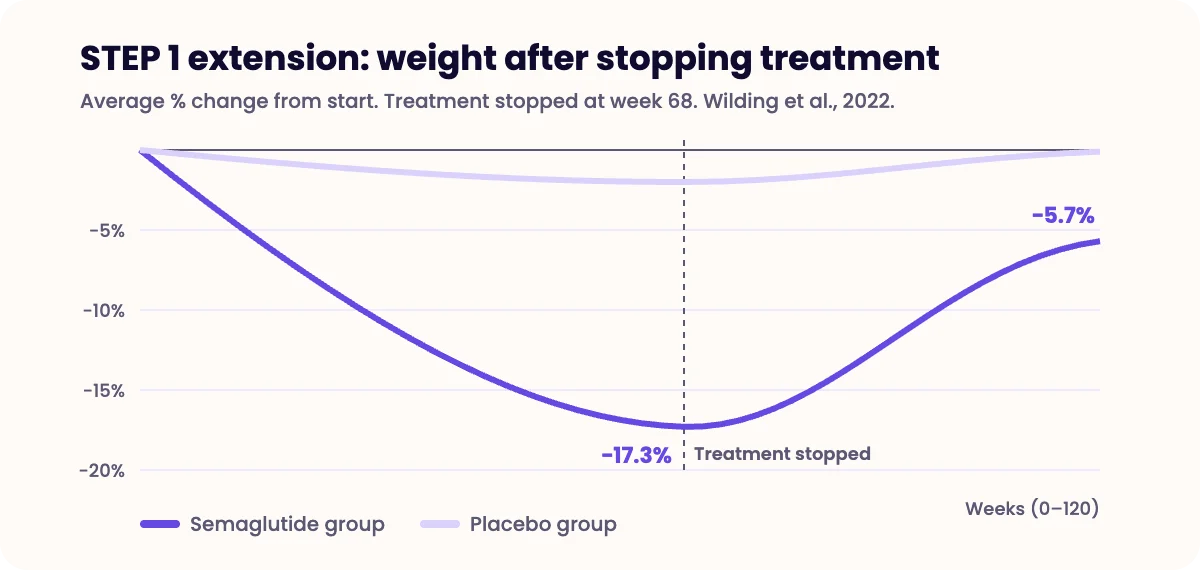
- One year after stopping semaglutide in the STEP 1 extension, people had regained about two-thirds of the weight they'd lost.
- A 2026 BMJ review of 37 studies found weight returned faster after stopping medication than after ending diet and exercise programmes.
- Stopping isn't failure. Obesity is a long-term condition. Planning with a prescriber, building strength and habits during treatment, and follow-up all help.
It’s one of the most common questions about weight loss medicines: what happens if I stop? It’s a sensible thing to ask before starting treatment, not just at the end.
The short answer is that weight usually returns once medication stops, often faster than people expect. That doesn’t make treatment pointless, but it does mean stopping should be planned. Here’s what the evidence shows.
Why weight comes back
Semaglutide and tirzepatide reduce appetite and help people feel full on less food. When the medicine leaves the body, those effects wear off within weeks.
At the same time, the body’s natural defences against weight loss are still there. After weight loss, hunger hormones shift in ways that increase appetite, and these changes can persist for at least a year [8]. Put together, it’s easy for eating to drift back towards previous levels.
What the trials found
Semaglutide: STEP 1 extension
In the STEP 1 trial, adults took semaglutide 2.4 mg or placebo for 68 weeks, then stopped treatment and were followed for another year [1]:
- By week 68, people on semaglutide had lost an average of 17.3% of their body weight (in the extension group).
- One year after stopping, they had regained 11.6 percentage points, about two-thirds of the weight lost.
- Improvements in blood pressure, blood sugar and other markers also moved back towards where they started.
Semaglutide: STEP 4
In STEP 4, everyone took semaglutide for 20 weeks. Then half continued and half switched to placebo. Over the next 48 weeks, those who continued lost a further 7.9%, while those switched to placebo regained 6.9% [4].
Tirzepatide: SURMOUNT-4
After 36 weeks of tirzepatide, participants had lost an average of 20.9%. Those then switched to placebo regained 14.0% of their body weight over the next year, while those who continued lost a further 5.5% [2]. Even so, the placebo group was still, on average, about 10% lighter than when they started at the end of the trial.
The big picture: 2026 BMJ review
A systematic review by Oxford researchers, published in the BMJ in January 2026, pooled 37 studies involving more than 9,300 adults [3, 7]:
- After stopping weight management medicines, people regained around 0.4 kg a month on average, and around 0.8 kg a month after newer medicines like semaglutide and tirzepatide.
- Weight was projected to return to starting levels within about 1.5 to 2 years.
- Regain was faster than after stopping behavioural (diet and exercise) programmes, regardless of how much weight had been lost.
- Blood sugar, blood pressure and cholesterol were projected to return to baseline within about 1.4 years.
The authors describe this as reflecting obesity as a chronic, relapsing condition, not a failure of the medicine or the person [7].
Reasons people stop
People stop treatment for many reasons, including side effects, cost, supply problems, reaching a goal, pregnancy plans, or a prescriber’s clinical decision. NHS guidance currently limits semaglutide to a maximum of 2 years within specialist services [6]. Knowing the likely effect of stopping helps you and your prescriber plan.
How to give yourself the best chance of keeping weight off
There’s no guaranteed method, but these are the most sensible, evidence-informed steps:
- Plan it with your prescriber. Don’t stop suddenly without advice. Agree what follow-up and support you’ll have.
- Build habits during treatment. Reduced appetite is an opportunity to establish routines: regular meals, protein at each meal, fewer ultra-processed foods and less alcohol.
- Strength train and stay active. Muscle supports your energy needs and function. In a trial of weight-loss maintenance, combining exercise with a GLP-1 medicine maintained weight loss and improved body composition better than either alone [5]. See how to lose weight without losing muscle.
- Keep measuring. Weekly weigh-ins and a monthly waist measurement help you spot regain early, when it’s easier to act.
- Agree an action threshold. For example: if you regain 3–5 kg, you book a review.
- Look after sleep and stress. Both drive appetite.
- Accept that long-term treatment may be appropriate for some people. For a chronic condition, ongoing treatment, like for high blood pressure, is a reasonable option to discuss.
When to speak to a prescriber
Speak to your prescriber before stopping or changing your dose, if you’re planning a pregnancy, or if you’re struggling with side effects, cost or supply. If you’ve had a break from treatment, don’t restart at your previous dose without advice. You may need to restart at a lower dose to reduce side effects.
Frequently asked questions
Will I put all the weight back on if I stop Mounjaro or Wegovy?
Not necessarily all of it, but regain is common. In trials, people typically regained a large share of the weight they lost within a year of stopping. Individual results vary, and habits built during treatment, such as strength training and higher protein intake, may help limit regain.
Should I taper off weight loss medication?
There isn't yet strong evidence that gradually reducing the dose prevents weight regain, though some prescribers use a step-down approach. Don't change or stop your dose without speaking to your prescriber, who can plan the approach with you and arrange follow-up.
How long do you need to stay on weight loss medication?
It depends on your health, response and goals. The licences don't set a fixed maximum duration, while NHS guidance limits semaglutide to 2 years within specialist services. Because obesity is a chronic condition, some people may benefit from longer-term treatment. It's a decision to review regularly with your prescriber.
Do the health benefits disappear when you stop?
Improvements in blood pressure, blood sugar and cholesterol tend to reverse as weight returns. The 2026 BMJ review estimated these markers return to baseline within about 1.4 years after stopping medication.
References
- Wilding JPH, Batterham RL, Davies M, et al. Weight regain and cardiometabolic effects after withdrawal of semaglutide: the STEP 1 trial extension. Diabetes, Obesity and Metabolism. 2022;24(8):1553-1564. doi.org/10.1111/dom.14725
- Aronne LJ, Sattar N, Horn DB, et al. Continued treatment with tirzepatide for maintenance of weight reduction in adults with obesity: the SURMOUNT-4 randomized clinical trial. JAMA. 2024;331(1):38-48. doi.org/10.1001/jama.2023.24945
- West S, et al. Weight regain after cessation of medication for weight management: systematic review and meta-analysis. BMJ. 2026;392:e085304. doi.org/10.1136/bmj-2025-085304
- Rubino D, Abrahamsson N, Davies M, et al. Effect of continued weekly subcutaneous semaglutide vs placebo on weight loss maintenance in adults with overweight or obesity: the STEP 4 randomized clinical trial. JAMA. 2021;325(14):1414-1425. doi.org/10.1001/jama.2021.3224
- Lundgren JR, Janus C, Jensen SBK, et al. Healthy weight loss maintenance with exercise, liraglutide, or both combined. New England Journal of Medicine. 2021;384(18):1719-1730. doi.org/10.1056/NEJMoa2028198
- National Institute for Health and Care Excellence. Semaglutide for managing overweight and obesity (TA875). 2023. www.nice.org.uk/guidance/ta875/chapter/1-Recommendations
- University of Oxford. New study finds stopping weight-loss drugs linked to faster regain than ending diet programmes. 8 January 2026. www.ox.ac.uk/news/2026-01-08-new-study-finds-stopping-weight-loss-drug
- Sumithran P, Prendergast LA, Delbridge E, et al. Long-term persistence of hormonal adaptations to weight loss. New England Journal of Medicine. 2011;365(17):1597-1604. doi.org/10.1056/NEJMoa1105816
Medical reviewer
Naeem Teni
Clinical Lead at Manova. Registered pharmacist and independent prescriber, GPhC 2215591. Reviews Manova’s clinical content for accuracy and safety.
Written by
Manova Editorial Team
Researched and written to our editorial policy, using NICE, NHS, MHRA and peer-reviewed sources.
This article is for general information and isn’t a substitute for advice from your own clinician. If you feel unwell, contact your GP or NHS 111. In an emergency, call 999.