

Key takeaways
- Topical minoxidil prolongs the growth phase of the hair cycle and increases follicle size; it is applied to the scalp once or twice daily depending on the product.
- Increased shedding in the first weeks is expected and reflects follicles resetting into a new cycle.
- Results need four months of consistent use before judging, and benefit is lost within months of stopping.
- Topical minoxidil is available from UK pharmacies; low-dose oral minoxidil is used off-label by specialists and is a prescription only medicine.
Minoxidil arrived as a blood pressure tablet and gained a reputation for an inconvenient side effect: it grew hair. Reformulated as a scalp solution, it became one of the two treatments for pattern hair loss with real randomised evidence behind it [3].
How it works
Minoxidil is a potassium channel opener and a vasodilator, but its hair effects are not simply “more blood flow”. It prolongs the anagen (growth) phase of the cycle, shortens the resting phase, and increases follicle size, so hairs grow for longer and come through thicker [4].
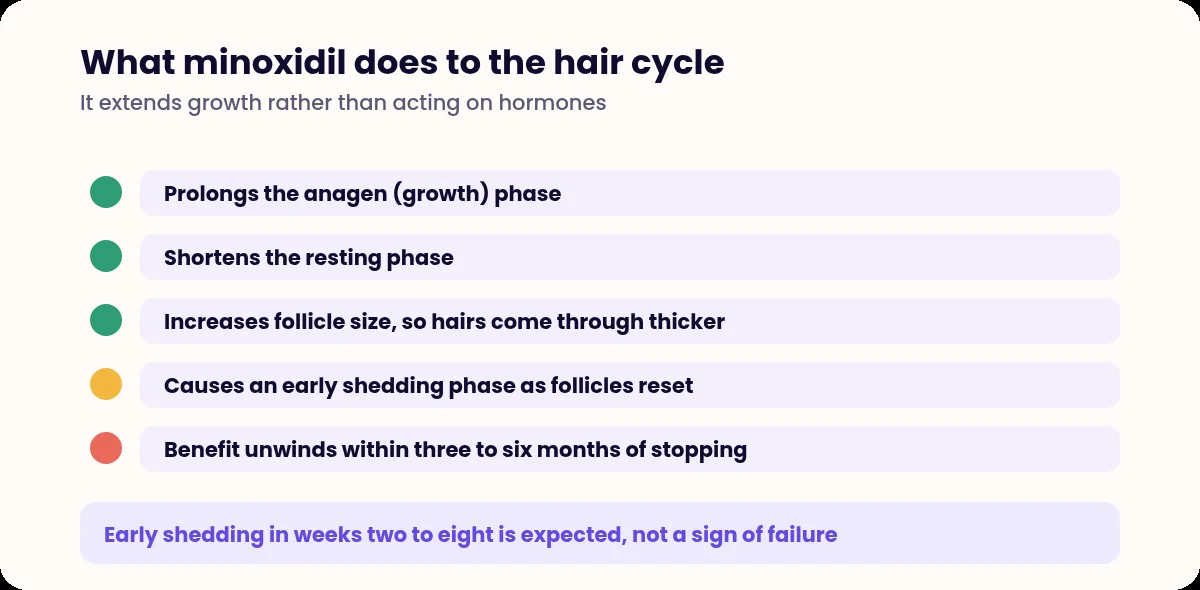
It does not act on DHT, which is what distinguishes it from finasteride and why the two are frequently used together — different mechanisms, additive effects.
Using it properly
This is where most of the difference between success and disappointment lies.
Apply to a dry scalp, not to hair. The solution or foam goes onto the skin in the thinning area. Applying it to hair wastes it.
Follow the product’s own regimen. Solutions are typically twice daily; some foam products are once daily for women and twice daily for men. The product information for your specific product is the authority [1].
Use the stated amount — usually 1 ml of solution or half a capful of foam per application — regardless of how large or small the area is. More does not work better and increases systemic absorption.
Leave it at least four hours before washing, and wash your hands afterwards.
Every day. Minoxidil works through continuous effect on the hair cycle. Intermittent use is close to no use.
The timeline
Weeks 2 to 8: shedding. Many users see increased shedding early on. This is follicles being pushed out of the resting phase, with old hairs released as new ones emerge [1, 4]. It is disconcerting and it is the point at which most people stop. It generally settles within a couple of months.
Month 4: the earliest fair assessment. The product information advises continued use for several months before judging.
Month 6 to 12: the real picture. Photographs in consistent lighting beat impressions.
If nothing at 12 months, review with a clinician rather than continuing indefinitely. A proportion of men do not respond, and it is worth confirming the diagnosis is androgenetic alopecia at that point.
Stopping returns the scalp to its untreated trajectory over three to six months [1]. The gained hairs shed; there is no rebound below baseline, but the loss can feel abrupt because it is concentrated.
Side effects
Topical minoxidil is generally well tolerated. The product information lists [1]:
- Scalp irritation, itching, dryness and flaking — the commonest issue. Propylene glycol in some solutions is a frequent culprit, and switching to a foam formulation, which omits it, often resolves it.
- Unwanted hair growth elsewhere, particularly on the face, usually from transfer via hands or pillow. Washing hands after application and allowing the scalp to dry before bed reduces it.
- Contact dermatitis, occasionally allergic rather than irritant.
- Rarely, systemic effects from absorption — dizziness, rapid heartbeat, swelling of hands or feet, or unexplained weight gain. These warrant stopping and seeking advice [1].
It should not be applied to broken, inflamed or infected scalp skin, which increases absorption.
Oral minoxidil
Low-dose oral minoxidil — typically far below the doses used for blood pressure — has become a common off-label option in dermatology, with a growing published literature and reported response in both men and women, including people who cannot tolerate the topical form.
Two things to be clear about. First, minoxidil tablets are licensed in the UK for severe hypertension, not for hair loss [2], so this is off-label prescribing which should be done by a clinician familiar with it. Second, the side effect profile is different: fluid retention, ankle swelling, palpitations, postural dizziness, and hypertrichosis — unwanted hair growth on the face and body, which is dose-related and is the commonest reason people stop. Cardiovascular history is assessed before starting, and there is monitoring.
It is not something to source without a prescriber, and the doses circulating online are not a substitute for one.
Where it fits
Topical minoxidil is available from UK pharmacies without a prescription, which makes it the usual starting point for men who want to begin treatment. Finasteride addresses the hormonal driver and is prescription only; used together they are more effective than either alone [3]. Our finasteride vs minoxidil guide sets them side by side, and male pattern baldness explains the condition they are both treating.
For women, minoxidil is used at different strengths and regimens and the assessment is different — see female pattern hair loss.
A note on what not to expect
Minoxidil thickens existing miniaturised hair and can bring back recently lost hair. It does not restore a hairline that receded a decade ago, and it performs better at the crown than at the temples. Judged against the right target it is a good treatment; judged against a photograph from university it will always disappoint.
Frequently asked questions
Why is my hair shedding more since starting minoxidil?
Minoxidil pushes resting follicles into a new growth phase, and the old hair is shed as the new one comes through. This usually appears in the first few weeks and settles. The product information notes it and advises continuing; if shedding is heavy or persists beyond a couple of months, get it checked.
Is 5% better than 2%?
In men, the 5% strength has shown greater hair count increases than 2% in comparative studies, and 5% foam or solution is the usual choice for men. In women, the licensed strength and regimen differ, so follow the product information for the specific product.
What happens if I stop?
Hair gained is lost over the following three to six months, and the scalp returns to where it would have been. It is a continuous treatment.
Can I take minoxidil tablets for hair loss?
Low-dose oral minoxidil is used off-label by some dermatologists and there is growing published experience with it, but minoxidil tablets are licensed in the UK for severe hypertension, not hair loss. It requires a prescriber who will assess cardiovascular suitability and monitor for fluid retention and unwanted hair growth.
References
- Summary of Product Characteristics: Regaine for Men Extra Strength 5% w/v cutaneous solution. Electronic Medicines Compendium. www.medicines.org.uk/emc/search?q=regaine
- British National Formulary. Minoxidil. bnf.nice.org.uk/drugs/minoxidil/
- NICE Clinical Knowledge Summaries. Alopecia, androgenetic – male. cks.nice.org.uk/topics/alopecia-androgenetic-male/
- DermNet. Minoxidil. dermnetnz.org/topics/minoxidil
- British Association of Dermatologists. Patient information leaflets. www.skinhealthinfo.org.uk/
Medical reviewer
Naeem Teni
Clinical Lead at Manova. Registered pharmacist and independent prescriber, GPhC 2215591. Reviews Manova’s clinical content for accuracy and safety.
Written by
Manova Editorial Team
Researched and written to our editorial policy, using NICE, NHS, MHRA and peer-reviewed sources.
This article is for general information and isn’t a substitute for advice from your own clinician. If you feel unwell, contact your GP or NHS 111. In an emergency, call 999.