

Key takeaways
- Thyroid hormone acts directly on the follicle, so thyroid disease produces a diffuse, non-scarring telogen effluvium rather than patterned baldness.
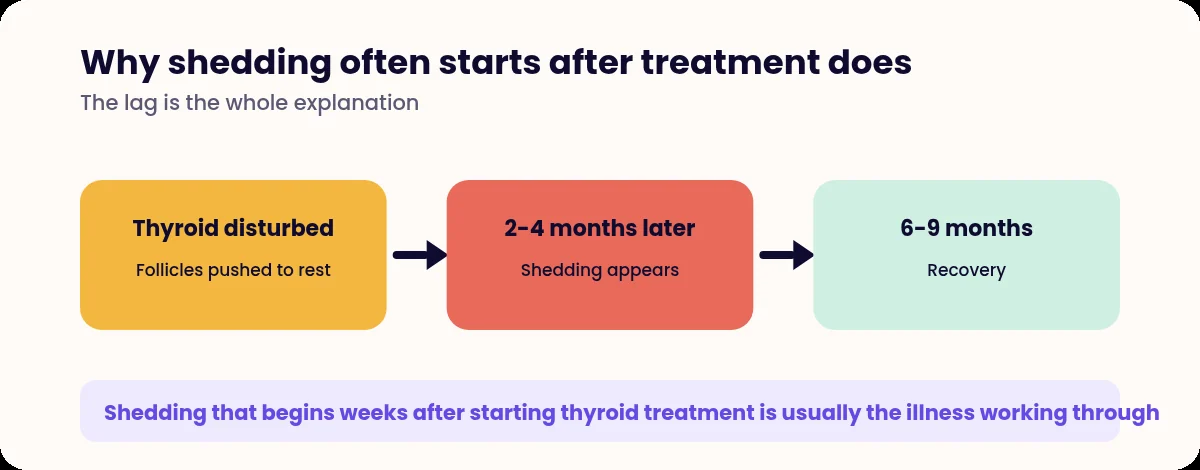
- Telogen effluvium has a two to four month lag between trigger and visible shedding, which is why hair often starts falling just as thyroid function is normalising — the shed usually reflects the pre-treatment illness.
- Both the disease and the treatment can be implicated: levothyroxine product information lists alopecia as an undesirable effect at unknown frequency, and carbimazole product information notes occasional reports of hair loss.
- Loss of the outer third of the eyebrows is classically described in hypothyroidism but is neither sensitive nor specific, so its absence does not rule thyroid disease out and its presence does not confirm it.
Thyroid hormone acts directly on the hair follicle. T3 and T4 help hold follicles in the growing anagen phase, and when they are deficient, anagen shortens and follicles are pushed into the resting telogen phase early.
The result is a diffuse, non-scarring telogen effluvium — thinning spread evenly across the whole scalp, with more hairs on the pillow, in the shower and in the brush. It is not patterned baldness. If your loss is concentrated at the temples and crown with a normal density elsewhere, thyroid disease is not the explanation, whatever your blood results say.
What hypothyroidism does to hair
In a series of 460 patients with hypothyroidism, diffuse hair loss was recorded in 46.09% and coarse scalp hair in 29.35% [5]. Texture change matters as much as density here: hair becomes dry, brittle and coarse, so it feels different to handle and breaks more readily even where the follicle count is normal.
Loss of the outer third of the eyebrows — madarosis — is the sign every medical student is taught. It is classically described, and it is neither sensitive nor specific [5]. Plenty of people with hypothyroidism have intact eyebrows, and plenty of people with thin outer eyebrows have entirely normal thyroid function. It is worth mentioning at an appointment. It is not a home diagnostic test, and the other causes of eyebrow loss are covered in beard and eyebrow hair loss.
What hyperthyroidism does
Less well recognised by patients, and different in character. In hyperthyroidism the hair becomes fine and soft rather than coarse, and diffuse non-scarring alopecia also occurs [5].
Because the texture change runs the opposite way, people often describe their hair as “gone limp” or “lost its body” rather than as falling out, and the connection to the thyroid is made late or not at all.
The part that catches everyone out
This is the single most useful thing on this page.
Telogen effluvium has a two to four month latency between trigger and visible shedding [4]. A follicle pushed into telogen does not release its hair immediately; it holds it for months, and the hair falls when a new one begins to grow beneath it.
Now put that against a typical thyroid story. Symptoms build over months. Blood tests are done. Treatment starts. Levels normalise over the following weeks. And somewhere in that window the shedding begins, because the follicles that gave up during the untreated illness are only now reaching the point of release.
From the inside it looks unmistakably like the tablets caused it. In most cases it is the pre-treatment illness working its way through the hair cycle, arriving late.
But both can be involved
It would be dishonest to stop there, because the product information does not.
Levothyroxine product information lists alopecia as an undesirable effect at frequency “not known”, and specifically notes transient hair loss in the paediatric population [2]. Carbimazole product information states that “hair loss has been occasionally reported” [3].
So both the disease and the treatment can be implicated, and in an individual case it is often impossible to separate them. What does not follow is that stopping treatment is the answer. Shedding beginning weeks after starting thyroid treatment is usually self-limiting and is not a reason to stop thyroid treatment. Untreated thyroid disease has consequences considerably more serious than hair, and returning to an untreated state reintroduces the original trigger. Raise it with your prescriber — there is a reasonable question about whether your dose and levels are right — but raise it rather than act on it.
The recovery timeline
Realistic expectations help more than anything else here [4]:
- Up to around 100 hairs a day is normal shedding. Counting is rarely useful, but it stops people panicking at a number that is normal.
- Acute telogen effluvium peaks over several months and then settles.
- It normalises over roughly six to nine months after the trigger resolves.
- Full cosmetic recovery can lag biochemical recovery by months, because a regrown hair has to reach length before it contributes to how your hair looks. A normal TSH in March does not mean normal-looking hair in April.
- Chronic telogen effluvium can persist for years, which is a different and more frustrating problem and worth naming if the shedding does not follow the curve above.
A trichogram showing more than 25% of hairs in telogen supports the diagnosis [4], though in practice most UK assessments rest on history, examination and blood tests rather than a trichogram.
Why the texture change matters as much as the count
One thing that gets missed in the focus on shedding: in hypothyroidism the hair that remains is dry, brittle and coarse [5], and brittle hair breaks. So part of what people experience as thinning is breakage along the shaft rather than loss at the root, and it responds to different things — gentler handling, less heat, less chemical processing — while the follicular recovery works through on its own timescale.
The practical test is to look at the hairs you are collecting. Shed hairs have a small pale bulb at one end and are close to your full length. Broken hairs have no bulb and come in a range of lengths. Most people with thyroid-related hair change have some of both, and separating them stops you attributing everything to a hormone level that may already be back in range.
Alopecia areata is a separate association
This one is genuinely different and gets conflated constantly.
Alopecia areata is separately associated with autoimmune thyroid disease — Graves’ disease and Hashimoto’s thyroiditis [6]. It is not the diffuse thyroid effluvium described above. It is patchy, immune-mediated loss: well-demarcated smooth circles, often appearing quickly, sometimes with short tapering hairs at the edges.
So a person with autoimmune thyroid disease can have either, or both, and they need different explanations and different management. Round patches are not thyroid effluvium and should be assessed as alopecia areata.
What to ask for
If you are shedding diffusely and thyroid disease is plausible, the blood tests worth having are the ones covered in our guide to hair loss blood tests — thyroid function alongside ferritin, full blood count and the other common contributors, because more than one trigger at once is the rule rather than the exception in effluvium.
If you already have a thyroid diagnosis and are shedding, the questions for your prescriber are whether your current levels are in range, how long you have been at this dose, and whether anything else happened two to four months before the shedding started. That last question uncovers more causes than any blood test does — illness, surgery, a crash diet, childbirth, a new medicine, a period of severe stress. Thyroid disease sits alongside all of these in the telogen effluvium list rather than above it.
If you also have weight changes you are trying to make sense of, thyroid disease and weight covers that side of it.
Frequently asked questions
Why did my hair start falling out after I started thyroid treatment?
Because of the lag. Telogen effluvium takes two to four months to become visible after the event that triggered it, so hairs pushed into the resting phase by months of untreated thyroid disease reach the shedding point around the time treatment is taking effect. It looks like the tablets caused it, and in most cases it is the illness working its way through the hair cycle.
Should I stop my thyroid medicine if my hair is falling out?
No. Shedding beginning weeks after starting treatment is usually the pre-treatment illness working through the cycle and is typically self-limiting. Stopping thyroid treatment risks returning you to the state that caused the problem. Raise it with your prescriber, who can check whether your levels are where they should be, but do not stop on your own.
How long does thyroid hair loss take to recover?
Acute telogen effluvium peaks over several months and settles over roughly six to nine months once the trigger has resolved. Full cosmetic recovery — hair that looks and feels as it did — can lag biochemical recovery by several months more, because regrown hairs have to reach length. A chronic effluvium can persist considerably longer.
Does losing my eyebrows mean I have a thyroid problem?
It is worth mentioning to a clinician, but it is not a reliable sign on its own. Loss of the outer third of the eyebrows is classically described in hypothyroidism and is neither sensitive nor specific in practice. Eyebrow loss that comes with scalp hairline recession, itch or pain, or facial papules points somewhere quite different and needs urgent assessment.
References
- NHS. Underactive thyroid (hypothyroidism). www.nhs.uk/conditions/underactive-thyroid-hypothyroidism/
- Summary of Product Characteristics: Vencamil (levothyroxine sodium) tablets. Electronic Medicines Compendium, revised 2 December 2025. www.medicines.org.uk/emc/
- Summary of Product Characteristics: Carbimazole tablets. Electronic Medicines Compendium. www.medicines.org.uk/emc/
- DermNet. Telogen effluvium. dermnetnz.org/topics/telogen-effluvium
- NICE Clinical Knowledge Summaries. Hypothyroidism. cks.nice.org.uk/topics/hypothyroidism/
- DermNet. Alopecia areata. dermnetnz.org/topics/alopecia-areata
Medical reviewer
Naeem Teni
Clinical Lead at Manova. Registered pharmacist and independent prescriber, GPhC 2215591. Reviews Manova’s clinical content for accuracy and safety.
Written by
Manova Editorial Team
Researched and written to our editorial policy, using NICE, NHS, MHRA and peer-reviewed sources.
This article is for general information and isn’t a substitute for advice from your own clinician. If you feel unwell, contact your GP or NHS 111. In an emergency, call 999.