

Key takeaways
- The MHRA licensed a 25 mg semaglutide tablet for weight management on 11 June 2026 — the UK's first GLP-1 tablet for weight loss.
- It must be taken on an empty stomach after at least 8 hours without food, with a sip of water, and nothing else for 30 minutes.
- Doses step up from 1.5 mg through 4 mg and 9 mg to 25 mg, a month at each level.
- In the OASIS-4 trial, average weight loss was about 14% at 64 weeks against 2% on placebo.
Semaglutide has been available as a weekly injection for weight management in the UK since 2021. In June 2026 it became available as a daily tablet as well.
This page explains what was licensed and what the evidence shows. It is information about a prescription-only medicine, not a recommendation.
What was approved
On 11 June 2026 the MHRA licensed a 25 mg oral semaglutide tablet for weight loss and weight management — described in the announcement as “the UK’s first GLP-1 receptor agonist tablet for weight loss and weight management” [1].
The licensed population is the same as for the injection: adults with a BMI of 30 or above, or 27 to 30 with at least one weight-related condition, alongside a reduced-calorie diet and increased physical activity [1].
The dosing, and the part people underestimate
The schedule steps up over four months [1]:
| Step | Dose | Minimum time at this dose |
|---|---|---|
| Start | 1.5 mg once daily | 1 month |
| 2 | 4 mg | 1 month |
| 3 | 9 mg | 1 month |
| 4 | 25 mg | — |
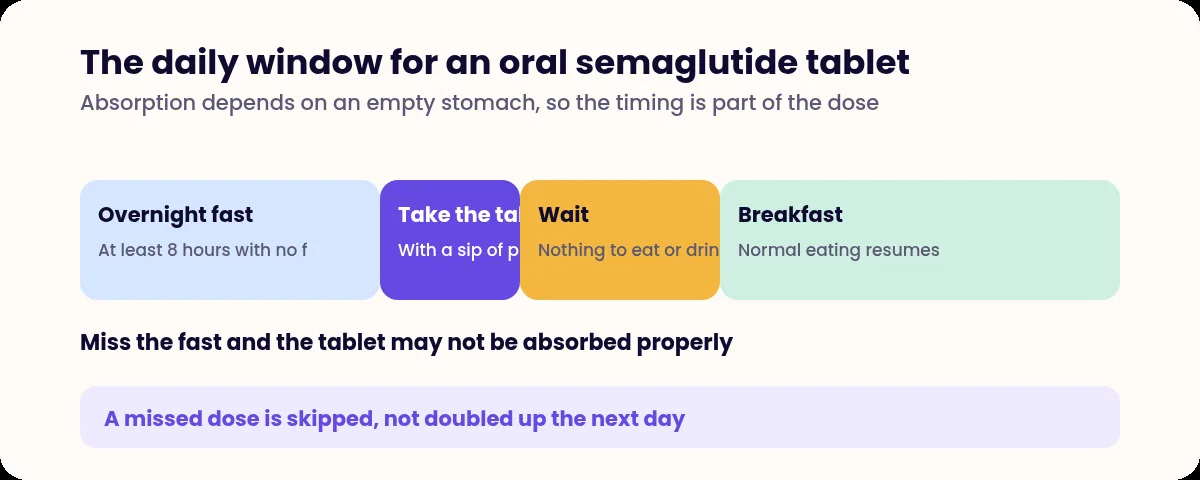
The administration instructions matter more here than with almost any other tablet. From the MHRA announcement [1]:
“The semaglutide tablet should be taken whole on an empty stomach after fasting for at least 8 hours with a sip of water. After taking it, no food or drink should be taken for at least thirty minutes.”
This is not fussiness. Semaglutide is a peptide, and peptides are normally destroyed by digestion. The tablet works by pairing the drug with an absorption enhancer, and that pairing only works reliably in an empty stomach with minimal fluid. Take it with breakfast and you may absorb very little.
In practice that means the tablet has to anchor your morning: wake, take it, wait half an hour, then eat or drink. For some people that is easier than a weekly injection. For others it is considerably harder.
What the trial found
OASIS-4 tested the 25 mg dose in 307 adults — 205 on semaglutide, 102 on placebo — over 71 weeks in total, including a 12-week escalation and 64 weeks of treatment [2].
| Group | Mean weight change |
|---|---|
| Oral semaglutide 25 mg | about −14% |
| Placebo | about −2% |
Thirty per cent of the semaglutide group lost 20% or more of their body weight, against 3% on placebo.
Side effects. Gastrointestinal side effects occurred in 74% of the semaglutide group against 42% on placebo. Discontinuation because of side effects was 7% against 6% — a much smaller gap than the raw side-effect numbers suggest, meaning most people who had side effects carried on [2].
Switching from the injection
The MHRA announcement notes that people already on the 2.4 mg weekly injection may transition directly to the 25 mg daily tablet [1]. That is a prescriber’s decision, and it is worth being clear about why someone might: convenience, needle aversion, or supply. It is not because one form is inherently safer.
What approval does not mean
It is not on the NHS. The announcement states that the product is not currently available through the NHS, and that decisions on NHS use will follow established processes including a NICE evaluation [1]. NICE’s existing appraisal of semaglutide, TA875, covers the injection [4].
It is not being advertised to you legally. On 18 June 2026 the MHRA, ASA and GPhC jointly warned that prescription-only weight-management medicines cannot be advertised to the public, and that referring to them by name or as “GLP-1 tablets” or “the new weight-loss tablets” is likely to breach the advertising code — including advertising waiting lists [5].
Safety information
The full warnings sit in the Summary of Product Characteristics [3]. Points worth knowing:
- Contraindication. The UK SmPC for Wegovy lists hypersensitivity to the active substance or excipients as the contraindication. Semaglutide has not been studied in people with a history of pancreatitis and should be used with caution in them [3].
- Pancreatitis. MHRA warnings were strengthened in January 2026 across this class. Severe, persistent abdominal pain needs urgent attention.
- Eyes. In February 2026 the MHRA issued advice on a very rare association with NAION, a condition causing sudden loss of vision, usually in one eye. Sudden visual change should be assessed urgently [6].
- Pregnancy. Semaglutide should not be used in pregnancy and should be discontinued at least two months before a planned pregnancy because of its long half-life [3].
- Dehydration. Nausea, vomiting and diarrhoea can cause dehydration, which in rare cases can worsen kidney function [3].
Suspected side effects can be reported via the Yellow Card scheme [7].
Where this information comes from
The regulatory detail is from the MHRA’s announcement and the product’s SmPC; trial results from the published OASIS-4 paper. The SmPC on the electronic Medicines Compendium is the current authority on licensed use, and it changes.
Frequently asked questions
Is there a Wegovy tablet in the UK?
Yes. The MHRA approved a 25 mg oral semaglutide tablet for weight management on 11 June 2026, described as the UK's first GLP-1 receptor agonist tablet for weight loss. Licensing is separate from NHS availability and from supply at any given time.
How do you have to take it?
On an empty stomach, after fasting for at least eight hours, swallowed whole with a sip of water — and then no food, drink or other tablets for at least thirty minutes. Those instructions are not optional: absorption of oral semaglutide is poor and inconsistent without them.
How does it compare with the injection?
It is the same active substance. In OASIS-4 the 25 mg tablet produced about 14% average weight loss over 64 weeks of treatment; the 2.4 mg weekly injection produced about 15% in its own trial, and the 7.2 mg injection about 18.7% in another. These are separate trials, so they are not a direct comparison.
Can you switch from the injection to the tablet?
The MHRA announcement states that people on the 2.4 mg weekly injection may transition directly to the 25 mg daily tablet. Any switch is a decision for your prescriber, not something to do on your own.
Are the side effects different?
The most common side effects are the same gastrointestinal ones: nausea, diarrhoea, constipation and vomiting. In OASIS-4, gastrointestinal side effects affected 74% of the tablet group against 42% on placebo, and discontinuation because of side effects was 7% against 6%.
References
- MHRA. First GLP-1 tablet for weight loss approved in the UK. 11 June 2026. www.gov.uk/government/news/first-glp-1-tablet-for-weight-loss-approved
- OASIS-4: oral semaglutide 25 mg in adults with overweight or obesity. New England Journal of Medicine. 17 September 2025. www.acc.org/latest-in-cardiology/journal-scans/2025/09/24/16/40/oasis-
- Novo Nordisk Limited. Wegovy: Summary of Product Characteristics. Electronic Medicines Compendium. www.medicines.org.uk/emc/product/13803/smpc
- National Institute for Health and Care Excellence. Semaglutide for managing overweight and obesity (TA875). www.nice.org.uk/guidance/ta875/chapter/1-Recommendations
- MHRA, ASA and GPhC. Warning on promoting newly licensed prescription only medicines and unlicensed medicines for weight management. 18 June 2026. www.gov.uk/government/news/warning-on-promoting-newly-licensed-prescri
- MHRA. Semaglutide: risk of non-arteritic anterior ischaemic optic neuropathy (NAION). Drug Safety Update, 5 February 2026. assets.publishing.service.gov.uk/media/69847cb7468d351e1406b4d2/DSU_-_
- MHRA. Yellow Card: report a suspected side effect. yellowcard.mhra.gov.uk/
Medical reviewer
Naeem Teni
Clinical Lead at Manova. Registered pharmacist and independent prescriber, GPhC 2215591. Reviews Manova’s clinical content for accuracy and safety.
Written by
Manova Editorial Team
Researched and written to our editorial policy, using NICE, NHS, MHRA and peer-reviewed sources.
This article is for general information and isn’t a substitute for advice from your own clinician. If you feel unwell, contact your GP or NHS 111. In an emergency, call 999.