

Key takeaways
- Liraglutide, sold as Saxenda, is a once-daily GLP-1 injection licensed for weight management in adults and in adolescents from 12 years.
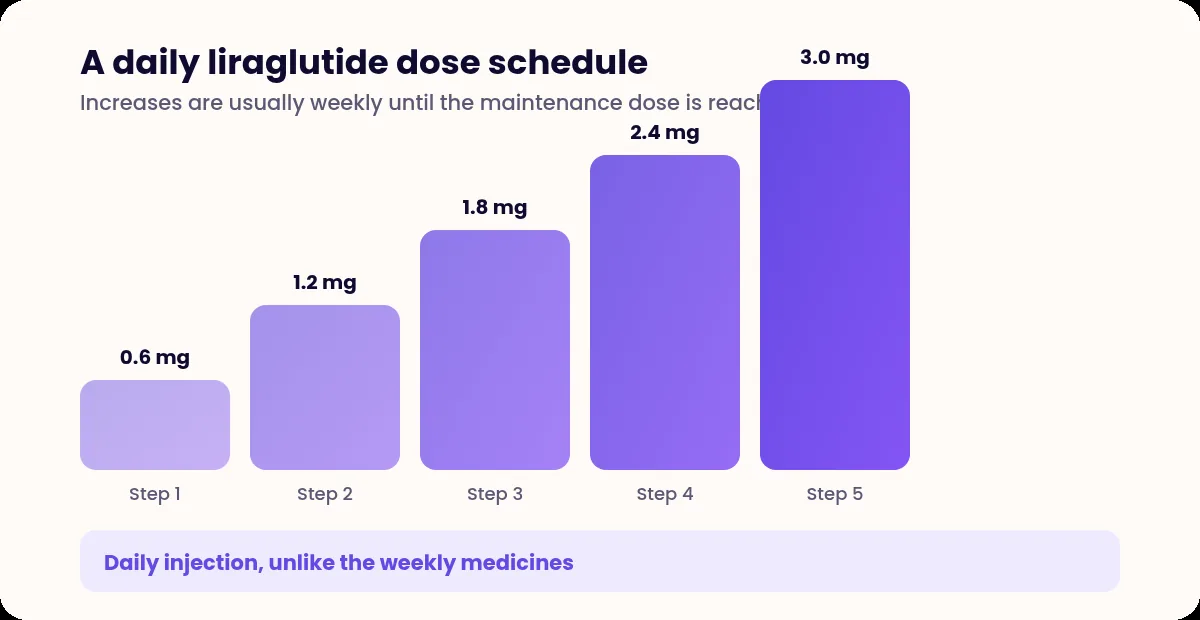
- It starts at 0.6 mg daily and increases weekly to a maintenance dose of 3 mg.
- In the SCALE trial it produced 8.0% average weight loss at 56 weeks against 2.6% on placebo.
- The SmPC says to stop if less than 5% of body weight has been lost after 12 weeks on the maintenance dose.
Liraglutide was the first GLP-1 medicine licensed for weight management in the UK, and for several years it was the only one. It has since been overtaken in the headlines, but it is still licensed and still prescribed.
This page sets out what the licence covers. It is information about a prescription-only medicine, not advice about whether it suits you.
What it is and who it is licensed for
Liraglutide, sold for weight management as Saxenda, is a GLP-1 receptor agonist given as a once-daily injection. Its SmPC licenses it as an adjunct to a reduced-calorie diet and increased physical activity for [1]:
- Adults with a BMI of 30 or above, or 27 or above with at least one weight-related condition
- Adolescents from 12 years with obesity and a body weight above 60 kg
That adolescent licence is unusual among weight-management medicines and belongs firmly in specialist paediatric services.
Dosing
The escalation is weekly rather than monthly [1]:
| Step | Dose | Time at this dose |
|---|---|---|
| Start | 0.6 mg once daily | 1 week |
| 2 | 1.2 mg | 1 week |
| 3 | 1.8 mg | 1 week |
| 4 | 2.4 mg | 1 week |
| Maintenance | 3.0 mg once daily | — |
The stopping rule. The SmPC states that treatment should be discontinued if an adult has not lost at least 5% of initial body weight after 12 weeks on the 3 mg dose — or, in adolescents, if BMI has not fallen by at least 4% [1]. That is a clearer and earlier review point than the six-month rule used for tirzepatide.
What the trial found
SCALE randomised 3,731 adults without type 2 diabetes to liraglutide 3 mg or placebo for 56 weeks [2].
| Group | Mean weight loss |
|---|---|
| Liraglutide 3 mg | 8.0% |
| Placebo | 2.6% |
Sixty-three per cent of the liraglutide group lost at least 5% of their body weight, against 27% on placebo; 33% lost at least 10%, against 11%.
Gastrointestinal side effects were common and dose-related: nausea in 40% against 15% on placebo, diarrhoea 21% against 9%, vomiting 16% against 4%, constipation 20% against 9% [2].
Where it sits now
Honestly: as a second choice for most adults, and a reasonable one.
Against it — the average weight loss in trials is roughly half that of the newer weekly injections, and it has to be injected every day rather than weekly. For most people, daily is the sticking point.
For it — it has the longest track record of any GLP-1 in weight management. It is the only one licensed from age 12. Generic versions have begun to appear now that patent protection has lapsed, which affects cost. And if a newer medicine is unsuitable, unavailable or not tolerated, liraglutide is a licensed alternative rather than a compromise.
NICE recommends liraglutide only within specialist weight-management services for people meeting the licensed criteria [3], which is narrower than the licence itself — the same pattern as the other medicines in this class.
Safety information
The full warnings are in the SmPC and patient information leaflet [1]. Points that apply across this class:
- Pancreatitis. MHRA warnings were strengthened in January 2026 following reports of severe and fatal cases across GLP-1 medicines. Severe, persistent abdominal pain, particularly radiating to the back with vomiting, needs urgent medical attention [4].
- Gallstones. Gallbladder problems are reported with rapid weight loss across this class.
- Dehydration. Vomiting and diarrhoea can cause dehydration, which in rare cases affects kidney function.
- Pregnancy. Not for use in pregnancy.
- Other medicines. Delayed gastric emptying can affect the absorption of other oral medicines, and the risk of low blood sugar rises if you also take insulin or a sulfonylurea.
Suspected side effects can be reported through the Yellow Card scheme [5].
Where this information comes from
Dosing and safety detail is taken from the UK SmPC; trial figures from the published SCALE paper; the NHS position from NICE TA664. Product information changes — the SmPC on the electronic Medicines Compendium is the current authority.
Frequently asked questions
Is Saxenda still available in the UK?
Yes. Liraglutide remains licensed for weight management, and its Summary of Product Characteristics was last revised in November 2025. Newer medicines have taken most of the attention, but it has not been withdrawn.
How is Saxenda dosed?
It starts at 0.6 mg once daily by injection and increases in 0.6 mg steps at intervals of at least a week, up to a maintenance dose of 3 mg once daily. The gradual increase is to reduce gastrointestinal side effects.
How does it compare with the weekly injections?
In its own trial liraglutide produced about 8% average weight loss at 56 weeks. Semaglutide and tirzepatide have produced larger averages in their trials. Those are separate studies rather than direct comparisons, but the difference is large enough that the newer medicines are generally preferred where they are suitable and available.
Is there a generic liraglutide?
Liraglutide's patent protection has lapsed and generic versions have begun to appear in the UK. Availability and price vary, and a generic is the same active substance as the brand.
Can under-18s take it?
Liraglutide is licensed for adolescents from the age of 12 with obesity and a body weight above 60 kg, which is unusual among these medicines. That is a specialist decision, not something to arrange privately on a young person's behalf.
References
- Novo Nordisk Limited. Saxenda 6 mg/mL solution for injection: Summary of Product Characteristics. Last revised November 2025. Electronic Medicines Compendium. www.medicines.org.uk/emc/product/2313/smpc
- Pi-Sunyer X, Astrup A, Fujioka K, et al. A randomized, controlled trial of 3.0 mg of liraglutide in weight management (SCALE). New England Journal of Medicine. 2015;373(1):11-22. doi.org/10.1056/NEJMoa1411892
- National Institute for Health and Care Excellence. Liraglutide for managing overweight and obesity (TA664). Published 9 December 2020. www.nice.org.uk/guidance/ta664
- MHRA. GLP-1 receptor agonists and dual GLP-1/GIP receptor agonists: strengthened warnings on acute pancreatitis. Drug Safety Update, 29 January 2026. www.gov.uk/drug-safety-update/glp-1-receptor-agonists-and-dual-glp-1-s
- MHRA. Yellow Card: report a suspected side effect. yellowcard.mhra.gov.uk/
Medical reviewer
Naeem Teni
Clinical Lead at Manova. Registered pharmacist and independent prescriber, GPhC 2215591. Reviews Manova’s clinical content for accuracy and safety.
Written by
Manova Editorial Team
Researched and written to our editorial policy, using NICE, NHS, MHRA and peer-reviewed sources.
This article is for general information and isn’t a substitute for advice from your own clinician. If you feel unwell, contact your GP or NHS 111. In an emergency, call 999.