

Key takeaways
- Fatty liver disease, now often called MASLD, affects roughly one in five UK adults.
- It usually causes no symptoms and is found incidentally on blood tests or a scan.
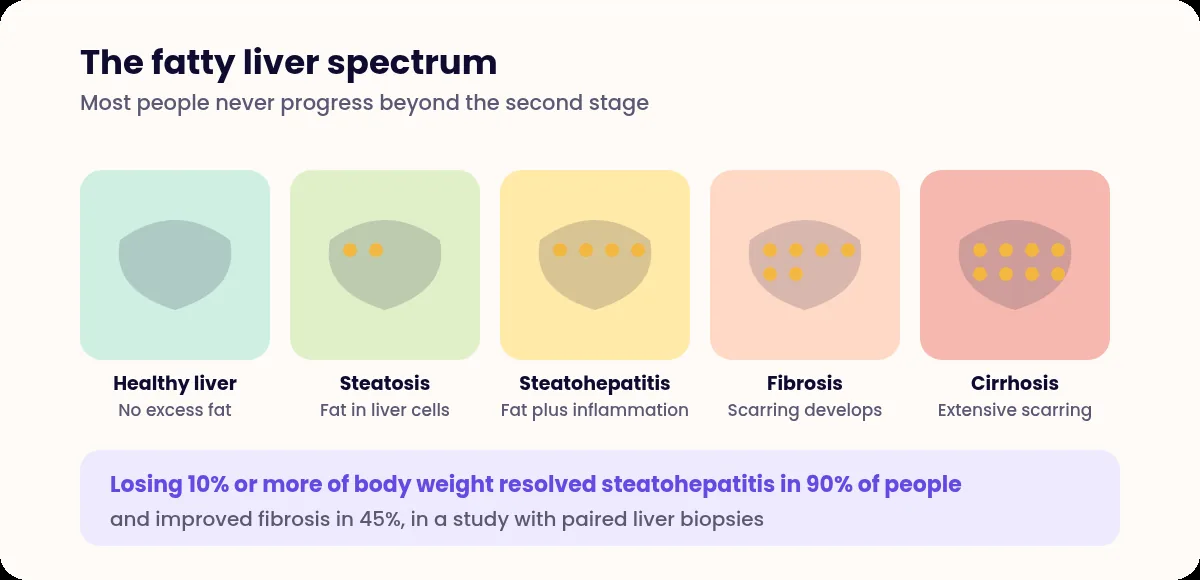
- In one landmark study, losing 10% or more of body weight resolved steatohepatitis in 90% of people and improved fibrosis in 45%.
- NICE recommends the ELF blood test, not FIB-4 or FibroScan, for assessing advanced fibrosis in NAFLD.
Fatty liver disease is the most common liver condition in the UK, affecting somewhere around one in five adults. Almost nobody with it feels ill. That combination — common, silent, and driven by weight — is what makes it worth understanding.
What it is
Fat accumulates inside liver cells in people who drink little or no alcohol. The condition has recently been renamed MASLD (metabolic dysfunction-associated steatotic liver disease), which reflects what actually drives it: insulin resistance, excess visceral fat and the metabolic problems that travel with them.
It exists on a spectrum:
- Simple steatosis — fat in the liver, no inflammation. Common and often harmless on its own.
- Steatohepatitis — fat plus inflammation and liver cell damage.
- Fibrosis — scarring in response to that inflammation.
- Cirrhosis — extensive scarring that affects how the liver works. Uncommon, but serious.
Most people never move beyond stage one. The point of assessment is finding the minority who will.
How it is found and assessed
Usually by accident: mildly raised ALT on a blood test, or fatty change reported on an abdominal ultrasound done for something else.
Where NICE guidance differs from what many people expect is the next step. NG49 recommends the Enhanced Liver Fibrosis (ELF) blood test to assess for advanced fibrosis in people with NAFLD, with a score of 10.51 or above indicating advanced fibrosis and prompting referral [1]. FIB-4 and transient elastography (FibroScan) are widely used in practice and in other guidelines, but they are not what NG49 specifies.
If your ELF is below that threshold, guidance suggests retesting every three years in adults.
How much weight loss changes it
This is where the evidence is genuinely strong. A prospective study followed 261 people with biopsy-proven steatohepatitis through 52 weeks of lifestyle intervention, with paired liver biopsies at the end. The results tracked weight loss closely [2]:
| Weight lost | What happened |
|---|---|
| Under 5% | Limited change |
| 5–7% | Steatohepatitis resolved in about a quarter |
| 7–10% | Resolution in around two-thirds |
| 10% or more | Resolution in 90%, and fibrosis regression in 45% |
Fibrosis was, until recently, assumed to be largely one-directional. That 45% figure is the reason weight loss is the first-line treatment rather than an adjunct to one.
What to change
Weight, by any sustainable route. The target here is 7 to 10%, and it is worth being explicit about that number.
Alcohol. Even though this is “non-alcohol related” liver disease, alcohol adds injury to an already stressed liver. Reducing it is standard advice.
Sugar-sweetened drinks and fructose. Liver fat is particularly responsive to liquid sugar.
Physical activity. Exercise reduces liver fat even where weight does not change much, which is unusual and useful.
Coffee. Repeatedly associated with lower rates of fibrosis in liver disease. A pleasant exception to most advice in this article.
What about medication?
Weight-loss medicines are licensed for weight management, and where a person meets the criteria for them, the weight loss achieved is relevant to the liver. Licensed drug treatments specifically for MASLD are an active area of research but availability on the NHS remains limited. Anything here is a discussion with a clinician who has your results.
When to speak to a clinician
Seek advice if you:
- have been told you have fatty liver or raised liver enzymes and have not had fibrosis assessed
- have yellowing of the eyes or skin, swelling of the abdomen or legs, or vomiting blood — seek urgent help
- drink above the UK guideline of 14 units a week
- have type 2 diabetes, which substantially raises the risk of progression
Frequently asked questions
What is fatty liver disease?
It is the build-up of fat inside liver cells in people who drink little or no alcohol. It is now commonly called metabolic dysfunction-associated steatotic liver disease, or MASLD. In some people it progresses to inflammation, scarring and, rarely, cirrhosis.
How much weight loss reverses fatty liver?
Fat in the liver starts to fall with around 3 to 5% weight loss. Inflammation improves at around 7%. The strongest effects on scarring were seen at 10% or more.
Does fatty liver cause symptoms?
Usually not. Some people have vague tiredness or a dull ache under the right ribs. Most are picked up because of mildly abnormal liver blood tests or an ultrasound done for another reason.
Can fatty liver be cured?
Simple fatty liver is often fully reversible with weight loss and reduced alcohol. Established scarring is harder to reverse, though it can improve. The earlier it is addressed, the better the outlook.
References
- NICE. Non-alcoholic fatty liver disease (NAFLD): assessment and management. NG49. www.nice.org.uk/guidance/ng49
- Vilar-Gomez E, Martinez-Perez Y, Calzadilla-Bertot L, et al. Weight loss through lifestyle modification significantly reduces features of nonalcoholic steatohepatitis. Gastroenterology. 2015;149(2):367-378. doi.org/10.1053/j.gastro.2015.04.005
- British Liver Trust. Non-alcohol related fatty liver disease. britishlivertrust.org.uk/information-and-support/liver-conditions/non-
- NHS. Non-alcoholic fatty liver disease (NAFLD). www.nhs.uk/conditions/non-alcoholic-fatty-liver-disease/
Medical reviewer
Naeem Teni
Clinical Lead at Manova. Registered pharmacist and independent prescriber, GPhC 2215591. Reviews Manova’s clinical content for accuracy and safety.
Written by
Manova Editorial Team
Researched and written to our editorial policy, using NICE, NHS, MHRA and peer-reviewed sources.
This article is for general information and isn’t a substitute for advice from your own clinician. If you feel unwell, contact your GP or NHS 111. In an emergency, call 999.