

Key takeaways
- Large hospitality businesses in England must display calories on menus, which makes comparing options far easier.
- Restaurant meals are typically higher in oil, butter and salt than the same dish at home.
- Drinks, sides and bread often account for more of the total than the main course.
- One meal out does not undo a week. Frequency is what matters, not any single occasion.
Most weight-loss advice quietly assumes you cook every meal at home. Most people’s lives do not work that way. There are birthdays, work dinners, Friday nights when nobody wants to cook.
The good news is that eating out is a solvable problem rather than a reason to abandon the plan.
Why restaurant food is higher in calories
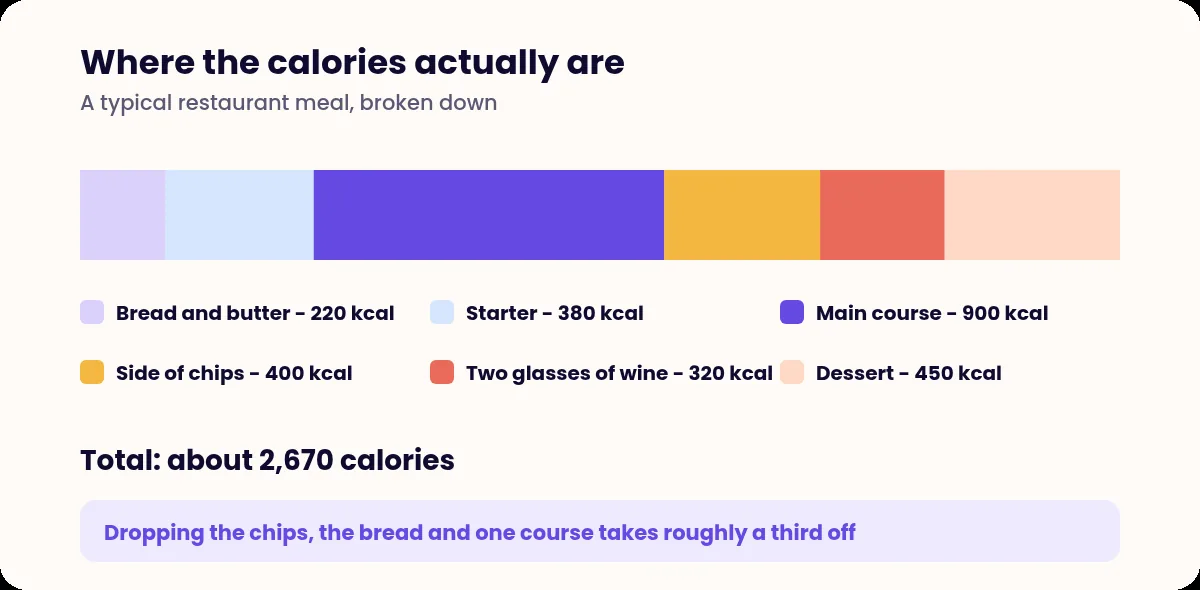
It is not a conspiracy. It is that restaurants are optimising for how good the food tastes, and fat, salt and sugar do that job well. A survey of main meals at large UK restaurant chains found that the great majority exceeded public health recommendations for a single meal, with an average energy content well above what most people would guess [3].
The usual culprits:
- Oil and butter used generously in cooking and finishing
- Portion size, which is set by what feels like value, not by your needs
- Sides and bread, which arrive by default
- Drinks, which are rarely counted at all
The single most useful change
In England, large businesses in the out-of-home sector — chains with 250 or more employees — are required to display calorie information on menus [1]. This is genuinely useful, and it is worth actually reading.
You do not need to pick the lowest number on the menu. You need to notice when two dishes you would enjoy equally differ by 600 calories, which happens constantly.
How to read a menu
The cooking method tells you most of it. Grilled, roasted, baked, steamed, poached, griddled sit at one end. Fried, battered, tempura, crispy, creamy, buttered, gratin sit at the other.
Look at the sauce. Tomato-based, broth-based and vinaigrettes cost far less than cream, cheese, butter or aioli.
Order the protein first, then build around it. Protein is the most satiating macronutrient and the one restaurant meals are often lightest on relative to their size.
Sides are where the meal is decided. A grilled steak is a reasonable choice. A grilled steak with chips, onion rings and peppercorn sauce is a different meal entirely.
Practical tactics that actually work
Don’t arrive ravenous. Eating a little protein beforehand — yoghurt, a boiled egg, some nuts — takes the edge off the decisions you make in the first five minutes.
Decide before you sit down. Most chains publish their menus online. Choosing at home rather than at the table removes the influence of everyone else’s order.
Ask for dressing and sauce on the side. Universally accepted, and it typically halves what you use.
Swap one side. Salad or vegetables instead of chips is the single highest-yield substitution available.
Order water alongside whatever you’re drinking. It slows the pace of everything.
Starter or dessert, not both. A simple rule that survives most occasions.
Three courses is a choice, not an obligation. So is finishing the plate.
Drinks
This is usually the biggest single item, and the one nobody counts. Three pints of lager is roughly 600 calories. A bottle of wine shared between two is around 300 each. Alcohol also reduces inhibition around food, which compounds the effect — we cover this properly in alcohol and weight.
If you are drinking, the useful lever is usually the number of drinks rather than the type.
Work dinners and other things you can’t control
Sometimes the menu is set and someone else ordered the wine. Two things help. First, eat a little more lightly earlier in the day if you know the evening is coming — not starving yourself, just shifting the balance. Second, get back to normal at the next meal rather than writing off the rest of the week.
That second one matters more than any menu choice in this article. A single large meal is around a day’s surplus. A week of “I’ve ruined it now” is around seven.
When to speak to a clinician
Get advice if you:
- feel unable to eat in front of other people, or avoid social events because of food
- find yourself restricting severely to compensate after eating out
- have specific dietary restrictions after bariatric surgery or for a medical condition
- are on weight-loss medication and find rich or fatty meals reliably make you unwell
If food and eating have become a source of persistent distress, that is worth raising with your GP.
Frequently asked questions
Can you lose weight while eating out regularly?
Yes, but it takes more deliberate choices. Restaurant portions and cooking methods are generally higher in calories than home cooking, so eating out several times a week means the choices within each meal matter more.
Are calories on menus accurate?
They are estimates based on standard recipes, so an individual plate can vary. They are still much more useful than guessing, and the relative differences between dishes are usually reliable even if the absolute numbers are not exact.
What's the best thing to order at a restaurant?
As a rule of thumb: a grilled, roasted, baked or steamed protein, a carbohydrate that has not been fried, and vegetables or salad with dressing on the side. The cooking method usually tells you more than the ingredient does.
What about takeaways?
Order the same way you would in a restaurant, but order it before you are very hungry, and consider ordering for one rather than for a table. Takeaway portions are often designed to feel generous.
References
- GOV.UK. Calorie labelling in the out of home sector. www.gov.uk/government/publications/calorie-labelling-in-the-out-of-hom
- NHS. The Eatwell Guide. www.nhs.uk/live-well/eat-well/food-guidelines-and-food-labels/the-eatw
- Robinson E, Jones A, Whitelock V, Mead BR, Haynes A. (Over)eating out at major UK restaurant chains: observational study of energy content of main meals. BMJ. 2018;363:k4982. doi.org/10.1136/bmj.k4982
- NHS. Alcohol units. www.nhs.uk/live-well/alcohol-advice/calculating-alcohol-units/
Medical reviewer
Naeem Teni
Clinical Lead at Manova. Registered pharmacist and independent prescriber, GPhC 2215591. Reviews Manova’s clinical content for accuracy and safety.
Written by
Manova Editorial Team
Researched and written to our editorial policy, using NICE, NHS, MHRA and peer-reviewed sources.
This article is for general information and isn’t a substitute for advice from your own clinician. If you feel unwell, contact your GP or NHS 111. In an emergency, call 999.