

Key takeaways
- Preparing components rather than complete identical meals keeps variety and reduces the chance of abandoning it.
- A protein source at every meal is the highest-value thing to prepare in advance.
- Food safety matters: cool cooked food within two hours, refrigerate, and eat within a few days.
- Two shorter sessions a week usually survive better than one long Sunday marathon.
The classic version of meal prep is four hours on a Sunday, sixteen identical boxes, and a quiet resentment by Tuesday. Then a fortnight of ordering in.
There is a better way to think about it: not a set of finished meals, but a set of ready components.
Why prepare food at all
Most people do not eat badly because they lack knowledge. They eat badly at the specific moment when they are hungry, tired, and there is nothing ready. Preparing food in advance is a solution to that one narrow problem, and it is very good at it.
The component system
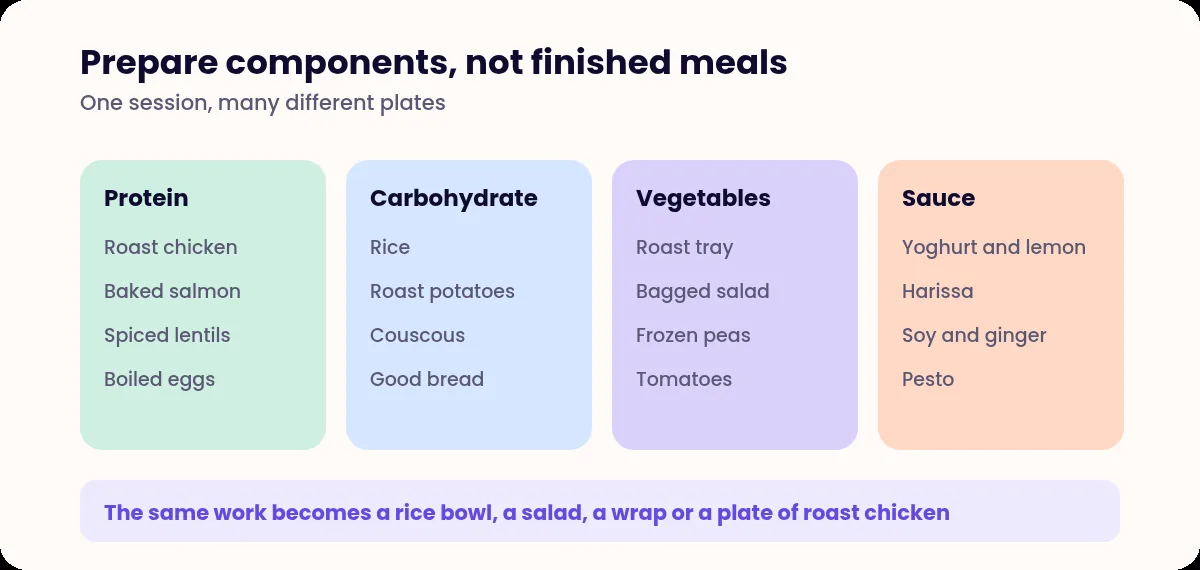
Instead of cooking complete meals, cook four categories and combine them differently through the week.
1. Protein — two or three options Roast a tray of chicken thighs. Bake a couple of salmon fillets. Cook a batch of lentils or a spiced mince. Boil six eggs. Press and bake tofu.
2. Carbohydrate — one or two A pot of rice, some roasted potatoes, couscous, or a bag of good bread in the freezer.
3. Vegetables — one roasted tray, one raw Roast whatever is cheap: peppers, courgette, red onion, broccoli. Separately, keep something raw and ready — bagged salad, cucumber, tomatoes.
4. A sauce or two This is what stops everything tasting the same. Yoghurt with lemon and garlic. Harissa loosened with a little oil. A soy, ginger and rice-vinegar dressing. Pesto.
From that, the same ingredients become a rice bowl, a salad, a wrap, or a plate of roast chicken and vegetables, depending on what you feel like.
Two sessions beat one
An hour on Sunday and thirty minutes on Wednesday works better than three hours on Sunday, for two reasons. Food is fresher, and you have not committed to a decision made five days earlier about what Thursday-you wants to eat.
Make protein the priority
If you only prepare one thing, prepare protein. It is the component people most often skip when improvising, the one most linked to satiety, and the one that protects muscle while you are losing weight [3].
Aim for roughly 25 to 30 g per meal. In practical terms:
| Food | Approximate protein |
|---|---|
| 120 g cooked chicken breast | 35 g |
| 1 tin of tuna (drained) | 25 g |
| 150 g Greek yoghurt | 15 g |
| 3 eggs | 18 g |
| 200 g firm tofu | 28 g |
| 150 g cooked lentils | 13 g |
Food safety, briefly
This is the part meal-prep content usually skips.
- Cool cooked food quickly — within two hours, then refrigerate. Dividing hot food into shallow containers speeds this up.
- Keep the fridge at 5°C or below [1].
- Eat within a few days. Most cooked dishes keep for up to three days refrigerated; if in doubt, freeze on day one rather than hoping on day four.
- Reheat until steaming hot throughout, and only reheat once.
- Rice needs care. Cool and refrigerate it quickly, and do not keep it more than a day.
Making it survive a bad week
Keep a freezer layer. Two or three portions of something you already like, frozen flat in bags. This is your Thursday-night insurance.
Keep a store-cupboard meal. Tinned fish, tinned beans, pasta, a jar of something. Fifteen minutes and no decisions.
Do not prep food you do not enjoy. The most common reason meal prep fails is that someone cooked a week of food they were tolerating rather than looking forward to.
Prep one meal, not three. Lunch is usually the highest-value target: it is the meal most often bought, most often rushed and most often disappointing.
When to speak to a clinician
Speak to your GP or a dietitian if you:
- have a condition affecting digestion, swallowing or nutrient absorption
- have had bariatric surgery and need structured dietary guidance
- are following a very restricted diet and are unsure whether it is nutritionally adequate
- are on weight-loss medication and struggling to eat enough protein because of reduced appetite
Reduced appetite is not the same as reduced nutritional need, and it is worth getting that checked.
Frequently asked questions
How long does meal prep last in the fridge?
Most cooked meals keep safely for up to three days in a fridge at 5°C or below. Cook once, cool quickly, and reheat until steaming hot throughout. Anything you want to keep longer should go in the freezer.
Do I have to eat the same thing every day?
No, and it is usually a mistake. Preparing components — a protein, a grain, a roasted vegetable tray, a sauce — lets you assemble different meals from the same work, which is far easier to keep doing.
Is meal prep necessary for weight loss?
Not necessary, but it removes a common failure point. Most people eat badly when they are hungry and there is nothing ready. Having something ready solves that specific problem.
How much protein should each meal have?
Roughly 25 to 30 g per meal suits most adults trying to preserve muscle while losing weight. That is about 100–120 g of cooked chicken breast, a tin of tuna, 150 g of Greek yoghurt with some nuts, or 200 g of tofu.
References
- Food Standards Agency. Chilling. www.food.gov.uk/business-guidance/chilling
- NHS. How to store food and leftovers safely. www.nhs.uk/live-well/eat-well/how-to-prepare-and-cook-food-safely/
- Leidy HJ, Clifton PM, Astrup A, et al. The role of protein in weight loss and maintenance. American Journal of Clinical Nutrition. 2015;101(6):1320S-1329S. doi.org/10.3945/ajcn.114.084038
- NHS. The Eatwell Guide. www.nhs.uk/live-well/eat-well/food-guidelines-and-food-labels/the-eatw
Medical reviewer
Naeem Teni
Clinical Lead at Manova. Registered pharmacist and independent prescriber, GPhC 2215591. Reviews Manova’s clinical content for accuracy and safety.
Written by
Manova Editorial Team
Researched and written to our editorial policy, using NICE, NHS, MHRA and peer-reviewed sources.
This article is for general information and isn’t a substitute for advice from your own clinician. If you feel unwell, contact your GP or NHS 111. In an emergency, call 999.