

Key takeaways
- Most erectile dysfunction has a vascular component, which is why it is a cardiovascular warning sign.
- British Society for Sexual Medicine guidance recommends checking glucose, lipids and morning testosterone in every man presenting with ED.
- Several common medicines contribute, including some blood pressure medicines and antidepressants.
- Sudden onset with preserved morning erections points towards a psychological component; gradual onset with loss of morning erections does not.
Erectile dysfunction is common, treatable, and routinely mis-attributed. The most consequential mistake is assuming it is psychological and stopping there, because the physical causes are the ones that are also telling you something about the rest of your health.
How an erection works
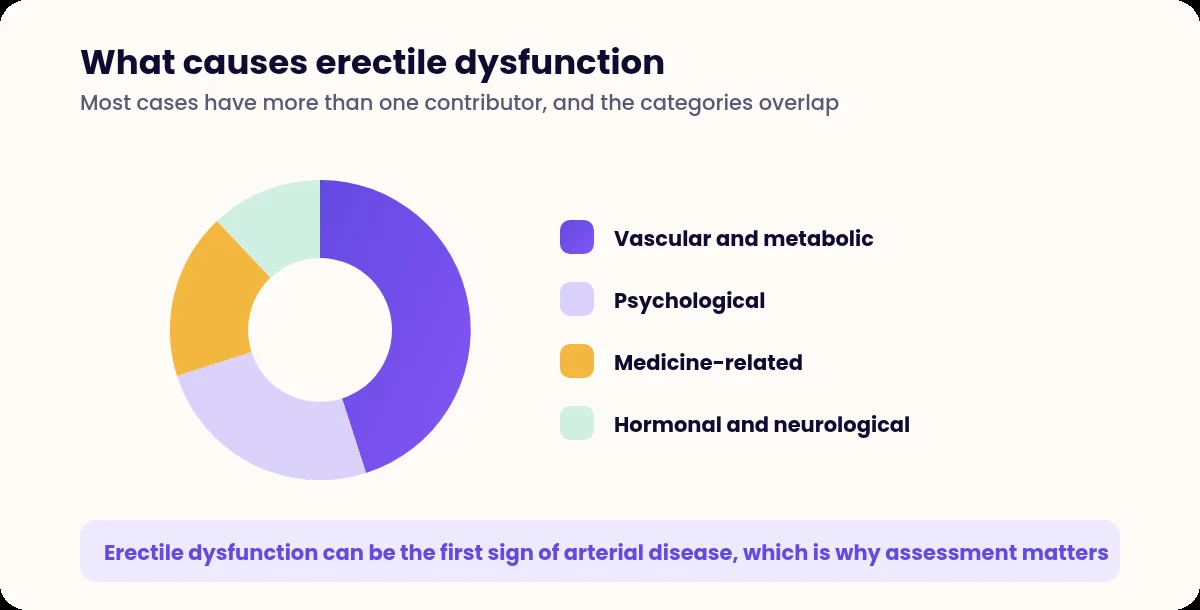
It is fundamentally a blood flow event. Arousal signals cause the smooth muscle in the penile arteries to relax, blood fills the erectile tissue, and the resulting pressure compresses the veins that would otherwise drain it.
That means an erection depends on three systems working together: nerves to carry the signal, arteries to deliver blood, and hormones to generate desire and support the tissue. A problem in any one of them produces the same symptom.
The main categories
Vascular
The most common. The arteries supplying the penis are 1–2 mm across — considerably smaller than the coronary arteries at 3–4 mm. Narrowing that would not yet produce chest pain can already produce erectile difficulty.
Risk factors are the familiar ones: high blood pressure, high cholesterol, diabetes, smoking, obesity, physical inactivity.
This is why UK guidance treats ED as a cardiovascular signal — covered in erections and heart disease.
Metabolic
Diabetes is strongly associated, through both vascular and nerve damage. ED is common enough in men with diabetes that NHS quality indicators specifically ask practices to record advice and assessment for it [3].
Hormonal
Low testosterone reduces desire and contributes to erectile difficulty. It is usually not the sole cause, which is why replacing testosterone alone often disappoints. British Society for Sexual Medicine guidance recommends a morning testosterone in every man presenting with ED [1].
Thyroid disease and raised prolactin are less common but worth excluding where indicated.
Neurological
Diabetes, multiple sclerosis, spinal injury, Parkinson’s disease, and pelvic or prostate surgery.
Medicines
A long list, and a frequently missed cause:
- Blood pressure medicines — particularly thiazide diuretics and beta blockers
- Antidepressants — most SSRIs, and others
- Finasteride and dutasteride — with the additional point that UK product information now carries warnings about sexual dysfunction that may persist after stopping
- Antipsychotics
- Opioids
- Some antihistamines and others
Never stop a prescribed medicine on this basis. Raise it — alternatives frequently exist.
Psychological
Performance anxiety, depression, relationship difficulties, stress, and the self-reinforcing loop where one difficult episode produces anxiety that causes the next.
These are real causes, they are common, and they frequently coexist with physical ones rather than replacing them.
Lifestyle
Smoking, excess alcohol, recreational drug use including anabolic steroids, obesity, physical inactivity and poor sleep — including untreated sleep apnoea.
The question that sorts it out
Not perfectly, but usefully: do you still get morning erections?
- Sudden onset, situational, morning erections preserved — a psychological component is more likely
- Gradual onset over months to years, morning erections reduced or absent, present in all situations — a physical cause is more likely
Both patterns still warrant assessment.
What a proper assessment involves
British Society for Sexual Medicine guidance recommends, in every man presenting with ED [1]:
- Fasting glucose and/or HbA1c
- Lipid profile
- Morning testosterone
- Blood pressure, heart rate and waist circumference
Plus a history covering onset, morning erections, medicines, mood, relationship context, alcohol, smoking and recreational drugs.
This is a short list and it is not routinely done. If you are prescribed treatment without any of it, it is reasonable to ask for it.
Why treating it blind is a missed opportunity
Tablets work well for most men, which is precisely the problem — it is easy to treat the symptom and never ask what produced it.
If the underlying cause is undiagnosed diabetes, untreated hypertension or early arterial disease, the erection improves and the risk carries on. That is the argument for a consultation rather than a purchase.
When to speak to a clinician
See a GP if you have:
- erectile difficulties lasting more than a few weeks
- gradual loss of morning erections
- reduced libido, fatigue, or loss of body hair alongside it
- a curve or bend developing in the penis, or pain with erections
- ED alongside chest pain, breathlessness on exertion, or calf pain on walking — seek advice promptly
- an erection lasting more than four hours — this is a medical emergency, attend A&E
Do not buy prescription medicines from sellers that do not require a consultation. UK enforcement seized around 20 million doses of illegal erectile dysfunction medicines between 2021 and 2025.
Frequently asked questions
Is erectile dysfunction usually psychological?
Less often than people assume. Most cases in men over 40 have a vascular or metabolic component. Psychological factors are common, frequently coexist, and matter — but assuming the problem is purely in the mind is the most common reason a treatable physical cause is missed.
What tests should I have?
UK guidance recommends fasting glucose or HbA1c, a lipid profile and a morning testosterone in every man presenting with erectile dysfunction, plus blood pressure, heart rate and waist measurement.
Can medicines cause it?
Yes. Thiazide diuretics and beta blockers among blood pressure medicines, most SSRIs and some other antidepressants, finasteride and dutasteride, some antipsychotics, and opioids are among the more common contributors.
Does it mean something is seriously wrong?
It often means something is worth checking. Erectile dysfunction commonly precedes cardiac symptoms, which is why guidance treats a man presenting with it as someone whose cardiovascular risk should be assessed.
References
- British Society for Sexual Medicine. Guidelines on the management of erectile dysfunction in men. 2018. bssm.org.uk/wp-content/uploads/2023/02/BSSM-ED-guidelines-2018-1.pdf
- NHS. Erectile dysfunction (impotence). www.nhs.uk/conditions/erection-problems-erectile-dysfunction/
- NICE. Indicator IND106: diabetes and erectile dysfunction. www.nice.org.uk/indicators/ind106-diabetes-advice-for-erectile-dysfunc
- NHS. Male menopause. www.nhs.uk/conditions/male-menopause/
Medical reviewer
Naeem Teni
Clinical Lead at Manova. Registered pharmacist and independent prescriber, GPhC 2215591. Reviews Manova’s clinical content for accuracy and safety.
Written by
Manova Editorial Team
Researched and written to our editorial policy, using NICE, NHS, MHRA and peer-reviewed sources.
This article is for general information and isn’t a substitute for advice from your own clinician. If you feel unwell, contact your GP or NHS 111. In an emergency, call 999.