

Key takeaways
- A steady rate of 0.5–1 kg a week is what the NHS describes as safe and realistic.
- Change two things at once, not eight. The number of changes predicts how long the attempt lasts.
- Weigh on the same day each week and read the trend, not the individual number.
- Protein, fibre, sleep and one form of movement you already tolerate will carry most of the first month.
Starting is the easy part. Almost everyone can eat differently for four days. The reason most attempts end is that they were designed for a version of you who has unlimited willpower and no bad weeks.
So this is a first fortnight built to survive week three.
The rate to aim for
The NHS describes a safe and sustainable rate as 0.5 to 1 kg a week [1]. Over a first month that is roughly 2 to 4 kg.
Your first week will probably show more. That is largely water and glycogen, not fat, and it is the single most common reason people feel they have failed in week two when the number barely moves. Expect it, and you will not be derailed by it.
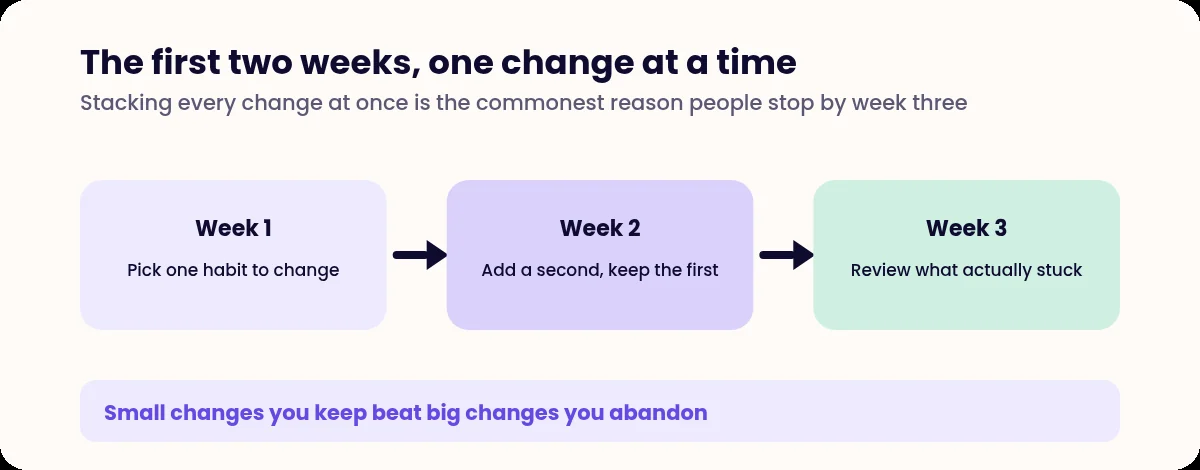
Change two things, not eight
The strongest predictor of whether a weight-loss attempt is still running in six weeks is not how good the plan was. It is how much of your life it asked you to change at once.
Pick two changes for the first fortnight. Genuinely two. Here are the ones that give the most back for the least disruption.
1. Deal with liquid calories first
Sugary drinks, fruit juice, sweetened coffees and alcohol deliver energy without meaningfully changing how full you feel. Removing or reducing them costs you less satisfaction per calorie than almost any other change.
2. Put protein at breakfast
Not because protein is magic, but because a protein-based breakfast changes what the rest of the day looks like. Eggs, Greek yoghurt, or last night’s leftovers. Aim for roughly 25–30 g.
3. Eat on a schedule
Erratic eating is what produces the 4pm decision you regret. A consistent pattern — three meals, or two meals and a planned snack — removes a whole category of bad choices.
4. Protect your sleep
This is the one people skip and it has better evidence than most diets. In a randomised trial, adults who habitually slept under 6.5 hours and extended their sleep by about 1.2 hours a night ate 270 fewer calories a day — with no dietary instruction at all [4].
Pick two. The others are still there in a fortnight.
How to weigh yourself
Once a week, same day, same time, after the loo and before breakfast. Write it down.
Then ignore the individual number and look at the line over a month. Body weight fluctuates by a kilogram or two with fluid, salt, hormones and what is still in your digestive system. A single reading tells you almost nothing. Four readings tell you a lot.
If you find weighing distressing rather than useful, measure your waist monthly instead — halfway between the lowest rib and the top of the hip bone, after breathing out.
Movement, honestly
UK Chief Medical Officers ask for 150 minutes of moderate activity a week plus strengthening on two days [3] — and they are unusually blunt about what activity does for weight: diet is the important factor in weight management, and physical activity plays a supporting role [3].
That is not a reason to skip it. Activity is the strongest predictor of keeping weight off, and it improves blood pressure, blood sugar, mood and function whether or not the scales move.
But in a first fortnight, do the version you already tolerate. A walk you will actually take beats a gym plan you will abandon.
What to do when it goes wrong
It will. A birthday, a work trip, a bad week.
The thing that separates people who lose weight from people who repeatedly start losing weight is not the size of the lapse. It is the length of it. One heavy weekend is about a day’s surplus. Three weeks of “I’ve ruined it now” is about twenty.
Decide in advance: the next meal is where you restart. Not Monday, not next month.
When to speak to a clinician
Make an appointment before or soon after starting if you:
- have type 2 diabetes, particularly if you take insulin or a sulfonylurea, because doses may need adjusting as you lose weight
- take medicines that need dose changes with weight loss, including some blood pressure and epilepsy medicines
- have a history of an eating disorder, or find that food and weight occupy a distressing amount of your attention
- have a BMI of 30 or above, or 27.5 or above if you are of South Asian, Chinese, Black African or African-Caribbean background, and want to know what support you qualify for
- are losing weight without trying, which always needs checking
Frequently asked questions
How much weight should I aim to lose in the first month?
Around 2 to 4 kg is a realistic first month at a steady rate. The first week often shows more than that because of water and glycogen changes, so don't build expectations on it.
Do I need to count calories to start?
No. Many people do better starting with structural changes — a protein-based breakfast, fewer liquid calories, a consistent eating pattern — and only counting later if progress stalls. Counting is a useful tool, not a compulsory one.
What is the single most useful first change?
For most people it is liquid calories: sugary drinks, juices, sweetened coffees and alcohol. They add energy without adding fullness, so removing them costs you very little in satisfaction.
Should I start exercising at the same time?
Start with something you already tolerate rather than something ambitious. Exercise contributes modestly to weight loss itself, but it is the strongest predictor of keeping weight off later, so building the habit early is worth it.
References
- NHS. Start losing weight. www.nhs.uk/live-well/healthy-weight/start-losing-weight/
- NICE. Overweight and obesity management. NG246. January 2025. www.nice.org.uk/guidance/ng246
- UK Chief Medical Officers. Physical activity guidelines. Updated 10 July 2026. www.gov.uk/government/publications/physical-activity-guidelines-uk-chi
- Tasali E, Wroblewski K, Kahn E, Kilkus J, Schoeller DA. Effect of sleep extension on objectively assessed energy intake among adults with overweight in real-life settings. JAMA Internal Medicine. 2022;182(4):365-374. doi.org/10.1001/jamainternmed.2021.8098
Medical reviewer
Naeem Teni
Clinical Lead at Manova. Registered pharmacist and independent prescriber, GPhC 2215591. Reviews Manova’s clinical content for accuracy and safety.
Written by
Manova Editorial Team
Researched and written to our editorial policy, using NICE, NHS, MHRA and peer-reviewed sources.
This article is for general information and isn’t a substitute for advice from your own clinician. If you feel unwell, contact your GP or NHS 111. In an emergency, call 999.